Leaders attending the NATO summit in Ankara, Turkey [Yonhap News File Photo]
On the 8th (local time), leaders of the North Atlantic Treaty Organization (NATO) reaffirmed their commitment to increasing defense spending in response to threats, including those posed by Russia to Euro-Atlantic security.
In the "Ankara Summit Declaration" adopted during the summit held in Ankara, Turkey, NATO leaders stated, "We announce plans for new procurement exceeding $50 billion (approximately 75.4 trillion KRW) and commit to accelerating innovation through expanded joint production capacity and industrial cooperation."
They further emphasized, "We will continue our efforts to remove barriers to defense trade among allies and leverage NATO partnerships to maximize the depth and collaboration of the defense industry."
The leaders noted, "To address the long-term threat Russia poses to Euro-Atlantic security and stability, as well as persistent terrorist threats, member states are fulfilling the 'Hague Defense Pledge.'"
During last year's Hague Summit, under pressure from U.S. President Donald Trump, NATO officially agreed to increase defense spending to a total of 5% of their gross domestic product (GDP) by 2035.
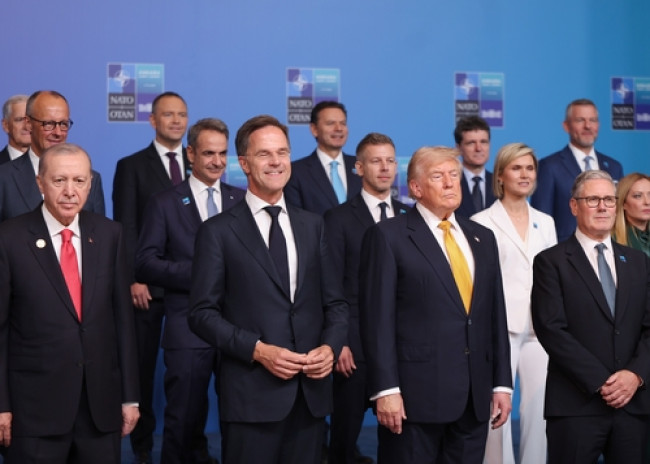 NATO leaders [Yonhap News File Photo]
The declaration included the statement: "NATO leaders gathered in Ankara to reaffirm the ironclad commitment to collective defense and the transatlantic alliance," adding that "European allies and Canada are working with the United States to take on greater responsibility for the defense of the alliance."
It also stated, "NATO’s deterrence and defense are completed by a proper mix of nuclear, conventional, and missile defense capabilities, complemented by space and cyber assets," and added that "the development of interoperable transatlantic combat clouds and the introduction of robust artificial intelligence (AI) models are underway."
Regarding the conflict between the U.S. and Iran, NATO leaders "reiterated that Iran must never possess nuclear weapons and urged full respect for freedom of navigation in the Strait of Hormuz."
Concerning the war in Ukraine, they declared that "Ukraine is contributing to transatlantic security," and "we have pledged to provide €70 billion (approximately 120.4 trillion KRW) in military equipment, support, and training this year, and we reaffirm our sovereign commitment to maintain at least this level in 2027."
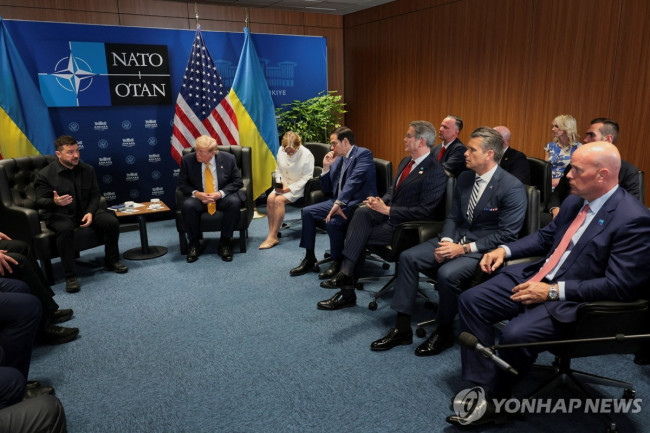 U.S. President Donald Trump and Ukrainian President Volodymyr Zelenskyy meeting on the sidelines of the NATO summit on the 8th (local time) [Reuters/Yonhap News]
In a press conference concluding the event, NATO Secretary General Mark Rutte assessed the summit by saying, "The message of this summit is simple: NATO is delivering." He added, "We are rebalancing the security equation in a better direction, and this is the essence of 'NATO 3.0.'"
The "NATO 3.0" concept, introduced by U.S. Department of War Under Secretary for Policy Elbridge Colby at the NATO Defense Ministers meeting this past February, envisions the U.S. focusing on homeland defense and deterring China in the Indo-Pacific, while Europe evolves into a "partnership" that does not rely on the U.S. for its security.
During the summit, Secretary General Rutte also announced plans to introduce several weapons systems, including the "NATO Drone Edge," a blueprint for strengthening NATO’s capability to counter unmanned aerial vehicles (UAVs).
Additionally, Secretary General Rutte announced a €27 billion (approximately 46.5 trillion KRW) project to modernize fuel infrastructure, which includes supporting new pipelines heading toward the eastern region of NATO. This appears to be linked to initiatives actively promoted by Turkey, the host country of the summit.

 Iranian Foreign Ministry: "Continuing Message Exchanges with the U.S. and Activities of Mediating Countries"
Esmaeil Baghaei, Spokesperson for the Iranian Ministry of Foreign Affairs [Xinhua, Yonhap News file photo]Esmaeil Baghaei, spokesperson for the Iranian Ministry of Foreign Affairs, stated on the 26th
Iranian Foreign Ministry: "Continuing Message Exchanges with the U.S. and Activities of Mediating Countries"
Esmaeil Baghaei, Spokesperson for the Iranian Ministry of Foreign Affairs [Xinhua, Yonhap News file photo]Esmaeil Baghaei, spokesperson for the Iranian Ministry of Foreign Affairs, stated on the 26th
 President Yoon: "Do You Think You Are Safe from the Special Counsel?"... Final Statement Video Released
President Yoon Suk Yeol rebuking the special prosecutor on the 24th. [Court video / @birds_justice X account subtitle GIF] A video of President Yoon Suk Yeol's closing statement at his trial rega
President Yoon: "Do You Think You Are Safe from the Special Counsel?"... Final Statement Video Released
President Yoon Suk Yeol rebuking the special prosecutor on the 24th. [Court video / @birds_justice X account subtitle GIF] A video of President Yoon Suk Yeol's closing statement at his trial rega
 President Yoon, regarding the first-instance ruling on the Public Official Election Act: “An excessive political verdict that distorts the facts… We will appeal immediately.”
The first-instance sentencing hearing for President Yoon Suk Yeol regarding violations of the Public Official Election Act is being broadcast live at Seoul Station on the 27th. [Photo=Yonhap News]Pres
President Yoon, regarding the first-instance ruling on the Public Official Election Act: “An excessive political verdict that distorts the facts… We will appeal immediately.”
The first-instance sentencing hearing for President Yoon Suk Yeol regarding violations of the Public Official Election Act is being broadcast live at Seoul Station on the 27th. [Photo=Yonhap News]Pres
 WSJ: "SK Hynix ADR Premium Is a Sign of AI Trading Overheat"
Advertisement for SK Hynix ADR listing in New York's Times Square [Reuters=Yonhap News file photo]The Wall Street Journal (WSJ) has pointed out that the price of SK Hynix’s American Depositary Recei
WSJ: "SK Hynix ADR Premium Is a Sign of AI Trading Overheat"
Advertisement for SK Hynix ADR listing in New York's Times Square [Reuters=Yonhap News file photo]The Wall Street Journal (WSJ) has pointed out that the price of SK Hynix’s American Depositary Recei
 'Godfather of Japanese Mystery Novels' Keigo Higashino Passes Away After Battle with Cancer at 68
Famous Japanese mystery novelist Keigo Higashino [AFP=Yonhap News]It has been belatedly reported that Keigo Higashino, the "godfather of Japanese mystery novels" and author of bestsellers such as "The
'Godfather of Japanese Mystery Novels' Keigo Higashino Passes Away After Battle with Cancer at 68
Famous Japanese mystery novelist Keigo Higashino [AFP=Yonhap News]It has been belatedly reported that Keigo Higashino, the "godfather of Japanese mystery novels" and author of bestsellers such as "The
 [Park Pil-kyu Security Column] To the Ignorant Trying to Clothe a Beast in Sheep's Clothing
Rep. Kim Byung-joo of the Democratic Party of Korea [Photo=Yonhap News]“The Air Force Academy doesn't teach you how to fly a plane!” “The Army, Navy, and Air Force academies are exactly the
[Park Pil-kyu Security Column] To the Ignorant Trying to Clothe a Beast in Sheep's Clothing
Rep. Kim Byung-joo of the Democratic Party of Korea [Photo=Yonhap News]“The Air Force Academy doesn't teach you how to fly a plane!” “The Army, Navy, and Air Force academies are exactly the
 [Issue Diagnosis] Two Effects of the Election Petition Review
 [Photo] Evidence of Election Fraud Flooding U.S. Media… Trump Had 2.7 Million Votes Stolen
 [Video] U.S. Semiquincentennial Air Show... 'Art in the Sky' streaks across New York
 [Editorial Cartoon] A Draconian Law That Undermines Freedom of Expression

 List
List