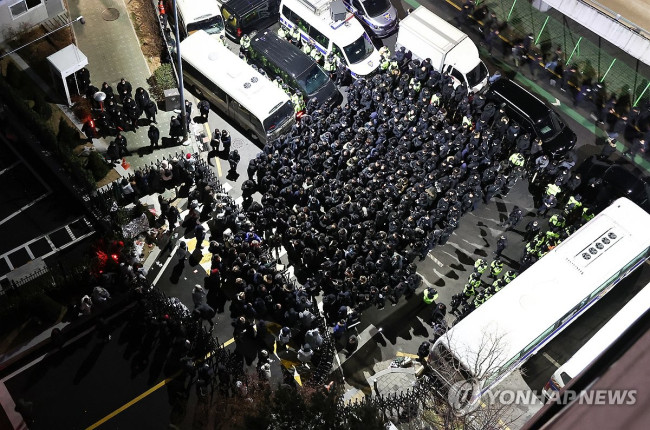
Today, the Supreme Court dismissed the appeal concerning significant legal issues in the original judgment. While the legal team respects the Supreme Court’s decision, we express deep regret that the highest court concluded such a critical case without sufficient deliberation, particularly in light of the rule of law and the warrant requirement, which are the foundations of the Constitution of the Republic of Korea. The original judgment in this case contained significant legal problems that conflict with the essence of existing Supreme Court precedents and En Banc rulings, as follows: First, the question of whether "compulsory investigation during tenure" is permissible under the President's criminal immunity guaranteed by Article 84 of the Constitution is a high-level constitutional issue essential to protecting the constitutional status of the Head of State and the Chief of the Executive Branch. Nevertheless, the lower courts avoided a clear legal judgment on this, and the Supreme Court also dismissed the appeal while completely ignoring this serious legal premise. Second, the issue concerns the lack of investigative authority of the Corruption Investigation Office for High-ranking Officials (CIO) and the violation of the principle of legal reservation. It is a total denial of the constitutional principle of legal reservation for the CIO—which lacks authority to investigate insurrection under the CIO Act—to arbitrarily label related crimes and force through an investigation. Third, the ruling effectively neutralized Article 110 of the Criminal Procedure Act, which limits search and seizure in military secret locations. It distorted the mandatory regulation requiring the consent of the person in charge when conducting search and seizure within national security zones such as the official residence or government offices, thereby undermining the essence of the warrant requirement. Fourth, it interpreted the deliberation power of State Council members as a "personal right" under the crime of abuse of power. The lower court’s judgment, which used the deliberation power—a duty-based authority of a state agency—as a basis for conviction, contradicts the spirit of previous Supreme Court En Banc rulings that have limited the framing of the infringement of deliberation and voting rights as "obstruction of the exercise of rights" under the crime of abuse of power. Fifth, it distorted the legal principles regarding the crime of abuse of power in relation to public relations activities concerning foreign media (PG). Foreign media briefings by the spokesperson and the secretary for overseas public relations are part of the routine operation of the state to convey the President's political and diplomatic positions to the international community and constitute legitimate performance of duties. Nevertheless, the lower court determined some of the content to be "false" and applied the crime of abuse of power; by upholding this, the Supreme Court maintained a judgment contrary to the principles of legality and strict interpretation, effectively excluding the legal reasoning of past En Banc rulings through a small bench. Sixth, the judgment on the abuse of power regarding control and measures within a security zone under the Presidential Security Service Act also contradicts existing precedents. By upholding the lower court’s decision that measures taken for security and protection purposes based on the Presidential Security Service Act constitute abuse of power, the Supreme Court has caused a result where the same legal principles of abuse of power are arbitrarily applied differently in the field of presidential security. Beyond the issues above, this case—where the lower court’s legal confusion is manifest and which involves numerous high-level constitutional issues with profound impact on the structure of state power and the fundamental rights of citizens—should have been referred to an En Banc session of the Supreme Court for in-depth consideration. Ensuring consistency in the interpretation of laws and securing the predictability of trials is the fundamental duty of the Supreme Court as the highest court. Nevertheless, the fact that the Supreme Court skipped even an En Banc deliberation and dismissed the appeal in a more rushed manner than a general case is nothing less than "insufficient deliberation," an abandonment of the judiciary's role as the court of last resort, and the politicization of the judiciary. This is a severe violation of the defendant’s right to a fair trial. Accordingly, to protect the fundamental rights guaranteed by the Constitution, our legal team plans to challenge the unconstitutionality of this ruling through constitutional court procedures, such as a constitutional complaint, and will proceed with all processes faithfully and responsibly within the bounds set by law and the Constitution. We ask for your continued interest in the upcoming constitutional proceedings.
July 9, 2026 Legal Representatives for Former President Yoon Suk Yeol
| 
 Iranian Foreign Ministry: "Continuing Message Exchanges with the U.S. and Activities of Mediating Countries"
Esmaeil Baghaei, Spokesperson for the Iranian Ministry of Foreign Affairs [Xinhua, Yonhap News file photo]Esmaeil Baghaei, spokesperson for the Iranian Ministry of Foreign Affairs, stated on the 26th
Iranian Foreign Ministry: "Continuing Message Exchanges with the U.S. and Activities of Mediating Countries"
Esmaeil Baghaei, Spokesperson for the Iranian Ministry of Foreign Affairs [Xinhua, Yonhap News file photo]Esmaeil Baghaei, spokesperson for the Iranian Ministry of Foreign Affairs, stated on the 26th
 President Yoon: "Do You Think You Are Safe from the Special Counsel?"... Final Statement Video Released
President Yoon Suk Yeol rebuking the special prosecutor on the 24th. [Court video / @birds_justice X account subtitle GIF] A video of President Yoon Suk Yeol's closing statement at his trial rega
President Yoon: "Do You Think You Are Safe from the Special Counsel?"... Final Statement Video Released
President Yoon Suk Yeol rebuking the special prosecutor on the 24th. [Court video / @birds_justice X account subtitle GIF] A video of President Yoon Suk Yeol's closing statement at his trial rega
 President Yoon, regarding the first-instance ruling on the Public Official Election Act: “An excessive political verdict that distorts the facts… We will appeal immediately.”
The first-instance sentencing hearing for President Yoon Suk Yeol regarding violations of the Public Official Election Act is being broadcast live at Seoul Station on the 27th. [Photo=Yonhap News]Pres
President Yoon, regarding the first-instance ruling on the Public Official Election Act: “An excessive political verdict that distorts the facts… We will appeal immediately.”
The first-instance sentencing hearing for President Yoon Suk Yeol regarding violations of the Public Official Election Act is being broadcast live at Seoul Station on the 27th. [Photo=Yonhap News]Pres
 WSJ: "SK Hynix ADR Premium Is a Sign of AI Trading Overheat"
Advertisement for SK Hynix ADR listing in New York's Times Square [Reuters=Yonhap News file photo]The Wall Street Journal (WSJ) has pointed out that the price of SK Hynix’s American Depositary Recei
WSJ: "SK Hynix ADR Premium Is a Sign of AI Trading Overheat"
Advertisement for SK Hynix ADR listing in New York's Times Square [Reuters=Yonhap News file photo]The Wall Street Journal (WSJ) has pointed out that the price of SK Hynix’s American Depositary Recei
 'Godfather of Japanese Mystery Novels' Keigo Higashino Passes Away After Battle with Cancer at 68
Famous Japanese mystery novelist Keigo Higashino [AFP=Yonhap News]It has been belatedly reported that Keigo Higashino, the "godfather of Japanese mystery novels" and author of bestsellers such as "The
'Godfather of Japanese Mystery Novels' Keigo Higashino Passes Away After Battle with Cancer at 68
Famous Japanese mystery novelist Keigo Higashino [AFP=Yonhap News]It has been belatedly reported that Keigo Higashino, the "godfather of Japanese mystery novels" and author of bestsellers such as "The
 [Park Pil-kyu Security Column] To the Ignorant Trying to Clothe a Beast in Sheep's Clothing
Rep. Kim Byung-joo of the Democratic Party of Korea [Photo=Yonhap News]“The Air Force Academy doesn't teach you how to fly a plane!” “The Army, Navy, and Air Force academies are exactly the
[Park Pil-kyu Security Column] To the Ignorant Trying to Clothe a Beast in Sheep's Clothing
Rep. Kim Byung-joo of the Democratic Party of Korea [Photo=Yonhap News]“The Air Force Academy doesn't teach you how to fly a plane!” “The Army, Navy, and Air Force academies are exactly the
 [Issue Diagnosis] Two Effects of the Election Petition Review
 [Photo] Evidence of Election Fraud Flooding U.S. Media… Trump Had 2.7 Million Votes Stolen
 [Video] U.S. Semiquincentennial Air Show... 'Art in the Sky' streaks across New York
 [Editorial Cartoon] A Draconian Law That Undermines Freedom of Expression

 List
List