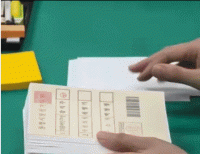
School classroom [Provided by Yonhap News TV]
It has been found that 1 in 5 teachers has experienced complaints or protests alleging a violation of political neutrality, even when they were conducting normal educational activities.
Even in cases where teachers explained the May 18 Democratization Movement according to textbooks or conducted history lessons, complaints regarding the "indoctrination of leftist ideology" were raised.
The Korean Teachers and Education Workers Union (KTU) held a press conference at its conference room in Yeongdeungpo-gu, Seoul, on the 9th and announced the results of its 'Survey on the Infringement of Teachers' Educational Rights and Political-Related Complaints.'
In a survey conducted by the teachers' union targeting teachers nationwide from November 3 to 9 last year, 391 respondents (20.2%) out of 1,937 said they had "experienced protests or complaints alleging a violation of political neutrality regarding normal educational activities."
It was found that 169 cases (8.7%) involved "receiving threats of being reported or sued," and 39 cases (2.0%) involved "actual experience with legal procedures such as reports or lawsuits."
In subjective responses, cases related to history education were the most frequent.
For example, in a 5th-grade elementary school social studies class that covered the Japanese colonial period, the March 1st Movement, and patriot Yu Gwan-sun, a teacher received a complaint stating that "the teacher and the school curriculum are biased toward the left."
Furthermore, even when the May 18 Democratization Movement was explained according to the content of textbooks, it was reported that protests accusing teachers of "indoctrinating leftist ideology" or being "communist" were raised.
There were also responses indicating that educational activities utilizing materials based on historical events, such as the films '12.12: The Day' and 'A Taxi Driver', led to complaints.
The scope of complaints also included modern political systems and civic education.
One teacher was reportedly protested against for "not conducting such classes" after guiding students to bring election leaflets from home to use during a 6th-grade elementary school social studies class.
The teachers' union stated that in-depth interviews conducted by the KTU Policy Research Institute with 10 education stakeholders, including teachers, students, and parents, from April 8 to May 11 this year, confirmed that the prerequisite for school civic education is the guarantee of teachers' educational rights.
At the press conference, the teachers' union also announced survey results showing that many citizens wish for the strengthening of school civic education.
In a survey conducted by Macromill Embrain at the request of the KTU Policy Research Institute from April 17 to 22, targeting 5,000 citizens (aged 16 to under 70), 66.0% of respondents stated that the current level of civic education in schools is insufficient.
Only 18.9% responded that school civic education is sufficient.
Respondents were generally found to have a positive view of democratic citizenship education within schools.
83.7% of respondents stated they agree with civic education in schools, and 82.4% answered that education on real-world political issues and social problems is necessary for students.
When asked, 'Where should students mainly learn about real-world political issues and social problems?', 66.4% chose schools, followed by family (14.6%), TV (6.3%), and online platforms (YouTube, social media, etc.) at 5.6%.
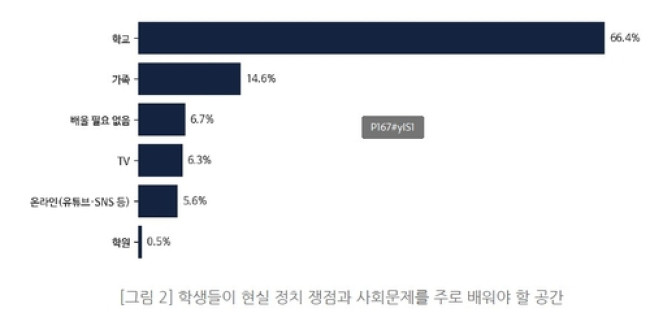 [Provided by the teachers' union]
While respondents agreed on the necessity of civic education, there were also significant concerns regarding the potential for political bias among teachers.
Regarding concerns surrounding lessons on real-world political issues and social problems, 63.6% of respondents cited the "indoctrination of distorted perspectives due to the teacher's political bias."
This was followed by "concerns over conflicts and confusion within schools due to politically sensitive topics" at 16.2%.
The KTU Policy Research Institute pointed out, "Although social demand for school civic education has formed, educational activities are shrinking due to complaints about political bias, ambiguous interpretations of political neutrality, and the absence of protective measures for teachers," adding, "An environment must be established where teachers can provide civic education."

 Iranian Foreign Ministry: "Continuing Message Exchanges with the U.S. and Activities of Mediating Countries"
Esmaeil Baghaei, Spokesperson for the Iranian Ministry of Foreign Affairs [Xinhua, Yonhap News file photo]Esmaeil Baghaei, spokesperson for the Iranian Ministry of Foreign Affairs, stated on the 26th
Iranian Foreign Ministry: "Continuing Message Exchanges with the U.S. and Activities of Mediating Countries"
Esmaeil Baghaei, Spokesperson for the Iranian Ministry of Foreign Affairs [Xinhua, Yonhap News file photo]Esmaeil Baghaei, spokesperson for the Iranian Ministry of Foreign Affairs, stated on the 26th
 President Yoon: "Do You Think You Are Safe from the Special Counsel?"... Final Statement Video Released
President Yoon Suk Yeol rebuking the special prosecutor on the 24th. [Court video / @birds_justice X account subtitle GIF] A video of President Yoon Suk Yeol's closing statement at his trial rega
President Yoon: "Do You Think You Are Safe from the Special Counsel?"... Final Statement Video Released
President Yoon Suk Yeol rebuking the special prosecutor on the 24th. [Court video / @birds_justice X account subtitle GIF] A video of President Yoon Suk Yeol's closing statement at his trial rega
 President Yoon, regarding the first-instance ruling on the Public Official Election Act: “An excessive political verdict that distorts the facts… We will appeal immediately.”
The first-instance sentencing hearing for President Yoon Suk Yeol regarding violations of the Public Official Election Act is being broadcast live at Seoul Station on the 27th. [Photo=Yonhap News]Pres
President Yoon, regarding the first-instance ruling on the Public Official Election Act: “An excessive political verdict that distorts the facts… We will appeal immediately.”
The first-instance sentencing hearing for President Yoon Suk Yeol regarding violations of the Public Official Election Act is being broadcast live at Seoul Station on the 27th. [Photo=Yonhap News]Pres
 WSJ: "SK Hynix ADR Premium Is a Sign of AI Trading Overheat"
Advertisement for SK Hynix ADR listing in New York's Times Square [Reuters=Yonhap News file photo]The Wall Street Journal (WSJ) has pointed out that the price of SK Hynix’s American Depositary Recei
WSJ: "SK Hynix ADR Premium Is a Sign of AI Trading Overheat"
Advertisement for SK Hynix ADR listing in New York's Times Square [Reuters=Yonhap News file photo]The Wall Street Journal (WSJ) has pointed out that the price of SK Hynix’s American Depositary Recei
 'Godfather of Japanese Mystery Novels' Keigo Higashino Passes Away After Battle with Cancer at 68
Famous Japanese mystery novelist Keigo Higashino [AFP=Yonhap News]It has been belatedly reported that Keigo Higashino, the "godfather of Japanese mystery novels" and author of bestsellers such as "The
'Godfather of Japanese Mystery Novels' Keigo Higashino Passes Away After Battle with Cancer at 68
Famous Japanese mystery novelist Keigo Higashino [AFP=Yonhap News]It has been belatedly reported that Keigo Higashino, the "godfather of Japanese mystery novels" and author of bestsellers such as "The
 [Park Pil-kyu Security Column] To the Ignorant Trying to Clothe a Beast in Sheep's Clothing
Rep. Kim Byung-joo of the Democratic Party of Korea [Photo=Yonhap News]“The Air Force Academy doesn't teach you how to fly a plane!” “The Army, Navy, and Air Force academies are exactly the
[Park Pil-kyu Security Column] To the Ignorant Trying to Clothe a Beast in Sheep's Clothing
Rep. Kim Byung-joo of the Democratic Party of Korea [Photo=Yonhap News]“The Air Force Academy doesn't teach you how to fly a plane!” “The Army, Navy, and Air Force academies are exactly the
 [Issue Diagnosis] Two Effects of the Election Petition Review
 [Photo] Evidence of Election Fraud Flooding U.S. Media… Trump Had 2.7 Million Votes Stolen
 [Video] U.S. Semiquincentennial Air Show... 'Art in the Sky' streaks across New York
 [Editorial Cartoon] A Draconian Law That Undermines Freedom of Expression

 List
List