- US "Promise to Resume Shipping Routes" vs. Iran "Recognition of Control"... Negotiations Remain at a Standstill
 U.S. President Donald Trump signing a Memorandum of Understanding (MOU) to end the war at the Palace of Versailles in France [AFP=Yonhap News file photo / @EmmanuelMacron X account capture]
A single clause in the Memorandum of Understanding (MOU) signed between the United States and Iran has become a flashpoint threatening the Strait of Hormuz, the Wall Street Journal (WSJ) reported on the 9th (local time).
The core of the conflict lies in Article 5 of the MOU.
This clause stipulates that Iran will take necessary measures to resume transit through the Strait of Hormuz, which was blockaded during the war.
It also includes a commitment from Iran to ensure safe navigation and to make efforts to remove military obstacles, such as sea mines.
The U.S. interprets this clause as the basis for guaranteeing safe passage through the Strait of Hormuz.
However, Iran offers a contrasting interpretation.
They argue that Article 5 recognizes Iran’s exclusive right to control the Strait of Hormuz.
In fact, Article 5 includes a provision stating that Iran will consult with Oman and neighboring countries on future management plans for the strait.
This phrasing was reportedly strongly demanded by the Islamic Revolutionary Guard Corps (IRGC).
According to officials who mediated the negotiations between the U.S. and Iran, both sides accepted ambiguous language at the time to reach an agreement.
Since the signing of the agreement, however, the IRGC has maintained a hardline interpretation that Iran effectively controls the Strait of Hormuz.
The IRGC is now demanding that vessels passing through its waters report their cargo and size and obtain transit authorization, while also threatening to impose transit fees.
The Iranian government has even launched the Persian Gulf Strait Authority (PGSA) for the purpose of collecting transit fees in the Strait of Hormuz.
In particular, Iran insists that merchant ships must use only designated routes along its coast, and has gone as far as conducting drone and missile attacks on merchant vessels using other routes.
They maintain that they cannot recognize any maritime routes that fall outside their control.
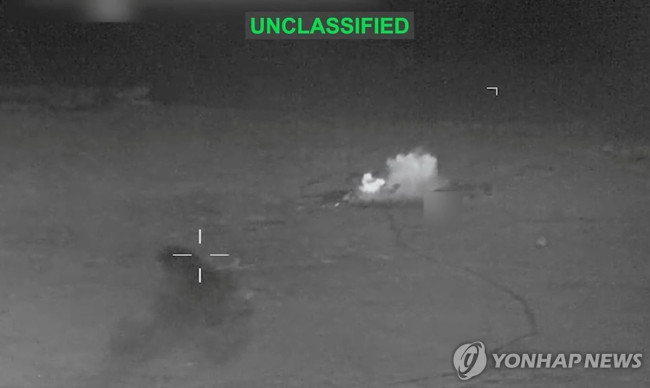 Footage of retaliatory airstrikes on Iran released by the U.S. military [Reuters=Yonhap News file photo / Provided by U.S. Central Command].
The U.S. stance is that it cannot accept Iran’s claim of control over the Strait of Hormuz, which is an international waterway.
This is precisely why U.S. President Donald Trump has adopted a hardline response, including the revocation of Iran's oil export licenses and ordering airstrikes on Iranian targets in and around the Strait of Hormuz.
A U.S. government official stated, "The two countries are interpreting Article 5 of the MOU in entirely different ways."
Experts believe it is highly likely that the divergence in interpretation exposed by the Strait of Hormuz issue will recur in future negotiations regarding Iran's nuclear program.
Raz Zimmt, an Iran expert at the Institute for National Security Studies (INSS) in Israel, predicted, "The lack of trust and the ambiguous language of the agreement have led to the current clash," adding, "If more sensitive issues like the nuclear program are discussed, the conflict could escalate even further."
What do you think of this article?

 Iranian Foreign Ministry: "Continuing Message Exchanges with the U.S. and Activities of Mediating Countries"
Esmaeil Baghaei, Spokesperson for the Iranian Ministry of Foreign Affairs [Xinhua, Yonhap News file photo]Esmaeil Baghaei, spokesperson for the Iranian Ministry of Foreign Affairs, stated on the 26th
Iranian Foreign Ministry: "Continuing Message Exchanges with the U.S. and Activities of Mediating Countries"
Esmaeil Baghaei, Spokesperson for the Iranian Ministry of Foreign Affairs [Xinhua, Yonhap News file photo]Esmaeil Baghaei, spokesperson for the Iranian Ministry of Foreign Affairs, stated on the 26th
 President Yoon: "Do You Think You Are Safe from the Special Counsel?"... Final Statement Video Released
President Yoon Suk Yeol rebuking the special prosecutor on the 24th. [Court video / @birds_justice X account subtitle GIF] A video of President Yoon Suk Yeol's closing statement at his trial rega
President Yoon: "Do You Think You Are Safe from the Special Counsel?"... Final Statement Video Released
President Yoon Suk Yeol rebuking the special prosecutor on the 24th. [Court video / @birds_justice X account subtitle GIF] A video of President Yoon Suk Yeol's closing statement at his trial rega
 President Yoon, regarding the first-instance ruling on the Public Official Election Act: “An excessive political verdict that distorts the facts… We will appeal immediately.”
The first-instance sentencing hearing for President Yoon Suk Yeol regarding violations of the Public Official Election Act is being broadcast live at Seoul Station on the 27th. [Photo=Yonhap News]Pres
President Yoon, regarding the first-instance ruling on the Public Official Election Act: “An excessive political verdict that distorts the facts… We will appeal immediately.”
The first-instance sentencing hearing for President Yoon Suk Yeol regarding violations of the Public Official Election Act is being broadcast live at Seoul Station on the 27th. [Photo=Yonhap News]Pres
 WSJ: "SK Hynix ADR Premium Is a Sign of AI Trading Overheat"
Advertisement for SK Hynix ADR listing in New York's Times Square [Reuters=Yonhap News file photo]The Wall Street Journal (WSJ) has pointed out that the price of SK Hynix’s American Depositary Recei
WSJ: "SK Hynix ADR Premium Is a Sign of AI Trading Overheat"
Advertisement for SK Hynix ADR listing in New York's Times Square [Reuters=Yonhap News file photo]The Wall Street Journal (WSJ) has pointed out that the price of SK Hynix’s American Depositary Recei
 'Godfather of Japanese Mystery Novels' Keigo Higashino Passes Away After Battle with Cancer at 68
Famous Japanese mystery novelist Keigo Higashino [AFP=Yonhap News]It has been belatedly reported that Keigo Higashino, the "godfather of Japanese mystery novels" and author of bestsellers such as "The
'Godfather of Japanese Mystery Novels' Keigo Higashino Passes Away After Battle with Cancer at 68
Famous Japanese mystery novelist Keigo Higashino [AFP=Yonhap News]It has been belatedly reported that Keigo Higashino, the "godfather of Japanese mystery novels" and author of bestsellers such as "The
 [Park Pil-kyu Security Column] To the Ignorant Trying to Clothe a Beast in Sheep's Clothing
Rep. Kim Byung-joo of the Democratic Party of Korea [Photo=Yonhap News]“The Air Force Academy doesn't teach you how to fly a plane!” “The Army, Navy, and Air Force academies are exactly the
[Park Pil-kyu Security Column] To the Ignorant Trying to Clothe a Beast in Sheep's Clothing
Rep. Kim Byung-joo of the Democratic Party of Korea [Photo=Yonhap News]“The Air Force Academy doesn't teach you how to fly a plane!” “The Army, Navy, and Air Force academies are exactly the
 [Issue Diagnosis] Two Effects of the Election Petition Review
 [Photo] Evidence of Election Fraud Flooding U.S. Media… Trump Had 2.7 Million Votes Stolen
 [Video] U.S. Semiquincentennial Air Show... 'Art in the Sky' streaks across New York
 [Editorial Cartoon] A Draconian Law That Undermines Freedom of Expression

 List
List