 People Power Party (PPP) leader Jang Dong-hyeok is chanting slogans on stage while attending a rally condemning the infringement of suffrage held at Heart Plaza in Seomyeon, Busan, on the 12th. As Jang chooses extra-parliamentary politics and a member-centered party, experts point out that a concrete strategy is needed to translate this into tangible outcomes, such as a special counsel investigation and institutional reform. [Photo = Yonhap News]
PPP leader Jang Dong-hyeok has opted for extra-parliamentary politics and a member-centered party. Following his meeting with youth groups in Incheon and the metropolitan area on the 8th, he attended a meeting with youth and college students in the Busan-Gyeongnam region and a civic rally on the 12th, effectively elevating the issue of the ballot shortage during the June 3 local elections to a national agenda. Jang’s demands include a public special counsel investigation, re-elections, and reforms of the National Election Commission and the electoral system.
The starting point of this issue is verified fact. According to data submitted by the National Election Commission to the National Assembly, there was a shortage of 7,194 ballots across 91 polling stations during the June 3 local elections. Voting was suspended at 26 of these stations, with the longest suspension lasting 105 minutes. However, this fact does not automatically prove organized fraud or the invalidity of the election results. That must be determined through data, testimony, investigations, and trials.
Regarding party operations, Jang emphasized a "member-centered party," stating, "The will of party members must be respected to the fullest regarding the tenure of a party leader chosen by them or disciplinary actions against those engaging in acts against the party." He added that a member-centered party is the starting point for becoming a "party of the people."
The direction has been set. Now, what is needed is not touring more regions, but creating a blueprint for extra-parliamentary politics.
Some media outlets are interpreting Jang’s national tour within the context of political motives, such as defending his leadership, rallying hardline supporters, and disagreements with the parliamentary leadership, rather than the issue of suffrage. One cannot blame these reports solely on media bias. When the same claims are repeated while only changing the city, interpretations of political intent inevitably fill the void where new facts should be.
If Jang wishes to overcome an unfavorable media landscape, he should not demand favorable coverage, but create events and results that the media cannot ignore. The struggle against the Private School Act led by then-Hannara Party leader Park Geun-hye in 2005 offers significant insights into his operational approach.
Park Geun-hye turned the same argument into ‘different news’
When the Uri Party passed the amendment to the Private School Act, which included a provision for an open board system, on December 9, 2005, the Hannara Party rejected the parliamentary schedule and launched an extra-parliamentary struggle. The legislative paralysis lasted 53 days until the end of January the following year, and the party faced criticism for delaying the passage of the new year's budget and livelihood bills.
The hallmark of Park’s struggle was not just holding a single large-scale rally. On December 13, the Hannara Party held street rallies in Myeong-dong and Seoul Station, featuring Park herself along with lawmakers and party officials. They also submitted a motion to dismiss the National Assembly Speaker, challenging the procedural irregularities in passing the Private School Act. From the very beginning, they combined extra-parliamentary public opinion warfare with parliamentary procedural responses.
Three days later, they shifted the stage to the plaza in front of Seoul City Hall, combining candlelight vigils with street marches. Subsequently, they expanded the scope of participants to include regional organizations, local council members, and private school, parent, and religious groups. While the core argument—the re-amendment of the Private School Act—remained the same, the venues, participants, and methods of action constantly evolved.
Street warfare in Myeong-dong, candlelight vigils and marches at Seoul Plaza, the involvement of city and provincial party chapters and related organizations, and procedural responses in the National Assembly followed. As a result, coverage did not stop at repeating that "Park Geun-hye criticized the Private School Act again." Every time a new location opened and a new organization joined, a distinct scene and event were created.
The extra-parliamentary struggle did not end on the streets. On January 30, 2006, Uri Party floor leader Kim Han-gil and Hannara Party floor leader Lee Jae-oh reached an agreement through the "Bukhansan Talks" to normalize the National Assembly starting February 1, and to discuss the re-amendment of the Private School Act if the Hannara Party submitted it. The 53-day extra-parliamentary struggle transitioned into parliamentary negotiations.
The Private School Act was finally re-amended as Act No. 8545 in July 2007. It cannot be concluded that the extra-parliamentary struggle was the sole or direct cause of the re-amendment. However, it is fair to assess that it served as political pressure that kept the demand for re-amendment a persistent parliamentary agenda and drew the ruling party to the negotiating table.
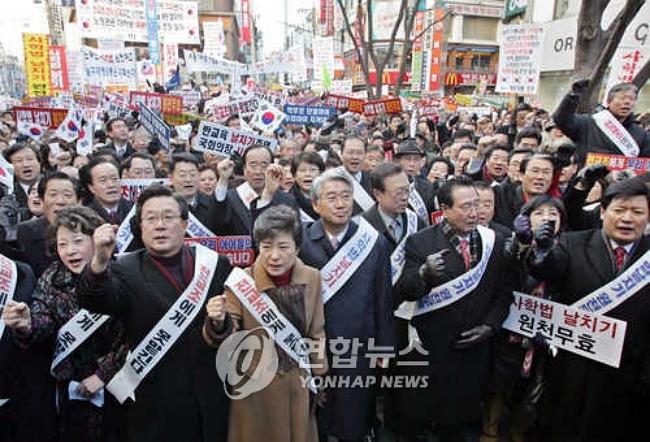 Then-Hannara Party leader Park Geun-hye and fellow lawmakers conduct an extra-parliamentary struggle against the amendment of the Private School Act in December 2005. The Hannara Party extended a single agenda into a series of news stories by continuing street rallies, candlelight vigils, regional tours, and solidarity with related groups. [Photo = Yonhap News]5 things Jang Dong-hyeok must change
What Jang Dong-hyeok must learn is not the intensity of a 53-day boycott or street speeches, but the operational method of turning one agenda into "new" news each time and transferring the strength gained outside the assembly into parliamentary legislation and negotiations.
First, don't change the region; change the news.
Repeating the same speech given in Incheon in Busan, Gwangju, and Daegu/Gyeongbuk may increase the number of events, but it does not build political capital. Every regional visit must produce independent news that could only come from that specific location.
For instance, in Incheon, secure individuals who can testify to the ballot shortage and the damage caused by the voting suspension. In Busan, verify the reporting and command structure and response records of the local election commission. In other regions, announce institutional reform proposals that could change the police’s initial response or the election commission’s personnel, audit, and record preservation systems.
Each visit should be followed by new facts, records, witnesses, actions, and a follow-up timeline. If there is only a politician's speech, it becomes a report on a rally. When combined with victim testimony and documents, it becomes investigative reporting. If it leads to information disclosure requests, evidence preservation, criminal complaints, and the proposal of bills, it creates follow-up reports.
Declaring "I will fight to the end" is not enough. You must disclose what materials you are requesting by when, who is in charge of which measures, and what the next steps will be if the relevant authorities do not respond.
A visit without new facts, witnesses, actions, and a timeline is just a schedule. When those four elements are present, it becomes news.
Second, transform party members from an audience into an organization for whistleblowing and action.
A member-centered party must not be confined to the logic of defending the leader’s tenure. If members are merely mobilized as an audience to fill rally seats and applaud, it is difficult to avoid the criticism that it is a "leader-centered party" rather than a "member-centered" one.
Members can collect regional damage reports and tips, verify records at election management sites, and connect victims with legal support organizations. Regional party committees should collect data and testimony, while the central party must verify the records gathered from across the country and consolidate them into a public database.
By preparing regional reporting channels, standard damage report forms, data preservation guidelines, information disclosure request templates, and legal support contact networks, members can be transformed from objects of mobilization into subjects who collect facts and take action. A member-centered party should not be one that puts members’ emotions first, but one that connects members' participation to fact-finding and policy production.
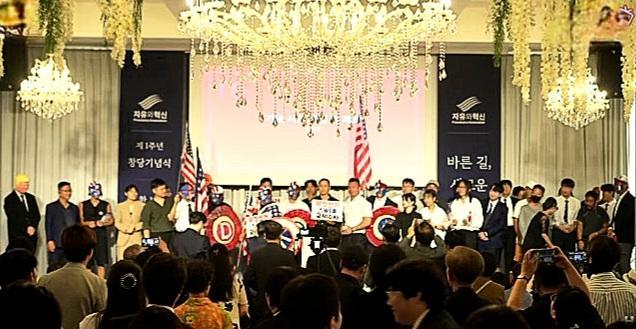 The 1st-anniversary ceremony of the founding of "Liberty and Innovation" is being held at Marina Park in Seocho-gu, Seoul, on the afternoon of the 12th. [Photo = Hanmi Ilbo]Third, build a one-point joint front with "Liberty and Innovation."
If Jang wants to form solidarity with civil society outside the People Power Party, there is no reason to ignore Hwang Kyo-ahn’s "Liberty and Innovation." During its founding process, Liberty and Innovation presented the eradication of election fraud and the restoration of sovereignty as its core goals, and it is one of the forces within the institutional sphere that has most actively put forward suspicions of election management and fraud as an agenda.
What is needed is not party integration or comprehensive agreement on all claims. It is about building solidarity on issues where joint response is possible, such as ballot shortages and voting suspensions verified by the National Election Commission's own data, preservation of related records, legal support for victims, and special counsel investigations and electoral system reforms.
The People Power Party holds institutional tools such as parliamentary seats, special counsel bills, parliamentary inspections, and standing committees. Liberty and Innovation possesses an organization and a support base that has consistently raised this issue. If both sides form a joint verification team and legal support group and conduct regional field investigations, victim meetings, and public forums, they can expand the reach of the extra-parliamentary front.
However, the foundation of solidarity must be provable facts. One must distinguish between the ballot shortage/voting suspension of the June 3 election and comprehensive suspicions regarding past elections in general. Rather than excluding Liberty and Innovation, both parties should establish joint verification criteria, confirm suspicions through documents, testimony, and legal procedures, and have the People Power Party link verified issues to special counsel investigations and legislation.
Fourth, open your doors to regional and small/medium-sized media first.
If the media landscape Jang faces is unfavorable, he must first change the communication structure that focuses only on large newspapers and broadcasters. The practice of distributing the same press release to the National Assembly press corps while touring the country makes it difficult to deeply convey regional incidents and testimonies.
Regional media can track the responses of local election commissions and voter damage that the central political press might overlook. Political and legal professional journals can handle issues like the structure of special counsel recommendations, the legal requirements for re-elections, and evidence preservation/record management with a long-term perspective. Small/medium-sized independent media, YouTube, and podcasts can deliver entire arguments and responses to counterarguments, going beyond short excerpts.
Whenever he visits a region, he should hold open press conferences and guarantee the right to ask questions regardless of the media outlet's size or stance. He should provide full transcripts of Q&A sessions, records of remarks, supporting documents, raw data, and contact points for lawmakers and staff responsible for follow-up reporting.
The goal is not to increase favorable articles. It is to build a multi-layered information distribution network where the overall facts and testimonies are not lost, regardless of what headline or frame one or two large media outlets choose.
Fifth, create an intersection between extra-parliamentary momentum and parliamentary execution power.
Extra-parliamentary politics and a member-centered party are not substitutes for parliamentary politics. If Jang makes the public special counsel investigation, re-election, and election commission reform a national agenda through his tours, the parliamentary leadership must translate these into executable laws and institutions.
If demanding a special counsel, you must propose the scope of the investigation, the recommendation method, the investigation period, and evidence preservation measures. If arguing for re-election, you must explain what legal procedures would follow once certain facts are verified. Regarding election commission reform, move beyond the slogan of punishing those responsible and put forward concrete plans on how to change ballot counting and supply, field reporting, record preservation, external audits, and personnel structures.
Lawmaker-lawyers can handle special counsel bills and litigation procedures; lawmakers in administration and budget fields can analyze the election commission’s organization and audit systems; and district lawmakers can handle victim interviews and data acquisition. The parliamentary leadership must leave the facts verified outside the assembly as official records through parliamentary inspections and standing committee activities.
In Park Geun-hye's Private School Act struggle, the party leader created extra-parliamentary pressure, and the floor leader negotiated the normalization of the National Assembly and discussions on re-amendment. The path Jang Dong-hyeok must take is not one that bypasses the assembly, but one that moves it.
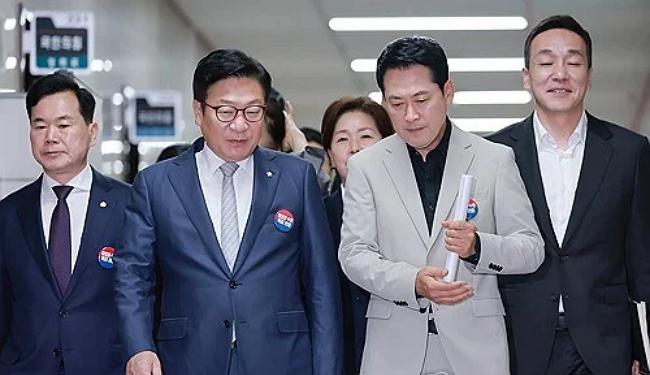 PPP leader Jang Dong-hyeok and floor leader Choo Kyung-ho talk while heading to a Supreme Council meeting at the National Assembly. The momentum of extra-parliamentary politics must be connected to parliamentary legislation and institutional reform. [Photo = Yonhap News]
Extra-parliamentary politics also needs a scorecard
For Jang Dong-hyeok’s extra-parliamentary politics to succeed, he must disclose what has been newly verified, what measures have been implemented, and which bills or institutional changes have resulted, rather than how many cities he visited or how many people gathered.
He can release a weekly scorecard. It would be a way of reporting to the public the newly secured data, confirmed victims, progress on information disclosure requests and complaints/investigation requests, the status of legal support, bills being proposed or prepared, and whether relevant agencies have responded.
The extra-parliamentary sphere is a space for creating national pressure, and party members are the organization that sustains that pressure. Liberty and Innovation and civil society must expand the reach of the joint front, regional/small/professional media must disseminate the facts, and the assembly must complete the process through special counsels, investigations, legislation, and institutional reform.
What is newly revealed in the places visited is more important than touring more regions. It is more important to know with whom you have joined forces to carry out a slogan and into which bills and actions you have translated it, rather than just chanting a stronger slogan.
The extra-parliamentary sphere must create momentum, members must organize, Liberty and Innovation and civil society must broaden the front, media must disseminate, and the parliamentary branch must produce results. Whether Jang Dong-hyeok’s choice succeeds will be determined not by the number of regions visited, but by the news and institutional outcomes created there.

 Iranian Foreign Ministry: "Continuing Message Exchanges with the U.S. and Activities of Mediating Countries"
Esmaeil Baghaei, Spokesperson for the Iranian Ministry of Foreign Affairs [Xinhua, Yonhap News file photo]Esmaeil Baghaei, spokesperson for the Iranian Ministry of Foreign Affairs, stated on the 26th
Iranian Foreign Ministry: "Continuing Message Exchanges with the U.S. and Activities of Mediating Countries"
Esmaeil Baghaei, Spokesperson for the Iranian Ministry of Foreign Affairs [Xinhua, Yonhap News file photo]Esmaeil Baghaei, spokesperson for the Iranian Ministry of Foreign Affairs, stated on the 26th
 President Yoon: "Do You Think You Are Safe from the Special Counsel?"... Final Statement Video Released
President Yoon Suk Yeol rebuking the special prosecutor on the 24th. [Court video / @birds_justice X account subtitle GIF] A video of President Yoon Suk Yeol's closing statement at his trial rega
President Yoon: "Do You Think You Are Safe from the Special Counsel?"... Final Statement Video Released
President Yoon Suk Yeol rebuking the special prosecutor on the 24th. [Court video / @birds_justice X account subtitle GIF] A video of President Yoon Suk Yeol's closing statement at his trial rega
 President Yoon, regarding the first-instance ruling on the Public Official Election Act: “An excessive political verdict that distorts the facts… We will appeal immediately.”
The first-instance sentencing hearing for President Yoon Suk Yeol regarding violations of the Public Official Election Act is being broadcast live at Seoul Station on the 27th. [Photo=Yonhap News]Pres
President Yoon, regarding the first-instance ruling on the Public Official Election Act: “An excessive political verdict that distorts the facts… We will appeal immediately.”
The first-instance sentencing hearing for President Yoon Suk Yeol regarding violations of the Public Official Election Act is being broadcast live at Seoul Station on the 27th. [Photo=Yonhap News]Pres
 WSJ: "SK Hynix ADR Premium Is a Sign of AI Trading Overheat"
Advertisement for SK Hynix ADR listing in New York's Times Square [Reuters=Yonhap News file photo]The Wall Street Journal (WSJ) has pointed out that the price of SK Hynix’s American Depositary Recei
WSJ: "SK Hynix ADR Premium Is a Sign of AI Trading Overheat"
Advertisement for SK Hynix ADR listing in New York's Times Square [Reuters=Yonhap News file photo]The Wall Street Journal (WSJ) has pointed out that the price of SK Hynix’s American Depositary Recei
 'Godfather of Japanese Mystery Novels' Keigo Higashino Passes Away After Battle with Cancer at 68
Famous Japanese mystery novelist Keigo Higashino [AFP=Yonhap News]It has been belatedly reported that Keigo Higashino, the "godfather of Japanese mystery novels" and author of bestsellers such as "The
'Godfather of Japanese Mystery Novels' Keigo Higashino Passes Away After Battle with Cancer at 68
Famous Japanese mystery novelist Keigo Higashino [AFP=Yonhap News]It has been belatedly reported that Keigo Higashino, the "godfather of Japanese mystery novels" and author of bestsellers such as "The
 [Park Pil-kyu Security Column] To the Ignorant Trying to Clothe a Beast in Sheep's Clothing
Rep. Kim Byung-joo of the Democratic Party of Korea [Photo=Yonhap News]“The Air Force Academy doesn't teach you how to fly a plane!” “The Army, Navy, and Air Force academies are exactly the
[Park Pil-kyu Security Column] To the Ignorant Trying to Clothe a Beast in Sheep's Clothing
Rep. Kim Byung-joo of the Democratic Party of Korea [Photo=Yonhap News]“The Air Force Academy doesn't teach you how to fly a plane!” “The Army, Navy, and Air Force academies are exactly the
 [Issue Diagnosis] Two Effects of the Election Petition Review
 [Photo] Evidence of Election Fraud Flooding U.S. Media… Trump Had 2.7 Million Votes Stolen
 [Video] U.S. Semiquincentennial Air Show... 'Art in the Sky' streaks across New York
 [Editorial Cartoon] A Draconian Law That Undermines Freedom of Expression

 List
List










