 Presiding judges from courts nationwide attend an extraordinary meeting of the National Conference of Court Presidents held at the Supreme Court in Seocho-gu, Seoul on the 12th. Yonhap News.
Presiding judges from courts nationwide announced their official stance on the ruling party's judicial reform initiatives on the 12th, stating, "Judicial independence must be guaranteed" and "Participation of the judiciary is essential in discussions on institutional reform."
Cheon Dae-yeop, Chief of the Court Administration and Justice of the Supreme Court, and presiding judges from courts nationwide held an extraordinary meeting of the National Conference of Court Presidents at the main conference room of the Supreme Court building in Seocho-dong that afternoon. The meeting concluded around 9:24 PM, after approximately seven and a half hours of discussions.
Following the meeting, the presiding judges issued a press release stating, "Judicial system reform is a significant responsibility of the judiciary for the people and a task of the era, and therefore, it must be pursued with full consideration of its impact on the public and society as a whole." They added, "To this end, we have agreed that it is necessary to go through a broad discussion, deliberation, and public consensus-building process."
They further stated, "The composition of the highest court and the judicial appointment system are core elements of judicial independence. To protect the fundamental rights of the people and realize the rule of law, judicial independence must be guaranteed, and therefore, the judiciary's participation in discussions for its improvement is essential."
The presiding judges emphasized, "The judiciary can only exist through the trust of the people, and therefore, we must do our utmost to regain that trust. While actively participating in reform discussions, the judiciary will maintain an open attitude in communication with the National Assembly, the government, and the public, and will strive to deliver swift and fair trials for the people under any circumstances." This meeting was a follow-up measure after Chief Justice Cheon requested presiding judges on the 1st to gather opinions from judges regarding the Democratic Party's judicial reform proposals.
The presiding judges shared opinions from judges across various levels and engaged in discussions on the five key agendas that the Democratic Party's Special Committee on Judicial Reform (SCJR) is pushing for passage in a plenary session before Chuseok: expansion of the number of Supreme Court justices, improvement of the Supreme Court justice nomination method, improvement of the judge evaluation system, expansion of the scope of disclosure for lower court judgments, and introduction of a prior review system for search and seizure warrants.
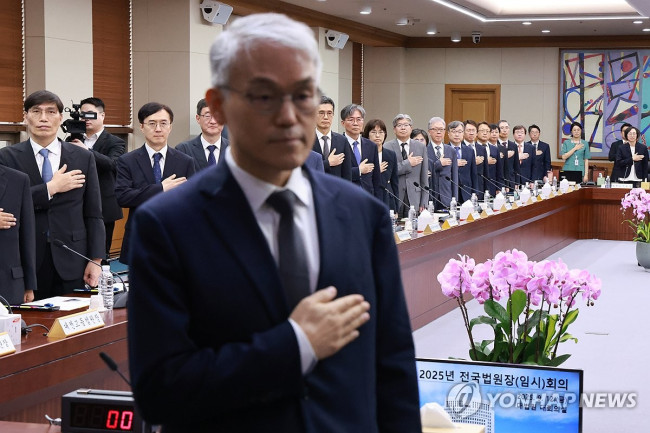 Presiding judges from courts nationwide salute the flag at an extraordinary meeting of the National Conference of Court Presidents held at the Supreme Court in Seocho-gu, Seoul on the 12th. Yonhap News.
Regarding the expansion of the number of Supreme Court justices, the majority of judges expressed concerns and the need for careful consideration, stating reasons such as "it is being pushed without sufficient deliberation," "there are concerns about the weakening of factual review functions," and "it should be discussed alongside desirable reform of the appeal system." Some suggested that a small increase of about four Supreme Court justices would be appropriate, or that sufficient human and material support for factual review should precede or accompany this.
The presiding judges agreed that strengthening factual review is a priority for the implementation of swift and thorough trials, and they decided that "a public discussion process is necessary for the reform of the appeal system and the increase in the number of Supreme Court justices, based on this premise."
Regarding the improvement of the Supreme Court justice nomination method through diversification of the Supreme Court Justice Nomination Committee, the majority of judges also expressed concerns and the need for careful consideration. This was due to the potential for infringement of judicial independence depending on the composition or number of members of the committee, or the argument that the diversity of Supreme Court justice composition can be secured through the proper operation of the current committee.
The presiding judges agreed that "while respecting the referral right guaranteed by the Constitution, it is necessary to review operational supplementary measures that can listen to diverse voices."
Concerning discussions on the improvement of the judge evaluation system, a majority of judges reportedly expressed concerns about the proposed bill, citing fears of infringement of judicial independence or unconstitutionality. In response, the presiding judges agreed that "while upholding the principle of judicial independence against undue external intervention, it is necessary to make efforts with a sense of responsibility as judicial administrative authorities to establish measures that can appropriately reflect the voices of the public."
Regarding the expansion of disclosure of lower court judgments and the introduction of a prior review system for search and seizure warrants, they agreed with the reform proposals but also stated that the review of supplementary measures for side effects is necessary.
On the expansion of judgment disclosure, a majority of judges expressed principled agreement for the sake of guaranteeing the public's right to know and enhancing judicial fairness and transparency, but they also raised the need for supplementary measures to protect personal information and privacy, and to prevent misuse aimed at influencing trials.
Regarding the introduction of a prior review system for search and seizure warrants, many judges also agreed in principle, but some expressed concerns that it could hinder the secrecy and speed of investigations.
Although not on the official agenda, discussions were also held on the establishment of a special rebellion court, which the Democratic Party is pursuing, and a majority of opinions suggested that "a cautious approach is needed."
In his opening remarks, Chief Justice Cheon expressed concern that "judicial reform measures are being pursued without a public consensus process with the official participation of the judiciary, which is the subject of judicial power under the Constitution." He stated that he would listen to opinions from within and outside the judiciary through various channels, including this meeting, to "strive for desirable judicial system reforms for the people."
He then urged, "Let us all members of the judiciary unite our efforts to ensure the implementation of swift and fair trials for the people."
On the 1st, Chief Justice Cheon shared the opinions presented to the Democratic Party's SCJR on the internal judicial network's presiding judge community and requested the collection of opinions.
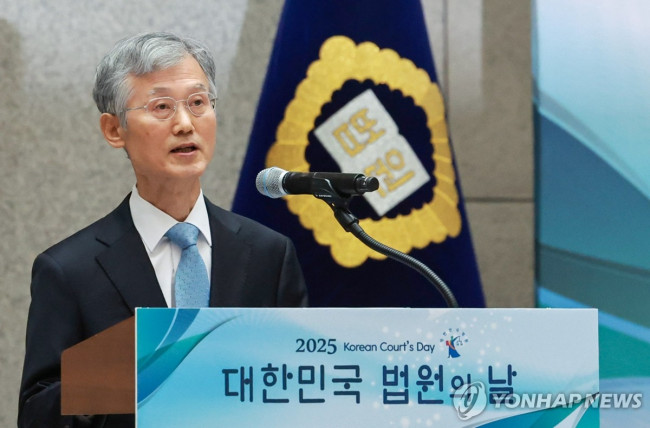 Chief Justice Cho Hee-dae delivers an commemorative address at the '2025 Republic of Korea Court Day Commemorative Ceremony' held at the Supreme Court in Seocho-gu, Seoul on the 12th. Yonhap News.
Chief Justice Cho Hee-dae did not attend the meeting of presiding judges. The meeting of presiding judges is chaired by the Chief of the Court Administration, who leads the judicial administration body. However, he expressed his stance on judicial reform at the 'Court Day' commemorative ceremony held in the morning.
Chief Justice Cho stated, "The judiciary will focus on the constitutional values of separation of powers and judicial independence. Based on the precedent of the judiciary's active participation in past major judicial system reforms, we will fully present the judiciary's opinions to the National Assembly."
This was interpreted as an expression of concern over the current situation where the judiciary's intentions are not reflected in judicial reform. He also emphasized, "We will find the right path for all the people by persuading them through rational explanations and communication." He also expressed the importance of firmly guaranteeing judicial independence.
Discussions on judicial reform, which began in earnest during the Kim Young-sam administration in the 1990s, have since proceeded with the participation of various entities in conjunction with social changes.
The executive branch, including the Blue House, the Supreme Court, the National Assembly, and the prosecution, discussed judicial system improvements through various committees such as the Judicial System Development Committee (JSDA), the Judicial Reform Promotion Committee (JRPC), the Judicial Reform Committee (JRC), and the Judicial System Reform Promotion Committee (JSRPC). These efforts resulted in amendments to the Criminal Procedure Act, reforms to the pre-trial detention system, the launch of law schools, the introduction of jury trials, and improvements to the sentencing system.
Yonhap News

 Trump pressures for rate cut again ahead of FOMC... "Should be the lowest in the world"
U.S. President Donald Trump. [Photo = The White House] U.S. President Donald Trump once again pressured the Federal Reserve, the U.S. central bank, to lower interest rates on the 27th (local time
Trump pressures for rate cut again ahead of FOMC... "Should be the lowest in the world"
U.S. President Donald Trump. [Photo = The White House] U.S. President Donald Trump once again pressured the Federal Reserve, the U.S. central bank, to lower interest rates on the 27th (local time
 “Ignoring crisp ballots and damaged seals”… Tongyeong mayoral recount concludes with ‘no change in outcome,’ leaving suspicions and public outrage behind
Suspected counterfeit ballots discovered in Tongyeong [GIF from social media of Representative Hwang Kyo-ahn / Attorney Park Joo-hyun]During a recount of the Tongyeong mayoral election in South Gyeong
“Ignoring crisp ballots and damaged seals”… Tongyeong mayoral recount concludes with ‘no change in outcome,’ leaving suspicions and public outrage behind
Suspected counterfeit ballots discovered in Tongyeong [GIF from social media of Representative Hwang Kyo-ahn / Attorney Park Joo-hyun]During a recount of the Tongyeong mayoral election in South Gyeong
 President Yoon, regarding the first-instance ruling on the Public Official Election Act: “An excessive political verdict that distorts the facts… We will appeal immediately.”
The first-instance sentencing hearing for President Yoon Suk Yeol regarding violations of the Public Official Election Act is being broadcast live at Seoul Station on the 27th. [Photo=Yonhap News]Pres
President Yoon, regarding the first-instance ruling on the Public Official Election Act: “An excessive political verdict that distorts the facts… We will appeal immediately.”
The first-instance sentencing hearing for President Yoon Suk Yeol regarding violations of the Public Official Election Act is being broadcast live at Seoul Station on the 27th. [Photo=Yonhap News]Pres
 WSJ: "SK Hynix ADR Premium Is a Sign of AI Trading Overheat"
Advertisement for SK Hynix ADR listing in New York's Times Square [Reuters=Yonhap News file photo]The Wall Street Journal (WSJ) has pointed out that the price of SK Hynix’s American Depositary Recei
WSJ: "SK Hynix ADR Premium Is a Sign of AI Trading Overheat"
Advertisement for SK Hynix ADR listing in New York's Times Square [Reuters=Yonhap News file photo]The Wall Street Journal (WSJ) has pointed out that the price of SK Hynix’s American Depositary Recei
 'Godfather of Japanese Mystery Novels' Keigo Higashino Passes Away After Battle with Cancer at 68
Famous Japanese mystery novelist Keigo Higashino [AFP=Yonhap News]It has been belatedly reported that Keigo Higashino, the "godfather of Japanese mystery novels" and author of bestsellers such as "The
'Godfather of Japanese Mystery Novels' Keigo Higashino Passes Away After Battle with Cancer at 68
Famous Japanese mystery novelist Keigo Higashino [AFP=Yonhap News]It has been belatedly reported that Keigo Higashino, the "godfather of Japanese mystery novels" and author of bestsellers such as "The
 [Park Pil-kyu Security Column] To the Ignorant Trying to Clothe a Beast in Sheep's Clothing
Rep. Kim Byung-joo of the Democratic Party of Korea [Photo=Yonhap News]“The Air Force Academy doesn't teach you how to fly a plane!” “The Army, Navy, and Air Force academies are exactly the
[Park Pil-kyu Security Column] To the Ignorant Trying to Clothe a Beast in Sheep's Clothing
Rep. Kim Byung-joo of the Democratic Party of Korea [Photo=Yonhap News]“The Air Force Academy doesn't teach you how to fly a plane!” “The Army, Navy, and Air Force academies are exactly the
 [Issue Diagnosis] Two Effects of the Election Petition Review
 [Photo] Evidence of Election Fraud Flooding U.S. Media… Trump Had 2.7 Million Votes Stolen
 [Video] U.S. Semiquincentennial Air Show... 'Art in the Sky' streaks across New York
 [Editorial Cartoon] A Draconian Law That Undermines Freedom of Expression

 List
List










