이번 기사는 한미 무역·투자 협상을 둘러싼 보도의 실체를 점검한다. 일본·EU 협상과 달리 한국 협상은 정치적 해석과 언론 프레임이 과도하게 개입하면서 본질이 왜곡되고 있다는 점에 주목했다. ‘무제한 스와프 요구’나 ‘현금 강요설’처럼 확인되지 않은 표현들이 확대 재생산되는 과정이 협상의 진짜 걸림돌일 수 있음을 지적한다. <편집자 주>
 Political and media frames such as ‘unlimited swap and forced cash’ are shaking economic negotiations. Hanmi Ilbo Graphic
South Korea-US trade and investment negotiations are continuing at length but without clear progress. While Japan and the European Union (EU) signed agreements with the US based on economic interests, criticism is emerging that the Korean negotiations are being shaken in their essence by a combination of political and media frames.
It is pointed out that the controversy over foreign exchange market safety nets and pressure for direct cash investment are, in fact, products of frames created by domestic politics and media.
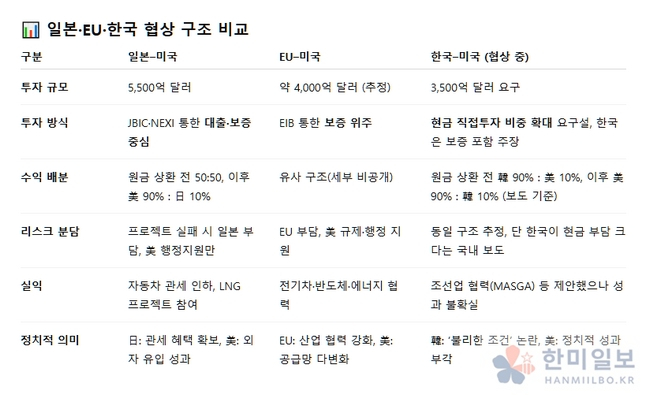
In September, Japan signed a Memorandum of Understanding (MOU) for a strategic investment fund worth $550 billion with the US. Specific exchange conditions were clear, such as reducing automobile tariffs from 25% to 15% and securing participation in the Alaska LNG project.
The majority of the investment funds were covered by loans and guarantees through the Japan Bank for International Cooperation (JBIC) and Nippon Export and Investment Insurance (NEXI). The US secured stable funding for industrial projects, and Japan secured tangible benefits for its industries.
The European Union also promised guarantee-oriented investments, primarily through the European Investment Bank (EIB), and exchanged economic benefits in the areas of electric vehicles, semiconductors, and energy cooperation.
In contrast, the situation in Korea is different.
Reports continued that the US demanded an investment of $350 billion from Korea and showed a stance of increasing the proportion of direct cash investment. While the Korean government is maintaining its position of including loans and guarantees from policy financial institutions, domestic media outlets have highlighted the "pressure for direct cash investment" and framed it as the cause of the negotiation deadlock.
Despite the structure being not significantly different from that of Japan, the nature of the negotiations is gradually transforming into a ‘political confrontation’.
In particular, the ‘forced cash’ frame is representative.
Some domestic media outlets published headlines such as “US forces Korea alone to make $350 billion in direct cash investment,” emphasizing unfavorable conditions.
In contrast, foreign media such as Reuters and Bloomberg, quoting statements from Korean government officials, reported only that “discussions are underway on the investment structure, including support through policy financial institutions,” and did not use the term ‘forced cash’.
Ultimately, despite no significant structural differences with Japan and the EU, the framing by domestic media has played a role in making Korea appear uniquely disadvantaged.
The currency swap controversy is in the same vein.
While it is a natural process for Korea to discuss measures for exchange rate stabilization, some media outlets have exaggerated this into a report of ‘unlimited swap demands’.
Nowhere in the publicly released statements from the Blue House and the White House, nor in foreign media or think tank reports, has the term ‘unlimited’ been confirmed. However, domestic political circles have consumed this as a symbol of the negotiation deadlock.
At this point, the US's intention to highlight the inflow of foreign capital as cash as a political achievement and symbol is also discernible.
The keywords frequently mentioned in relation to the negotiation deadlock, in particular, show clear differences in their sources.
Reuters and Bloomberg, quoting Korean government officials, reported that “discussions are underway with the US on measures to mitigate the impact of foreign exchange market shocks due to exchange rate volatility,” but the term ‘unlimited swap’ was not confirmed.
On the other hand, some domestic economic newspapers featured headlines such as “Government unveils unlimited won-dollar currency swap card” (Korea International Trade Association News). This difference is cited as a case where media framing has spread before the reality of the negotiations.
Trade experts also emphasize caution.
A former trade negotiation headquarters official stated, “What the US wants is to highlight political achievements rather than ‘forced cash’,” adding, “Domestic media have simplified this and interpreted it as ‘cash pressure’.” Another international finance researcher analyzed, “Despite the structures of Japan, the EU, and Korea not being significantly different, the fact that only Korea appears particularly disadvantaged is due to the effect of media framing.”
As the South Korea-US negotiations drag on, the uncertainty for export-oriented industries grows.
Instead of exchanges prioritizing economic benefits like Japan, a negotiation structure that prioritizes political and media symbolism can ultimately be disadvantageous to the Korean economy.
If negotiations are reduced to hostages of politics and media rather than national interests, the price will be paid by the people.
#KoreaUSNegotiations #PoliticalMediaHostage #CurrencySwapControversy #DirectCashInvestment #TrumpTrade #LeeJaeMyungGovernment #KoreaJapanMOU #KoreaEUComparison #EconomicLogicVsPoliticalLogic #NationalInterestNegotiations

 Iranian Foreign Ministry: "Continuing Message Exchanges with the U.S. and Activities of Mediating Countries"
Esmaeil Baghaei, Spokesperson for the Iranian Ministry of Foreign Affairs [Xinhua, Yonhap News file photo]Esmaeil Baghaei, spokesperson for the Iranian Ministry of Foreign Affairs, stated on the 26th
Iranian Foreign Ministry: "Continuing Message Exchanges with the U.S. and Activities of Mediating Countries"
Esmaeil Baghaei, Spokesperson for the Iranian Ministry of Foreign Affairs [Xinhua, Yonhap News file photo]Esmaeil Baghaei, spokesperson for the Iranian Ministry of Foreign Affairs, stated on the 26th
 President Yoon: "Do You Think You Are Safe from the Special Counsel?"... Final Statement Video Released
President Yoon Suk Yeol rebuking the special prosecutor on the 24th. [Court video / @birds_justice X account subtitle GIF] A video of President Yoon Suk Yeol's closing statement at his trial rega
President Yoon: "Do You Think You Are Safe from the Special Counsel?"... Final Statement Video Released
President Yoon Suk Yeol rebuking the special prosecutor on the 24th. [Court video / @birds_justice X account subtitle GIF] A video of President Yoon Suk Yeol's closing statement at his trial rega
 President Yoon, regarding the first-instance ruling on the Public Official Election Act: “An excessive political verdict that distorts the facts… We will appeal immediately.”
The first-instance sentencing hearing for President Yoon Suk Yeol regarding violations of the Public Official Election Act is being broadcast live at Seoul Station on the 27th. [Photo=Yonhap News]Pres
President Yoon, regarding the first-instance ruling on the Public Official Election Act: “An excessive political verdict that distorts the facts… We will appeal immediately.”
The first-instance sentencing hearing for President Yoon Suk Yeol regarding violations of the Public Official Election Act is being broadcast live at Seoul Station on the 27th. [Photo=Yonhap News]Pres
 WSJ: "SK Hynix ADR Premium Is a Sign of AI Trading Overheat"
Advertisement for SK Hynix ADR listing in New York's Times Square [Reuters=Yonhap News file photo]The Wall Street Journal (WSJ) has pointed out that the price of SK Hynix’s American Depositary Recei
WSJ: "SK Hynix ADR Premium Is a Sign of AI Trading Overheat"
Advertisement for SK Hynix ADR listing in New York's Times Square [Reuters=Yonhap News file photo]The Wall Street Journal (WSJ) has pointed out that the price of SK Hynix’s American Depositary Recei
 'Godfather of Japanese Mystery Novels' Keigo Higashino Passes Away After Battle with Cancer at 68
Famous Japanese mystery novelist Keigo Higashino [AFP=Yonhap News]It has been belatedly reported that Keigo Higashino, the "godfather of Japanese mystery novels" and author of bestsellers such as "The
'Godfather of Japanese Mystery Novels' Keigo Higashino Passes Away After Battle with Cancer at 68
Famous Japanese mystery novelist Keigo Higashino [AFP=Yonhap News]It has been belatedly reported that Keigo Higashino, the "godfather of Japanese mystery novels" and author of bestsellers such as "The
 [Park Pil-kyu Security Column] To the Ignorant Trying to Clothe a Beast in Sheep's Clothing
Rep. Kim Byung-joo of the Democratic Party of Korea [Photo=Yonhap News]“The Air Force Academy doesn't teach you how to fly a plane!” “The Army, Navy, and Air Force academies are exactly the
[Park Pil-kyu Security Column] To the Ignorant Trying to Clothe a Beast in Sheep's Clothing
Rep. Kim Byung-joo of the Democratic Party of Korea [Photo=Yonhap News]“The Air Force Academy doesn't teach you how to fly a plane!” “The Army, Navy, and Air Force academies are exactly the
 [Issue Diagnosis] Two Effects of the Election Petition Review
 [Photo] Evidence of Election Fraud Flooding U.S. Media… Trump Had 2.7 Million Votes Stolen
 [Video] U.S. Semiquincentennial Air Show... 'Art in the Sky' streaks across New York
 [Editorial Cartoon] A Draconian Law That Undermines Freedom of Expression

 List
List










