Joo Eun-sik, President of the Korea Institute for Strategic StudiesRecently, President Lee Jae-myung stated, "Fifty AI combat robots can handle thousands of enemy troops." While this may sound like a vision for defense innovation based on cutting-edge technology, it could actually be a dangerous signal misunderstanding the essence of military power. The highest commander must first decide the environment in which their military will fight. That is their most important responsibility. Defense is not a political slogan but a matter of national survival, and it is a "complex system" of interwoven military personnel, technology, and alliances. This paper analyzes the problems with this statement from a military science perspective and proposes directions for realistic defense reform.
Military power begins with the strength of numbers.
In his work "On War," the master of war philosophy and military science, Clausewitz, emphasized "the Law of Numbers," which states that numerical superiority is the first principle of war. A larger number of troops allows for maintaining the front line and expands strategic options such as flanking maneuvers and the deployment of reserves. Conversely, insufficient troop numbers make a military vulnerable to protracted or attrition warfare, regardless of the quality of weapons and strategies.
It is true that modern warfare is increasingly centered on advanced weaponry. However, the Russia-Ukraine war since 2022 offers us important lessons. Both countries engage in large-scale drone warfare, cyber warfare, and precision-strike warfare, while simultaneously continuing to conscript and deploy hundreds of thousands of troops. Ultimately, war is not a one-off duel but a continuous conflict, and the total amount of personnel remains a key indicator of a nation's capacity to sustain the war. The statement "fifty people defeating thousands" is a result of misunderstanding war as a game and an optimism that disregards strategic realities.
The ‘Balance of Quantity and Quality’ Explained by the Dupuy Equation
American military analyst Trevor N. Dupuy, in his various writings published by the Historical Evaluation Research Organization (HERO), explained combat power with the equation S = k·N², where:
N represents the number of troops,
k represents the quality of troops, including weapons, command, and morale,
S represents combat power (Strength).
In this formula, N is squared, meaning that a decrease in troop numbers leads to an exponential decline in combat power. No matter how elite a unit is, if its numbers (N) are extremely small, it cannot sustain operations for extended periods. While special forces achieve remarkable results in tactical, localized engagements, they cannot end a war for an entire nation. AI, drones, and smart weapons play a significant role as combat multipliers, but they cannot completely replace human soldiers. If the troop size is reduced by two-thirds, the quality must increase ninefold to compensate. Even if the North Korean army is a weak force, it is unlikely that our military is nine times superior in quality.
War is Total War and Sustained War — The Illusion of AI Omnipotence
AI combat robots and autonomous drones will bring innovation to the battlefield. However, they are expendable. Once destroyed, they require resupply, maintenance, and reprogramming, which must be supported by production capacity, logistics systems, and communication networks. Furthermore, tasks such as controlling occupied territories, protecting civilians, maintaining public order, and post-war reconstruction will still fall to humans.
Even in the recent Israel-Hamas war, AI-based target identification and drone strikes were used extensively, but ultimately, ground troop deployment in Gaza could not be avoided. The notion that 50 robots can end a war is akin to technological determinism that overlooks the multifaceted reality of military operations—psychological warfare, information warfare, diplomatic warfare, and civil-military operations.
Self-reliant defense does not mean excluding allies.
President Lee also stated, "To believe that self-reliant defense is impossible without foreign troops is subservient thinking." However, self-reliant defense is not a declaration of abandoning allies and standing alone. True self-reliance is achieved through the maximization of domestic capabilities plus optimal integration with allied forces.
Former President Roh Moo-hyun also said during his lifetime, "The ROK-US alliance is a combat multiplier that doubles our strength." Alliances complement our weaknesses, expand deterrence, and guarantee the deployment of US strategic assets during wartime. Pushing this into ideological confrontation or attacking it with a frame of "subservience" will only divide the public into unnecessary security debates. Self-reliant defense should move towards strengthening joint defense capabilities, not isolationism.
A more fundamental issue is the response to nuclear weapons. The President should have first presented his plan for North Korea's nuclear weapons before discussing the aforementioned points. The most fundamental and core issue currently facing our military is how our nuclear-less military will respond to Kim Jong-un, who possesses nuclear weapons, and how it will protect the lives and property of our citizens. Therefore, past military commanders, setting aside their pride, have pursued joint operations with the US military and maintained alliances for the sake of the people, in order to guarantee extended deterrence with the US military.
If we are prepared to endure any economic hardship for the sake of self-reliant defense through the development of our own nuclear capabilities, I will boldly challenge this path. With our nation's Gross National Product of $1.8 trillion, if we were to invest a similar amount of money in the United States as Japan, which has about three times our population and a GNP of $4.9 trillion, our economy would collapse, and the South Korean economy would fall into ruin again. This is a cost we must bear because self-reliant defense is not achievable. My fellow citizens, which path will you choose? This is how the statement should have been made.
Looking at the level of the Minister of National Defense's speeches, I am truly concerned whether he has long experience in defense committee activities. And seeing the awareness of the supreme commander of the armed forces, I sigh from the perspective of the people. If you don't know much, you should ask experts and at least listen, so the public can feel at ease. The statements from the two leaders responsible for security are precarious, like standing at the edge of a well without a railing.
Realistic defense reform is the answer.
The South Korean security environment is under triple pressure: North Korea's nuclear weapons, US-China competition, and a declining birthrate leading to a reduction in military personnel. The solution lies in the balanced combination of technology, personnel, and alliances.
Securing sufficient personnel and reserve forces — by streamlining the conscription system, enhancing the qualitative level of the officer corps, stabilizing the lives of non-commissioned officers to boost morale, and achieving qualitative transformation through advanced education and training.
Integrated operation of manned and unmanned systems — complementary integration of AI, drones, robots, and human command systems through interfaces.
Strengthening the ROK-US alliance and multinational joint forces — real-time integration of intelligence, command and control, and fire cooperation systems.
Only when these three elements are harmonized can a true "strong military" be completed. Political slogans or excessive reliance on science and technology can instead instill false security illusions in the public and weaken preparedness. The "Jingbirok" by Seoae Ryu Seong-ryong points out that if the nation's top leader does not know how to manage national defense, it is equivalent to surrendering the country to the enemy. Defense reform that faces reality and strategic leadership are needed.

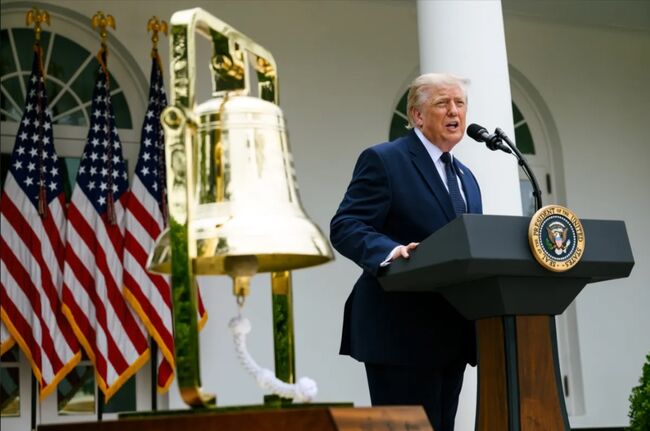 Trump pressures for rate cut again ahead of FOMC... "Should be the lowest in the world"
U.S. President Donald Trump. [Photo = The White House] U.S. President Donald Trump once again pressured the Federal Reserve, the U.S. central bank, to lower interest rates on the 27th (local time
Trump pressures for rate cut again ahead of FOMC... "Should be the lowest in the world"
U.S. President Donald Trump. [Photo = The White House] U.S. President Donald Trump once again pressured the Federal Reserve, the U.S. central bank, to lower interest rates on the 27th (local time
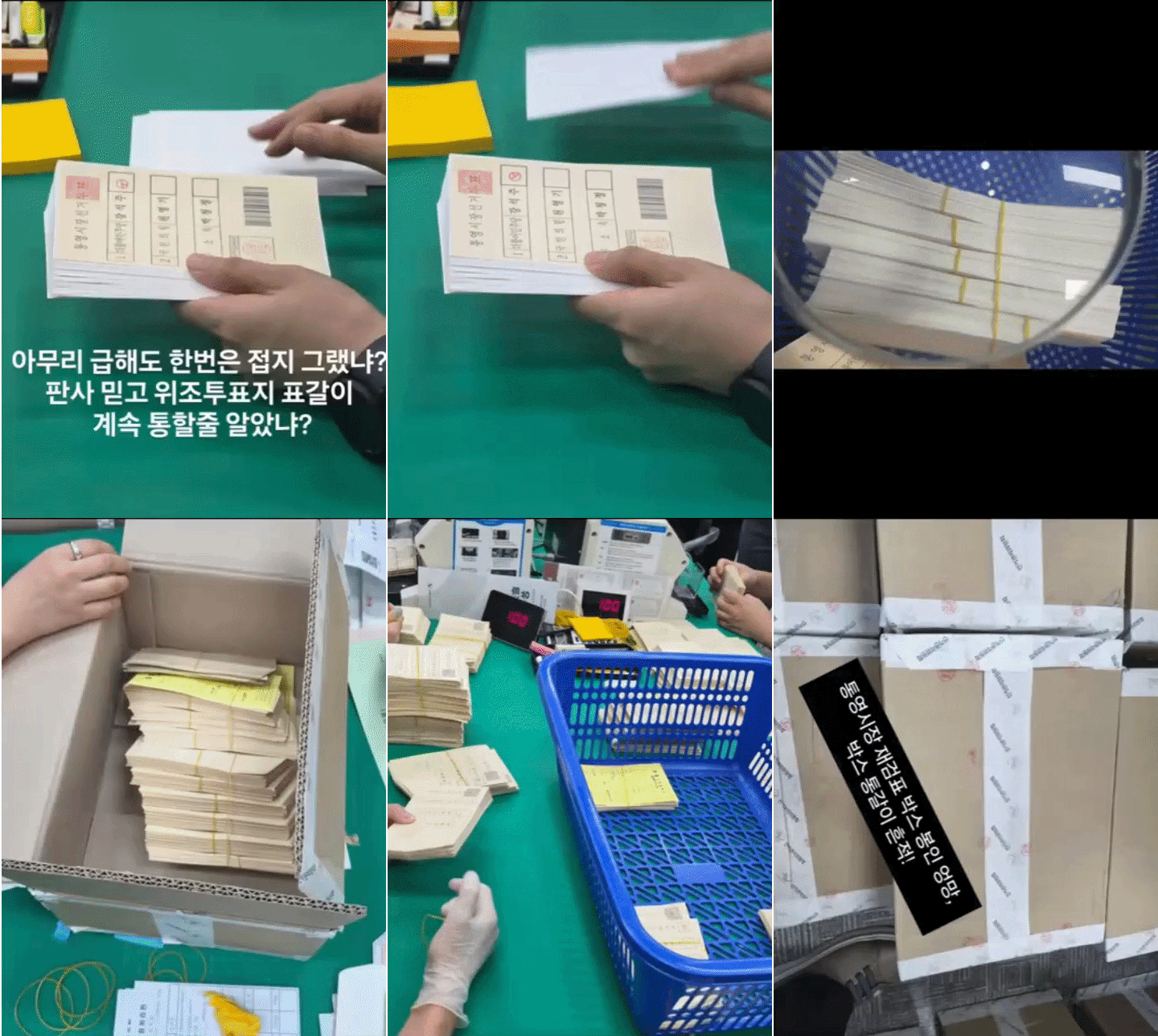 “Ignoring crisp ballots and damaged seals”… Tongyeong mayoral recount concludes with ‘no change in outcome,’ leaving suspicions and public outrage behind
Suspected counterfeit ballots discovered in Tongyeong [GIF from social media of Representative Hwang Kyo-ahn / Attorney Park Joo-hyun]During a recount of the Tongyeong mayoral election in South Gyeong
“Ignoring crisp ballots and damaged seals”… Tongyeong mayoral recount concludes with ‘no change in outcome,’ leaving suspicions and public outrage behind
Suspected counterfeit ballots discovered in Tongyeong [GIF from social media of Representative Hwang Kyo-ahn / Attorney Park Joo-hyun]During a recount of the Tongyeong mayoral election in South Gyeong
 President Yoon, regarding the first-instance ruling on the Public Official Election Act: “An excessive political verdict that distorts the facts… We will appeal immediately.”
The first-instance sentencing hearing for President Yoon Suk Yeol regarding violations of the Public Official Election Act is being broadcast live at Seoul Station on the 27th. [Photo=Yonhap News]Pres
President Yoon, regarding the first-instance ruling on the Public Official Election Act: “An excessive political verdict that distorts the facts… We will appeal immediately.”
The first-instance sentencing hearing for President Yoon Suk Yeol regarding violations of the Public Official Election Act is being broadcast live at Seoul Station on the 27th. [Photo=Yonhap News]Pres
 WSJ: "SK Hynix ADR Premium Is a Sign of AI Trading Overheat"
Advertisement for SK Hynix ADR listing in New York's Times Square [Reuters=Yonhap News file photo]The Wall Street Journal (WSJ) has pointed out that the price of SK Hynix’s American Depositary Recei
WSJ: "SK Hynix ADR Premium Is a Sign of AI Trading Overheat"
Advertisement for SK Hynix ADR listing in New York's Times Square [Reuters=Yonhap News file photo]The Wall Street Journal (WSJ) has pointed out that the price of SK Hynix’s American Depositary Recei
 'Godfather of Japanese Mystery Novels' Keigo Higashino Passes Away After Battle with Cancer at 68
Famous Japanese mystery novelist Keigo Higashino [AFP=Yonhap News]It has been belatedly reported that Keigo Higashino, the "godfather of Japanese mystery novels" and author of bestsellers such as "The
'Godfather of Japanese Mystery Novels' Keigo Higashino Passes Away After Battle with Cancer at 68
Famous Japanese mystery novelist Keigo Higashino [AFP=Yonhap News]It has been belatedly reported that Keigo Higashino, the "godfather of Japanese mystery novels" and author of bestsellers such as "The
 [Park Pil-kyu Security Column] To the Ignorant Trying to Clothe a Beast in Sheep's Clothing
Rep. Kim Byung-joo of the Democratic Party of Korea [Photo=Yonhap News]“The Air Force Academy doesn't teach you how to fly a plane!” “The Army, Navy, and Air Force academies are exactly the
[Park Pil-kyu Security Column] To the Ignorant Trying to Clothe a Beast in Sheep's Clothing
Rep. Kim Byung-joo of the Democratic Party of Korea [Photo=Yonhap News]“The Air Force Academy doesn't teach you how to fly a plane!” “The Army, Navy, and Air Force academies are exactly the
 [Issue Diagnosis] Two Effects of the Election Petition Review
 [Photo] Evidence of Election Fraud Flooding U.S. Media… Trump Had 2.7 Million Votes Stolen
 [Video] U.S. Semiquincentennial Air Show... 'Art in the Sky' streaks across New York
 [Editorial Cartoon] A Draconian Law That Undermines Freedom of Expression

 List
List