Joo Eun-sik, Director of the Korea Institute for National StrategyI had to double-check my eyes when I read a recent editorial in the Chosun Ilbo. While I have heard plenty of talk about how the conservative media landscape has changed, I never expected it to reach this point.
The Chosun Ilbo Editorial’s Critical Oversight: Misunderstanding the Essence of "China’s Rise"
The Chosun Ilbo editorial warns of a crisis in Korean industry and points to the state-led national strategy of the Chinese Communist Party (CCP) as the backdrop. However, the problem is that this point sounds less like "criticism" and more like "praise."
The editorial describes the CCP’s state-led economy, its engineer-dominated leadership, its government-directed funds, and its "valley of death" industrial policy as if they were an innovative model. This is, in fact, an error that romanticizes the imbalanced and undemocratic development born of a dictatorial regime, and it constitutes a dangerous discourse that shakes the foundations of a liberal democratic system.
While China’s rise is certainly something to be wary of, an attitude of imitating or praising it could cause serious confusion regarding South Korea’s long-term development strategy and identity.
The Reality of the Chinese Model: "State-Monopoly Developmental Dictatorship," Not "State-Led"
On the surface, the CCP-style economy may appear to promote science and technology and foster efficient industries, but in reality, it is a product of monopoly-power control and market distortion.
Regarding human resources, China’s engineer-bureaucracy is not based on democratic verification but on loyalty to the Party. This structure fails to guarantee the flexibility of national strategy and, instead, blocks criticism and innovation.
As for funds and investment structures, while the Party-led "government-guided funds" are said to be massive—reportedly reaching 10% of GDP—their transparency and sustainability raise profound questions. With a accumulation of numerous zombie companies and poor investments, the social impact could become uncontrollable should this bubble burst.
The "valley of death" method—where hundreds of companies are nurtured only for subsidies to be cut off so that only a few survive—breeds waste and structural corruption. This approach, in which only companies with ties to CCP power and guanxi survive, is by no means fair competition.
Ultimately, development led by the Chinese Communist Party is not efficient state management; it is merely an "industrial laboratory for dictatorial power."
Liberal Democracy and the Korean Path: The True Meaning of "Team Korea"
The "Team Korea" slogan proposed by the Chosun Ilbo is necessary. However, it is dangerous if the premise is that we must emulate the Chinese-style authoritarian model. The path to South Korea’s survival lies not in a Communist-style command economy, but in a democratic market competition system that respects freedom and innovation.
Regarding the separation of politics and industry, the editorial praises the consistency of China’s strategy due to the absence of government turnover, but that is merely the shadow of absolute power. In a democracy, long-term policy is entirely possible through bipartisan agreement and consensus on industrial strategy. The problem is the short-term confrontation between political factions, not the system itself.
In terms of involving technical experts, instead of using authoritarian expressions like "industrial czar," we should strengthen independent and professional organizations like the National Science and Technology Commission. Such bodies can ensure continuity regardless of changes in government.
As for the state-corporate cooperation model, Korea already has a history of global success in semiconductors, shipbuilding, and displays. Those achievements were not the result of dictatorial government control, but of entrepreneurship, global cooperation, and market competition. A true "Team Korea" is a system where the government and businesses cooperate while guaranteeing free competition and creativity.
The Trap of Praising the Chinese Model: Beware of Strategic Misjudgments
Romanticizing the CCP model carries several serious traps:
A. Erosion of Democratic Values: Praising technocrats and national planning can inadvertently lead to the false conclusion that "democracy is inefficient." This is a path toward denying the fundamentals of popular sovereignty.
B. Ignoring Economic Vulnerability: China’s rapid growth relied on a massive domestic market, cheap labor, and limitless state intervention. However, structural crises—such as population decline, soaring debt, a real estate collapse, and youth unemployment—are already underway. The Communist model is highly likely to exacerbate these crises.
C. International Isolation: China’s "government-led market economy" conflicts with international norms and amplifies tensions in global supply chains. Ultimately, this poses a threat to Korean companies as well.
"Criticism and Preparation," Not "Praise," Are Needed
While highlighting the crisis facing Korean industry, the Chosun Ilbo has excessively praised or lauded the very system of the Chinese Communist Party that caused it. What Korea must keep in mind is not imitation, but the pursuit of critical self-reflection and the path to self-strengthening.
Korea must respond with long-term strategies, technological innovation, and bipartisan industrial policies while upholding the fundamental values of liberal democracy and a market economy. The moment we praise the Chinese development model, we surrender our own identity.
The self-strengthening of Korean industry is not achieved by following the Communist model, but only by reinforcing Korean-style innovation based on freedom and creativity.
The liberal democratic market economy is the value system that the Constitution of the Republic of Korea must aim for and uphold. The Korean economy has been ruined by politicians and the media. The editorial writers and the Chosun Ilbo desk who produced this piece need to wake up.

 Trump pressures for rate cut again ahead of FOMC... "Should be the lowest in the world"
U.S. President Donald Trump. [Photo = The White House] U.S. President Donald Trump once again pressured the Federal Reserve, the U.S. central bank, to lower interest rates on the 27th (local time
Trump pressures for rate cut again ahead of FOMC... "Should be the lowest in the world"
U.S. President Donald Trump. [Photo = The White House] U.S. President Donald Trump once again pressured the Federal Reserve, the U.S. central bank, to lower interest rates on the 27th (local time
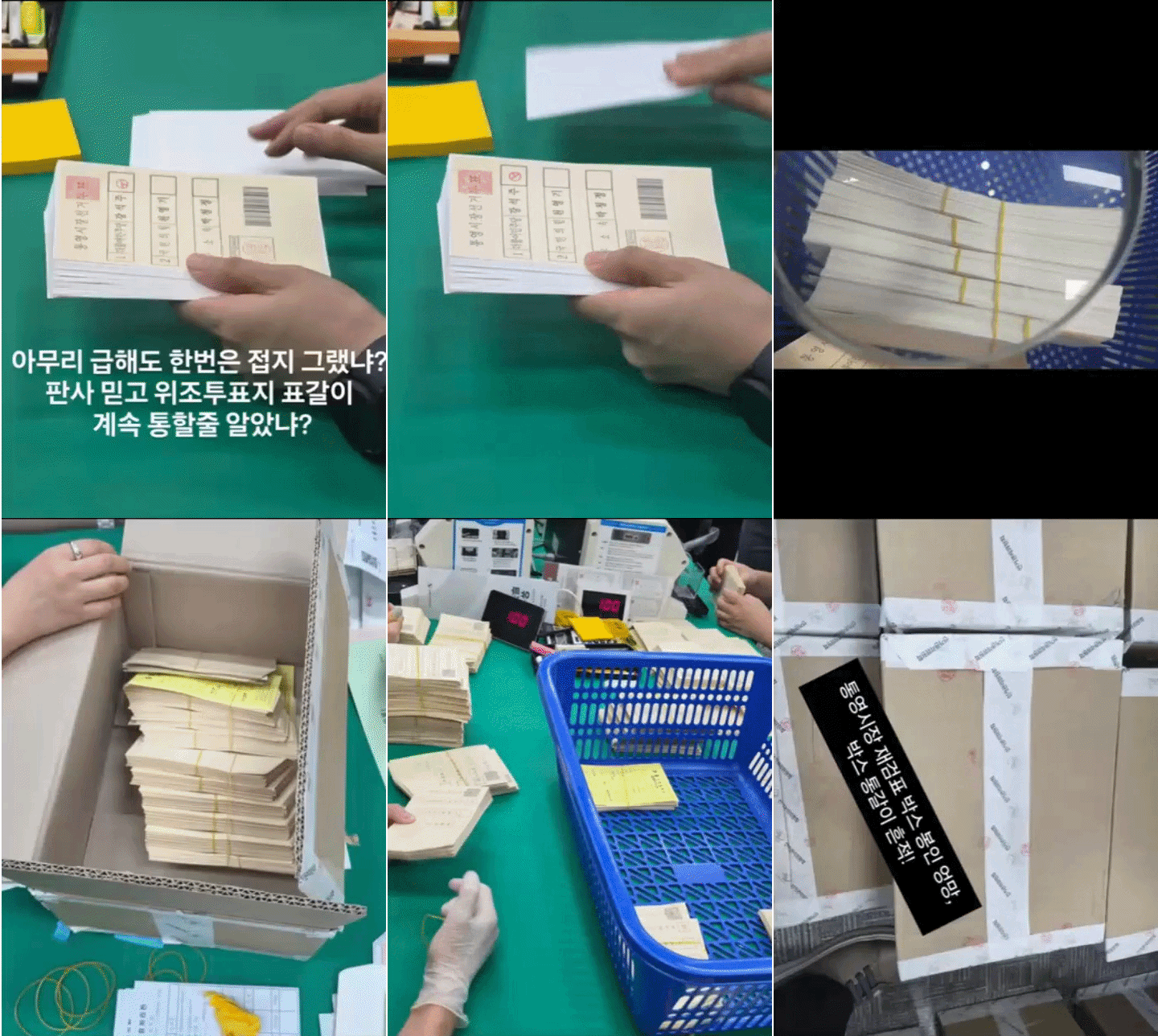 “Ignoring crisp ballots and damaged seals”… Tongyeong mayoral recount concludes with ‘no change in outcome,’ leaving suspicions and public outrage behind
Suspected counterfeit ballots discovered in Tongyeong [GIF from social media of Representative Hwang Kyo-ahn / Attorney Park Joo-hyun]During a recount of the Tongyeong mayoral election in South Gyeong
“Ignoring crisp ballots and damaged seals”… Tongyeong mayoral recount concludes with ‘no change in outcome,’ leaving suspicions and public outrage behind
Suspected counterfeit ballots discovered in Tongyeong [GIF from social media of Representative Hwang Kyo-ahn / Attorney Park Joo-hyun]During a recount of the Tongyeong mayoral election in South Gyeong
 President Yoon, regarding the first-instance ruling on the Public Official Election Act: “An excessive political verdict that distorts the facts… We will appeal immediately.”
The first-instance sentencing hearing for President Yoon Suk Yeol regarding violations of the Public Official Election Act is being broadcast live at Seoul Station on the 27th. [Photo=Yonhap News]Pres
President Yoon, regarding the first-instance ruling on the Public Official Election Act: “An excessive political verdict that distorts the facts… We will appeal immediately.”
The first-instance sentencing hearing for President Yoon Suk Yeol regarding violations of the Public Official Election Act is being broadcast live at Seoul Station on the 27th. [Photo=Yonhap News]Pres
 WSJ: "SK Hynix ADR Premium Is a Sign of AI Trading Overheat"
Advertisement for SK Hynix ADR listing in New York's Times Square [Reuters=Yonhap News file photo]The Wall Street Journal (WSJ) has pointed out that the price of SK Hynix’s American Depositary Recei
WSJ: "SK Hynix ADR Premium Is a Sign of AI Trading Overheat"
Advertisement for SK Hynix ADR listing in New York's Times Square [Reuters=Yonhap News file photo]The Wall Street Journal (WSJ) has pointed out that the price of SK Hynix’s American Depositary Recei
 'Godfather of Japanese Mystery Novels' Keigo Higashino Passes Away After Battle with Cancer at 68
Famous Japanese mystery novelist Keigo Higashino [AFP=Yonhap News]It has been belatedly reported that Keigo Higashino, the "godfather of Japanese mystery novels" and author of bestsellers such as "The
'Godfather of Japanese Mystery Novels' Keigo Higashino Passes Away After Battle with Cancer at 68
Famous Japanese mystery novelist Keigo Higashino [AFP=Yonhap News]It has been belatedly reported that Keigo Higashino, the "godfather of Japanese mystery novels" and author of bestsellers such as "The
 [Park Pil-kyu Security Column] To the Ignorant Trying to Clothe a Beast in Sheep's Clothing
Rep. Kim Byung-joo of the Democratic Party of Korea [Photo=Yonhap News]“The Air Force Academy doesn't teach you how to fly a plane!” “The Army, Navy, and Air Force academies are exactly the
[Park Pil-kyu Security Column] To the Ignorant Trying to Clothe a Beast in Sheep's Clothing
Rep. Kim Byung-joo of the Democratic Party of Korea [Photo=Yonhap News]“The Air Force Academy doesn't teach you how to fly a plane!” “The Army, Navy, and Air Force academies are exactly the
 [Issue Diagnosis] Two Effects of the Election Petition Review
 [Photo] Evidence of Election Fraud Flooding U.S. Media… Trump Had 2.7 Million Votes Stolen
 [Video] U.S. Semiquincentennial Air Show... 'Art in the Sky' streaks across New York
 [Editorial Cartoon] A Draconian Law That Undermines Freedom of Expression

 List
List