This Year's 'Revenue Shortfall' Projected at 12.5 Trillion Won... Another 2 Trillion Won Increase in Three Months
National Tax Revenue Expected to Fall Below 370 Trillion Won... Impacted by Decreased Import Value-Added Tax, etc.
Revenue Shortfall for the Third Consecutive Year Virtually Confirmed... Government Plans to Respond with 'Unspent Funds'
 National Tax Revenue (PG) [Produced by Lee Tae-ho] Photo Composite · Illustration
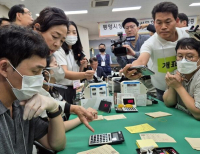
The scale of this year's revenue shortfall is projected to be approximately 2 trillion won larger than the 10 trillion won estimated three months ago.
The increase in the revenue shortfall is attributed to a decrease in import value-added tax due to the fall in exchange rates and an expansion of income tax refunds for individuals like delivery riders.
The Ministry of Economy and Finance announced the revised national tax revenue projection results on the 24th.
According to the revised projections, this year's national tax revenue is expected to be 369.9 trillion won. This is 33.4 trillion won more than last year's settlement (336.5 trillion won), which saw a significant revenue shortfall due to poor corporate performance.
However, following a reduction of 10.3 trillion won from the initial revenue budget in June, an additional 2.2 trillion won was cut in the subsequent three months, expanding the projected revenue shortfall for this year to approximately 12.5 trillion won.
This effectively confirms a revenue shortfall for the third consecutive year, following 56.4 trillion won in 2023 and 30.8 trillion won in 2024.
The government's initial projection for this year's national tax revenue, announced when the budget was compiled last year, was 382.4 trillion won.
However, economic slowdown and sluggish corporate performance following the 12.13 emergency economic measures, along with a worsening consumer sentiment, continued. In June, the government lowered its revenue projection to 372.1 trillion won through the second supplementary budget.
After the second supplementary budget, the decline in exchange rates became a concern. The average won/dollar exchange rate, which was 1,439 won from January to May, dropped to 1,379 won from June to August.
The fall in exchange rates led to a decrease in import value-added tax revenue. The government expected value-added tax revenue to decrease by 2.4 trillion won compared to the second supplementary budget.
 Strong Dollar (PG) [Illustration by Yang On-ha]
The extension of the temporary reduction in fuel taxes to alleviate the burden of fuel costs is expected to further reduce transportation tax revenue by 900 billion won.
Comprehensive income tax revenue will also decrease by 1.1 trillion won due to policies that expand income tax refunds for individuals engaged in low-income services, such as delivery riders.
The projection for earned income tax has increased by 2.8 trillion won compared to the second supplementary budget, influenced by factors such as an increase in performance-based bonuses.
The special tax for agriculture and fisheries, levied on stock transactions, is expected to generate an additional 1.1 trillion won due to the recent stock market boom. However, the securities transaction tax on KOSDAQ market transactions is predicted to decrease by 700 billion won due to a decline in transaction volume.
Breaking down national tax revenue by accounting type, general accounts (358.2 trillion won) are expected to decrease by 3.2 trillion won from the second supplementary budget, while special accounts (11.7 trillion won) are projected to increase by 1.1 trillion won.
Despite the larger revenue shortfall, the government states that there are no significant issues with fiscal operations.
Considering that the government's unspent budget (unspent funds) annually amounts to 6-7 trillion won, the revenue shortfall is within a manageable level that can be addressed without significant new financial measures.
The government is pursuing an amendment to the State Finance Act to mandate a reassessment of revenue projections every September.
A Ministry of Economy and Finance official stated, "If we consider this year's revenue shortfall to be 12.5 trillion won, the error rate is about 3.3%," adding, "We believe this is relatively low compared to the average error rate of 4.8% over the past 10 years." Yonhap News

 Bill Pulte to Restructure ‘Deep State’… Announces 4th Round of Layoffs at the Office of the Director of National Intelligence
Acting Director of National Intelligence Bill Pulte announced Sunday that he has carried out a fourth "deliberate and measured" reduction in personnel since taking office on June 19, as part of the Tr
Bill Pulte to Restructure ‘Deep State’… Announces 4th Round of Layoffs at the Office of the Director of National Intelligence
Acting Director of National Intelligence Bill Pulte announced Sunday that he has carried out a fourth "deliberate and measured" reduction in personnel since taking office on June 19, as part of the Tr
 First U.S. Ambassador of Trump's Second Term to Arrive This Week… Will It Provide Momentum to Resolve Pending Issues?
U.S. Ambassador to South Korea Michelle Steel speaks at the opening ceremony of the Korea-U.S. Shipbuilding Cooperation Center held at the Mayflower Hotel in Washington, D.C., on the 23rd (local time)
First U.S. Ambassador of Trump's Second Term to Arrive This Week… Will It Provide Momentum to Resolve Pending Issues?
U.S. Ambassador to South Korea Michelle Steel speaks at the opening ceremony of the Korea-U.S. Shipbuilding Cooperation Center held at the Mayflower Hotel in Washington, D.C., on the 23rd (local time)
 President Yoon, regarding the first-instance ruling on the Public Official Election Act: “An excessive political verdict that distorts the facts… We will appeal immediately.”
The first-instance sentencing hearing for President Yoon Suk Yeol regarding violations of the Public Official Election Act is being broadcast live at Seoul Station on the 27th. [Photo=Yonhap News]Pres
President Yoon, regarding the first-instance ruling on the Public Official Election Act: “An excessive political verdict that distorts the facts… We will appeal immediately.”
The first-instance sentencing hearing for President Yoon Suk Yeol regarding violations of the Public Official Election Act is being broadcast live at Seoul Station on the 27th. [Photo=Yonhap News]Pres
 91% of Net Influx of MZ Generation Goes to Seoul Metropolitan Area… Population Migration Also Shows 'K-shaped Polarization' by Industry
[Provided by Leaders Index]Over the past four years, the MZ generation population has become increasingly concentrated in the Seoul metropolitan area and the Chungcheong region. While cities cen
91% of Net Influx of MZ Generation Goes to Seoul Metropolitan Area… Population Migration Also Shows 'K-shaped Polarization' by Industry
[Provided by Leaders Index]Over the past four years, the MZ generation population has become increasingly concentrated in the Seoul metropolitan area and the Chungcheong region. While cities cen
 'Godfather of Japanese Mystery Novels' Keigo Higashino Passes Away After Battle with Cancer at 68
Famous Japanese mystery novelist Keigo Higashino [AFP=Yonhap News]It has been belatedly reported that Keigo Higashino, the "godfather of Japanese mystery novels" and author of bestsellers such as "The
'Godfather of Japanese Mystery Novels' Keigo Higashino Passes Away After Battle with Cancer at 68
Famous Japanese mystery novelist Keigo Higashino [AFP=Yonhap News]It has been belatedly reported that Keigo Higashino, the "godfather of Japanese mystery novels" and author of bestsellers such as "The
 [Park Pil-kyu Security Column] To the Ignorant Trying to Clothe a Beast in Sheep's Clothing
Rep. Kim Byung-joo of the Democratic Party of Korea [Photo=Yonhap News]“The Air Force Academy doesn't teach you how to fly a plane!” “The Army, Navy, and Air Force academies are exactly the
[Park Pil-kyu Security Column] To the Ignorant Trying to Clothe a Beast in Sheep's Clothing
Rep. Kim Byung-joo of the Democratic Party of Korea [Photo=Yonhap News]“The Air Force Academy doesn't teach you how to fly a plane!” “The Army, Navy, and Air Force academies are exactly the
 [Issue Diagnosis] Two Effects of the Election Petition Review
 [Photo] Evidence of Election Fraud Flooding U.S. Media… Trump Had 2.7 Million Votes Stolen
 [Video] U.S. Semiquincentennial Air Show... 'Art in the Sky' streaks across New York
 [Editorial Cartoon] A Draconian Law That Undermines Freedom of Expression

 List
List