Guest Columnist. Korea Military Academy, Class of '84 President Lee Jae-myung declared a 'return to a democratic Republic of Korea' at the UN General Assembly, proposing a three-stage denuclearization roadmap based on 'nuclear realism' and cooperation on 'AI for All'. However, remarks on 'abandoning absorption unification' and 'halting North Korean leaflet distribution' have led to controversy for undermining the constitutional principle of peaceful unification and 'destroying the nation's constitution'.
Furthermore, at the New York Investment Summit, with the aim of resolving geopolitical risks on the Korean Peninsula and improving the undervaluation of the Korean stock market, he acknowledged North Korea's nuclear weapons and proposed 'halting production and exports'. After delivering a shock, seemingly as Kim Jong-un's spokesperson, he designated President Trump as North Korea's sole negotiation partner.
The Lee Jae-myung administration's 'nuclear realism' and 'Trump leverage' strategies are a dangerous independent path that goes against the tide of the international order. It recalls the history of the fall of Joseon, where the Korean Empire lost its country due to corruption and misjudgment amidst the hegemonic competition of great powers, and the tragic end of Yugoslavia under 'Tito', who relied on charisma and pursued a non-aligned path, only to face a brutal civil war and national disintegration.
1. A Runaway Train Going in the Wrong Direction
The policies currently being pursued by the Lee Jae-myung administration directly conflict with the US foreign and security policy and the free market values of the West, both in terms of security and economy. The situation, which deepens the national crisis, is reminiscent of the 1985 film 'Runaway Train'. The movie depicts a railway company attempting a derailment and the passengers fighting for survival on board.
The President's argument that we should acknowledge the uncomfortable truth that "North Korea has sufficiently secured nuclear weapons" and lower the goal from 'complete denuclearization' to 'practical control' through 'halting production' is merely submissive pacifism. This is akin to laying down new tracks in the opposite direction, abandoning the existing ones.
The moment we effectively acknowledge North Korea's nuclear armament and negotiate its 'control', we become destroyers of the nuclear non-proliferation regime and assume the permanent risk of living under the threat of an enemy's nuclear weapons. 'Nuclear realism', which seeks to acknowledge North Korea's nuclear weapons, directly clashes with the security principle of supporting peace through strength.
2. An Anarchic Train with No Engineer
Under the guise of restoring the September 19 Military Agreement, the consideration of halting military live-fire drills near the MDL entirely negates the military's reason for existence. Despite legislator Jin Jong-oh's exposure that over 100 homemade firearms and more than 20,000 competition-grade live rounds are being illegally distributed, the government offers no response. It appears indifferent to the safety of the people.
This is reminiscent of the 2010 film 'Unstoppable'. In the movie, a freight train, number 777, departs without an engineer due to a mechanic's carelessness, carrying toxic chemicals and speeding towards a city at over 100 km/h. A veteran engineer risks his life to attempt a final method to stop the runaway train.
The strategy of designating President Trump as "the only party North Korea can trust" and using his 'destructive negotiation power' as a security lever is truly bizarre. The core of the ROK-US alliance is 'shared values and predictability', yet President Lee is opting for 'short-term transactions and uncertainty'. While South Korea positions itself as a 'pacemaker' to mediate between Trump's obsession with a 'big deal' and North Korea's 'regime safety', any repercussions from a failed negotiation will directly hit South Korea's security and economy.
3. A Zombie Train with an Unknown Direction
President Lee Jae-myung stated 'protecting America and enriching Korea' in the US, while domestically advocating for self-reliant defense and calling reliance on foreign militaries subservient. These oscillating remarks are reminiscent of the 2016 film 'Train to Busan'. The film is a disaster movie where the KTX train, a confined space, descends into chaos due to a zombie virus, and passengers fight desperately to reach the safe city of Busan.
The attempt to strengthen economic relations with China, contrary to the US-led demand to exclude China from supply chains, creates cracks in ROK-US economic security cooperation and ultimately increases the risk of isolation from both sides. Maintaining the nuclear phase-out policy runs counter to the values of Western nations that prioritize stable energy supply and free market economic principles. These policies are a dangerous gamble that abandons security principles and alliance trust, leading the nation's destiny to ruin.
4. A Train Going in the Wrong Direction Must Be Stopped Urgently
Numerous pro-China policies that appear to be instigated by China, 'giveaway' policies that deplete the national treasury, voluntary dismantling of security under the guise of peace, and a policy of 'de-alliance balancing' are like a 'runaway train going in the wrong direction', fundamentally destroying the foundation for the survival of the Republic of Korea under the guise of pragmatism. If left unchecked, it will collide head-on with the security defenses. If the security steering wheel, which is going in the wrong direction, is not urgently turned back, there will be no future for the Republic of Korea.
We reject submissive catastrophe. It is possible that if we do not expel the evil with our own strength, we will witness a 'New Acheson Line' where we are excluded from America's security umbrella. With unified strength, we must stop the 'train going in the wrong direction' and return the nation's track to the right direction, based on principles and alliances. We believe in the greatness of our people.

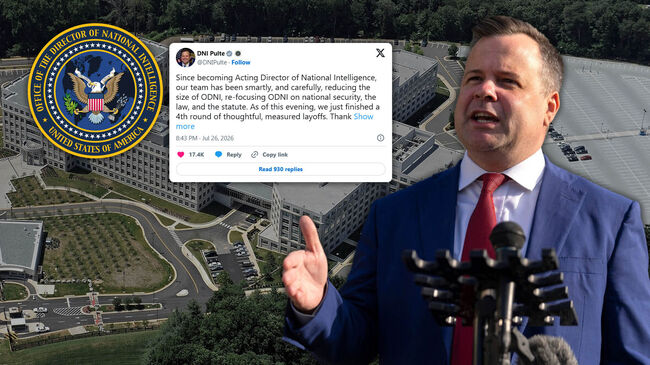 Bill Pulte to Restructure ‘Deep State’… Announces 4th Round of Layoffs at the Office of the Director of National Intelligence
Acting Director of National Intelligence Bill Pulte announced Sunday that he has carried out a fourth "deliberate and measured" reduction in personnel since taking office on June 19, as part of the Tr
Bill Pulte to Restructure ‘Deep State’… Announces 4th Round of Layoffs at the Office of the Director of National Intelligence
Acting Director of National Intelligence Bill Pulte announced Sunday that he has carried out a fourth "deliberate and measured" reduction in personnel since taking office on June 19, as part of the Tr
 First U.S. Ambassador of Trump's Second Term to Arrive This Week… Will It Provide Momentum to Resolve Pending Issues?
U.S. Ambassador to South Korea Michelle Steel speaks at the opening ceremony of the Korea-U.S. Shipbuilding Cooperation Center held at the Mayflower Hotel in Washington, D.C., on the 23rd (local time)
First U.S. Ambassador of Trump's Second Term to Arrive This Week… Will It Provide Momentum to Resolve Pending Issues?
U.S. Ambassador to South Korea Michelle Steel speaks at the opening ceremony of the Korea-U.S. Shipbuilding Cooperation Center held at the Mayflower Hotel in Washington, D.C., on the 23rd (local time)
 President Yoon, regarding the first-instance ruling on the Public Official Election Act: “An excessive political verdict that distorts the facts… We will appeal immediately.”
The first-instance sentencing hearing for President Yoon Suk Yeol regarding violations of the Public Official Election Act is being broadcast live at Seoul Station on the 27th. [Photo=Yonhap News]Pres
President Yoon, regarding the first-instance ruling on the Public Official Election Act: “An excessive political verdict that distorts the facts… We will appeal immediately.”
The first-instance sentencing hearing for President Yoon Suk Yeol regarding violations of the Public Official Election Act is being broadcast live at Seoul Station on the 27th. [Photo=Yonhap News]Pres
 91% of Net Influx of MZ Generation Goes to Seoul Metropolitan Area… Population Migration Also Shows 'K-shaped Polarization' by Industry
[Provided by Leaders Index]Over the past four years, the MZ generation population has become increasingly concentrated in the Seoul metropolitan area and the Chungcheong region. While cities cen
91% of Net Influx of MZ Generation Goes to Seoul Metropolitan Area… Population Migration Also Shows 'K-shaped Polarization' by Industry
[Provided by Leaders Index]Over the past four years, the MZ generation population has become increasingly concentrated in the Seoul metropolitan area and the Chungcheong region. While cities cen
 'Godfather of Japanese Mystery Novels' Keigo Higashino Passes Away After Battle with Cancer at 68
Famous Japanese mystery novelist Keigo Higashino [AFP=Yonhap News]It has been belatedly reported that Keigo Higashino, the "godfather of Japanese mystery novels" and author of bestsellers such as "The
'Godfather of Japanese Mystery Novels' Keigo Higashino Passes Away After Battle with Cancer at 68
Famous Japanese mystery novelist Keigo Higashino [AFP=Yonhap News]It has been belatedly reported that Keigo Higashino, the "godfather of Japanese mystery novels" and author of bestsellers such as "The
 [Park Pil-kyu Security Column] To the Ignorant Trying to Clothe a Beast in Sheep's Clothing
Rep. Kim Byung-joo of the Democratic Party of Korea [Photo=Yonhap News]“The Air Force Academy doesn't teach you how to fly a plane!” “The Army, Navy, and Air Force academies are exactly the
[Park Pil-kyu Security Column] To the Ignorant Trying to Clothe a Beast in Sheep's Clothing
Rep. Kim Byung-joo of the Democratic Party of Korea [Photo=Yonhap News]“The Air Force Academy doesn't teach you how to fly a plane!” “The Army, Navy, and Air Force academies are exactly the
 [Issue Diagnosis] Two Effects of the Election Petition Review
 [Photo] Evidence of Election Fraud Flooding U.S. Media… Trump Had 2.7 Million Votes Stolen
 [Video] U.S. Semiquincentennial Air Show... 'Art in the Sky' streaks across New York
 [Editorial Cartoon] A Draconian Law That Undermines Freedom of Expression

 List
List