The three winners of this year's Nobel Prize in Physiology or Medicine. Yonhap News.
This year’s Nobel Prize in Physiology or Medicine has been awarded to three life scientists—Mary E. Brunkow (64) and Fred Ramsdell (65) of the United States, and Shimon Sakaguchi (74) of Japan—for their contributions to human immunology research through discoveries related to peripheral immune tolerance.
The Nobel Assembly at the Karolinska Institute in Sweden announced on the 6th (local time) that these three individuals were selected as the recipients of this year’s prize.
Brunkow is a senior program manager at the Institute for Systems Biology in Seattle, while Ramsdell serves as a scientific advisor at Sonoma Biotherapeutics in San Francisco. Sakaguchi is a distinguished professor at Osaka University in Japan.
They identified the existence of "regulatory T cells," the guardians of the immune system that prevent immune cells from attacking the body's own tissues.
The Nobel Committee explained that their findings revealed "how the human immune system is controlled."
While the human immune system is incredibly powerful, it can attack our own organs if not properly regulated.
Regulatory T cells serve as guardians of the immune system, ensuring that it distinguishes targets correctly so as not to cause self-inflicted damage.
These cells monitor other immune cells and regulate the immune system to attack external invaders while recognizing the body's own tissues as objects of "tolerance."
In the past, the prevailing theory was that this immune tolerance occurred solely through "central tolerance" generated in the thymus.
However, the validation of regulatory T cells through the laureates' research opened a new field of study known as "peripheral immune tolerance."
Building on this research, the development of treatments for cancer and autoimmune diseases is being accelerated. These findings can also be utilized to improve the success rates of organ transplants.
Olle Kämpe, chairman of the Nobel Committee, stated, "Their discovery has played a decisive role in understanding how the immune system works and why we do not all suffer from severe autoimmune diseases."
The discovery of regulatory T cells was made possible by linking the key findings of Sakaguchi with those of Brunkow and Ramsdell.
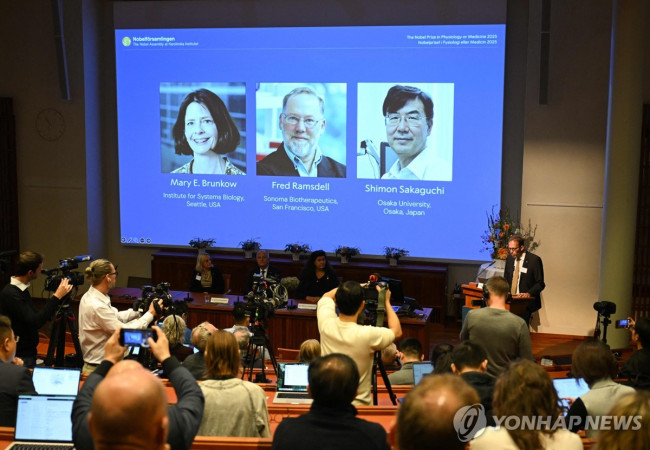 The announcement of the Nobel Prize in Physiology or Medicine at the Karolinska Institute in Stockholm. Yonhap News.
First, in 1995, Sakaguchi discovered a new type of immune cell that protects the body from autoimmune diseases.
Subsequently, in 2001, Brunkow and Ramsdell identified genetic mutations in mice that frequently developed autoimmune diseases and determined that similar genetic mutations cause autoimmune disorders in humans as well.
Two years later, Sakaguchi linked his own research with that of Brunkow and Ramsdell, confirming that the immune cells discovered in 1995 were connected to the genetic mutations identified in 2001.
The Nobel Committee explained that this confirmed the existence of regulatory T cells.
Thomas Perlmann, secretary-general of the Nobel Committee, reported that during the notification call, Sakaguchi expressed his deep gratitude, calling it "a great honor."
However, Perlmann noted that they were unable to reach the other two laureates by phone due to time differences and other reasons, and had to leave voice messages instead.
As the 116th recipients of the Nobel Prize in Physiology or Medicine, the trio will share the prize money of 11 million Swedish kronor (approximately 1.64 billion Korean won).
Beginning with the Physiology or Medicine prize, the Nobel Committee will announce the winners for Physics on the 7th, Chemistry on the 8th, Literature on the 9th, Peace on the 10th, and Economics on the 13th.
Yonhap News

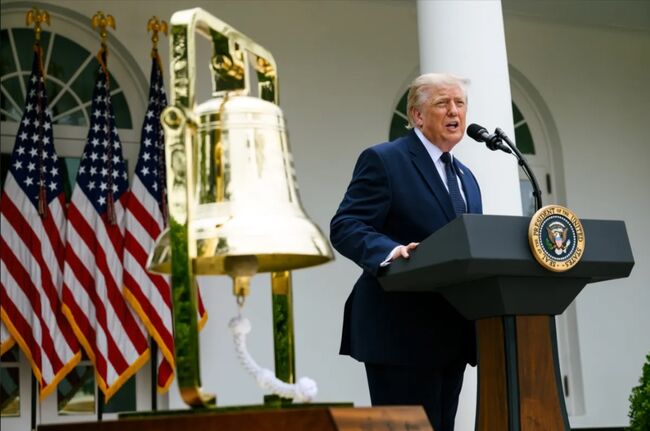 Trump pressures for rate cut again ahead of FOMC... "Should be the lowest in the world"
U.S. President Donald Trump. [Photo = The White House] U.S. President Donald Trump once again pressured the Federal Reserve, the U.S. central bank, to lower interest rates on the 27th (local time
Trump pressures for rate cut again ahead of FOMC... "Should be the lowest in the world"
U.S. President Donald Trump. [Photo = The White House] U.S. President Donald Trump once again pressured the Federal Reserve, the U.S. central bank, to lower interest rates on the 27th (local time
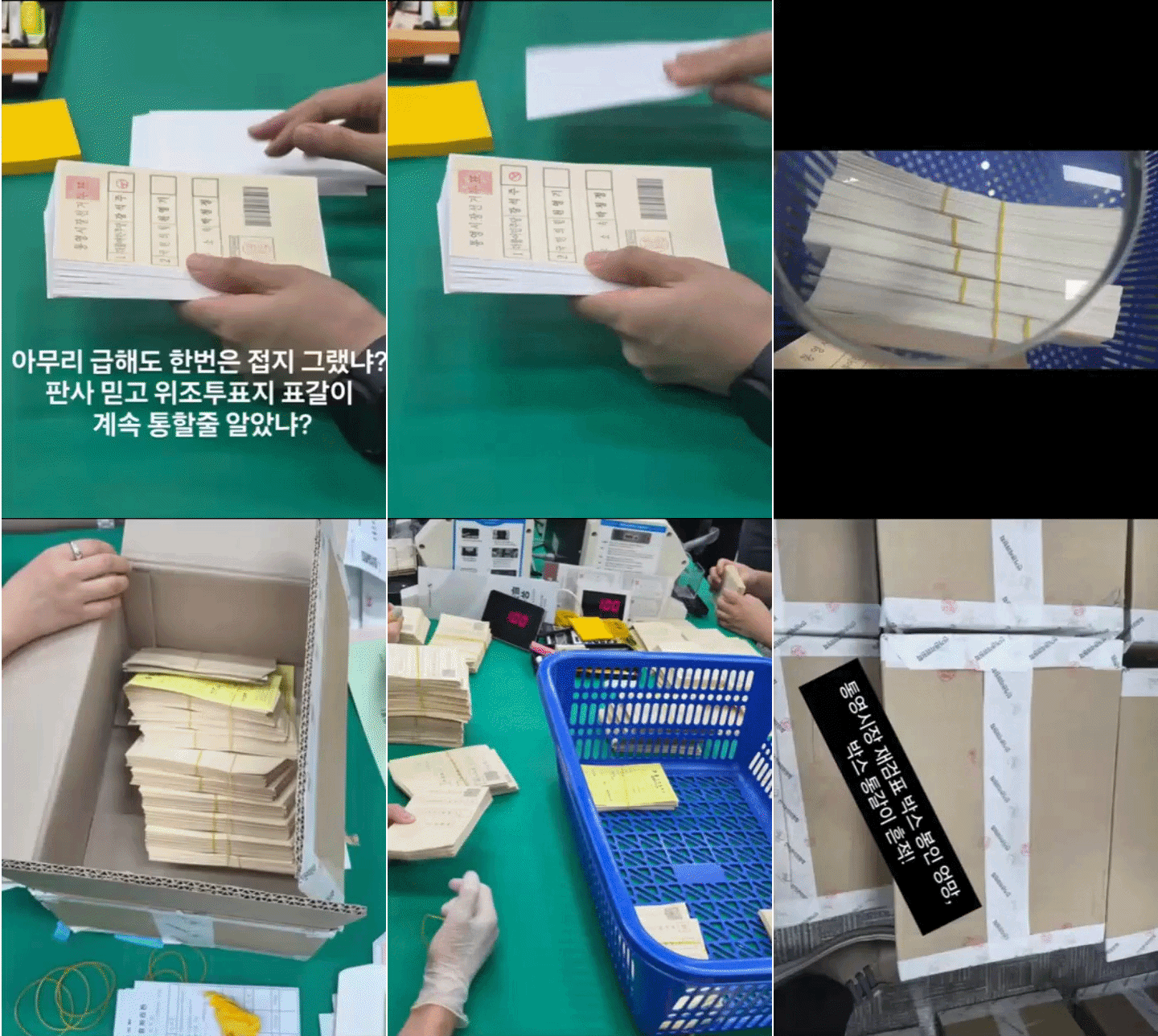 “Ignoring crisp ballots and damaged seals”… Tongyeong mayoral recount concludes with ‘no change in outcome,’ leaving suspicions and public outrage behind
Suspected counterfeit ballots discovered in Tongyeong [GIF from social media of Representative Hwang Kyo-ahn / Attorney Park Joo-hyun]During a recount of the Tongyeong mayoral election in South Gyeong
“Ignoring crisp ballots and damaged seals”… Tongyeong mayoral recount concludes with ‘no change in outcome,’ leaving suspicions and public outrage behind
Suspected counterfeit ballots discovered in Tongyeong [GIF from social media of Representative Hwang Kyo-ahn / Attorney Park Joo-hyun]During a recount of the Tongyeong mayoral election in South Gyeong
 President Yoon, regarding the first-instance ruling on the Public Official Election Act: “An excessive political verdict that distorts the facts… We will appeal immediately.”
The first-instance sentencing hearing for President Yoon Suk Yeol regarding violations of the Public Official Election Act is being broadcast live at Seoul Station on the 27th. [Photo=Yonhap News]Pres
President Yoon, regarding the first-instance ruling on the Public Official Election Act: “An excessive political verdict that distorts the facts… We will appeal immediately.”
The first-instance sentencing hearing for President Yoon Suk Yeol regarding violations of the Public Official Election Act is being broadcast live at Seoul Station on the 27th. [Photo=Yonhap News]Pres
 WSJ: "SK Hynix ADR Premium Is a Sign of AI Trading Overheat"
Advertisement for SK Hynix ADR listing in New York's Times Square [Reuters=Yonhap News file photo]The Wall Street Journal (WSJ) has pointed out that the price of SK Hynix’s American Depositary Recei
WSJ: "SK Hynix ADR Premium Is a Sign of AI Trading Overheat"
Advertisement for SK Hynix ADR listing in New York's Times Square [Reuters=Yonhap News file photo]The Wall Street Journal (WSJ) has pointed out that the price of SK Hynix’s American Depositary Recei
 'Godfather of Japanese Mystery Novels' Keigo Higashino Passes Away After Battle with Cancer at 68
Famous Japanese mystery novelist Keigo Higashino [AFP=Yonhap News]It has been belatedly reported that Keigo Higashino, the "godfather of Japanese mystery novels" and author of bestsellers such as "The
'Godfather of Japanese Mystery Novels' Keigo Higashino Passes Away After Battle with Cancer at 68
Famous Japanese mystery novelist Keigo Higashino [AFP=Yonhap News]It has been belatedly reported that Keigo Higashino, the "godfather of Japanese mystery novels" and author of bestsellers such as "The
 [Park Pil-kyu Security Column] To the Ignorant Trying to Clothe a Beast in Sheep's Clothing
Rep. Kim Byung-joo of the Democratic Party of Korea [Photo=Yonhap News]“The Air Force Academy doesn't teach you how to fly a plane!” “The Army, Navy, and Air Force academies are exactly the
[Park Pil-kyu Security Column] To the Ignorant Trying to Clothe a Beast in Sheep's Clothing
Rep. Kim Byung-joo of the Democratic Party of Korea [Photo=Yonhap News]“The Air Force Academy doesn't teach you how to fly a plane!” “The Army, Navy, and Air Force academies are exactly the
 [Issue Diagnosis] Two Effects of the Election Petition Review
 [Photo] Evidence of Election Fraud Flooding U.S. Media… Trump Had 2.7 Million Votes Stolen
 [Video] U.S. Semiquincentennial Air Show... 'Art in the Sky' streaks across New York
 [Editorial Cartoon] A Draconian Law That Undermines Freedom of Expression

 List
List