 Trump and Xi Jinping. AFP-Yonhap News.
The "war clouds" of conflict are gathering once again over U.S.-China relations, which have faced ups and downs since the start of Donald Trump's second term.
Initially, U.S. President Donald Trump and Chinese President Xi Jinping were expected to meet on the sidelines of the Asia-Pacific Economic Cooperation (APEC) summit, which begins on the 31st (local time) in Gyeongju, to discuss matters such as "extending the tariff truce." However, the situation is changing rapidly.
This follows China's move to play the card of rare earth export controls, which prompted President Trump to retaliate on the 10th (local time) with a threat of ultra-high tariffs on China (an additional 100% on top of existing tariffs) and export controls on key software (both effective November 1).
When asked by reporters that day about items the U.S. might target for export controls against China, President Trump suggested that aircraft parts could be included, stating, "We have many things, including 'big things' like aircraft. They (China) have many Boeing aircraft, and they need (U.S.-made) parts for them."
Furthermore, President Trump hinted at the possibility of canceling the meeting with President Xi, suggesting that there no longer seemed to be a reason for it despite the APEC summit.
There have been several ominous signs in U.S.-China relations recently.
In addition to halting imports of U.S. soybeans, China announced plans on the 9th to tighten export controls on rare earth alloys. On the 10th, it also announced that it would impose a "special port service fee" of 400 yuan (approx. 80,000 KRW) per net ton on U.S.-related vessels starting from the 14th.
This appeared to be a retaliatory measure by China, coming after the U.S. announced it would impose an entry fee of $50 (approx. 71,000 KRW) per ton on Chinese vessels starting the 14th, with plans for incremental increases.
Amidst this, news emerged that the Chinese government has also blocked the acquisition of the Israeli automotive chip design company (fabless) "Autotalks" by U.S. semiconductor firm Qualcomm.
Conversely, Bloomberg reported on the 9th that the U.S. Trump administration is considering measures to restrict the U.S. operations of "TP-Link," a multinational network equipment provider with headquarters in China, Singapore, and the U.S. The review is based on concerns regarding the company's relationship with the Chinese government.
On the same day, it was also reported that the U.S. Department of Transportation is pushing for a ban on Chinese airlines flying through Russian airspace to and from the United States.
While these actions could have been interpreted as "skirmishing" ahead of the U.S.-China summit, the atmosphere has rapidly chilled following President Trump's hardline stance on the 10th.
President Trump's decision to specifically single out the rare earth export control issue among China's series of measures is interpreted as his judgment that China is undermining the framework of the U.S.-China tariff truce agreement.
The U.S.-China "tariff truce" includes plans for each side to normalize the other's respective export controls on high-tech semiconductors and rare earths.
As President Trump has stated he is considering large-scale tariffs on China as retaliation, the possibility of a tariff war resurfacing before the expiration of the U.S.-China tariff truce in November cannot be ruled out.
However, President Trump suggested that the level of U.S. response could be adjusted based on China's subsequent actions, stating, "It depends on what they have to say about the hostile 'order' they just issued."
Given that both nations have much to lose if they drive their relations back into catastrophe after having managed them through the tariff war that unfolded as a "chicken game" in April, it is possible they will resolve the situation through back-channel contacts or by activating the Scott Bessent (U.S. Treasury Secretary)-He Lifeng (Chinese Vice Premier) line, potentially leading to a summit at APEC.
On the evening of the 10th, when asked by reporters about holding a summit at APEC, President Trump said, "I don't know if we'll do it, but I'm going there regardless," before adding, "I think we might have a meeting," keeping the possibility open.
Since China's rare earth export control measures and President Trump's threatened 100% tariff hike and software export controls are all set to begin on November 1, there is about a 20-day window for the two sides to find a compromise.
However, some analysts suggest this could be a precursor to a serious conflict that goes beyond mere posturing.
Above all, China’s attitude is different from that of Trump's first term.
During the first term, China agreed to trade deals involving massive increases in U.S. imports in the face of tariff pressure. Now, in the second term, having learned from that experience, China is standing up to the U.S. more equally. Finding rare earths as a decisive leverage card may be one reason why President Xi Jinping has gained confidence in dealing with the U.S.
It may be that China's intention is to no longer adopt a defensive posture in negotiations, going beyond merely maximizing its "leverage" ahead of the first U.S.-China summit of the second term.
Some analysts suggest that President Xi may believe that if an inevitable confrontation with President Trump is unavoidable, there is no point in delaying it indefinitely.
President Trump, having expressed strong displeasure over China's rare earth measures—which dampen his diplomatic achievements in mediating the Gaza war—may also be unlikely to back down easily.
Ultimately, it is clear that U.S.-China relations, which appeared to be in a managed state through the tariff truce and compromises regarding the potential sale of the TikTok platform, have reached a crossroads, facing a phase of acute conflict.
While attention is focused on whether China will retaliate against President Trump’s "additional 100% tariffs," if the two sides return to a "chicken game" of mutually imposing ultra-high tariffs, the blow to both nations and the global economy will be significant.
The sharp simultaneous drop in the New York stock market and cryptocurrency prices, such as Bitcoin, on the 10th reflects these market concerns.
If the conflict is not resolved by the time of the APEC summit and the meeting is canceled, it is expected to affect the Lee Jae-myung administration's efforts to use APEC to alleviate global trade tensions and create positive momentum for security in Northeast Asia.
Wendy Cutler, Vice President of the Asia Society Policy Institute (ASPI) and former Deputy U.S. Trade Representative, noted in a commentary sent to Yonhap News, "With the APEC summit only two weeks away, it is unclear whether either side is willing to de-escalate tensions to save the U.S.-China summit."
Cutler pointed out, "China is becoming increasingly aggressive, believing it has the upper hand in the bilateral relationship. Furthermore, it appears China has concluded that 'President Trump is so desperate for a face-to-face meeting with President Xi that he is willing to overlook the rare earth restrictions.'"
However, she added that by threatening new tariffs and the cancellation of the summit, President Trump has made it clear that he is not willing to overlook China's rare earth export controls, "demonstrating that both sides are capable of playing this game (of conflict over tariffs and export controls)."
Yonhap News

 Trump pressures for rate cut again ahead of FOMC... "Should be the lowest in the world"
U.S. President Donald Trump. [Photo = The White House] U.S. President Donald Trump once again pressured the Federal Reserve, the U.S. central bank, to lower interest rates on the 27th (local time
Trump pressures for rate cut again ahead of FOMC... "Should be the lowest in the world"
U.S. President Donald Trump. [Photo = The White House] U.S. President Donald Trump once again pressured the Federal Reserve, the U.S. central bank, to lower interest rates on the 27th (local time
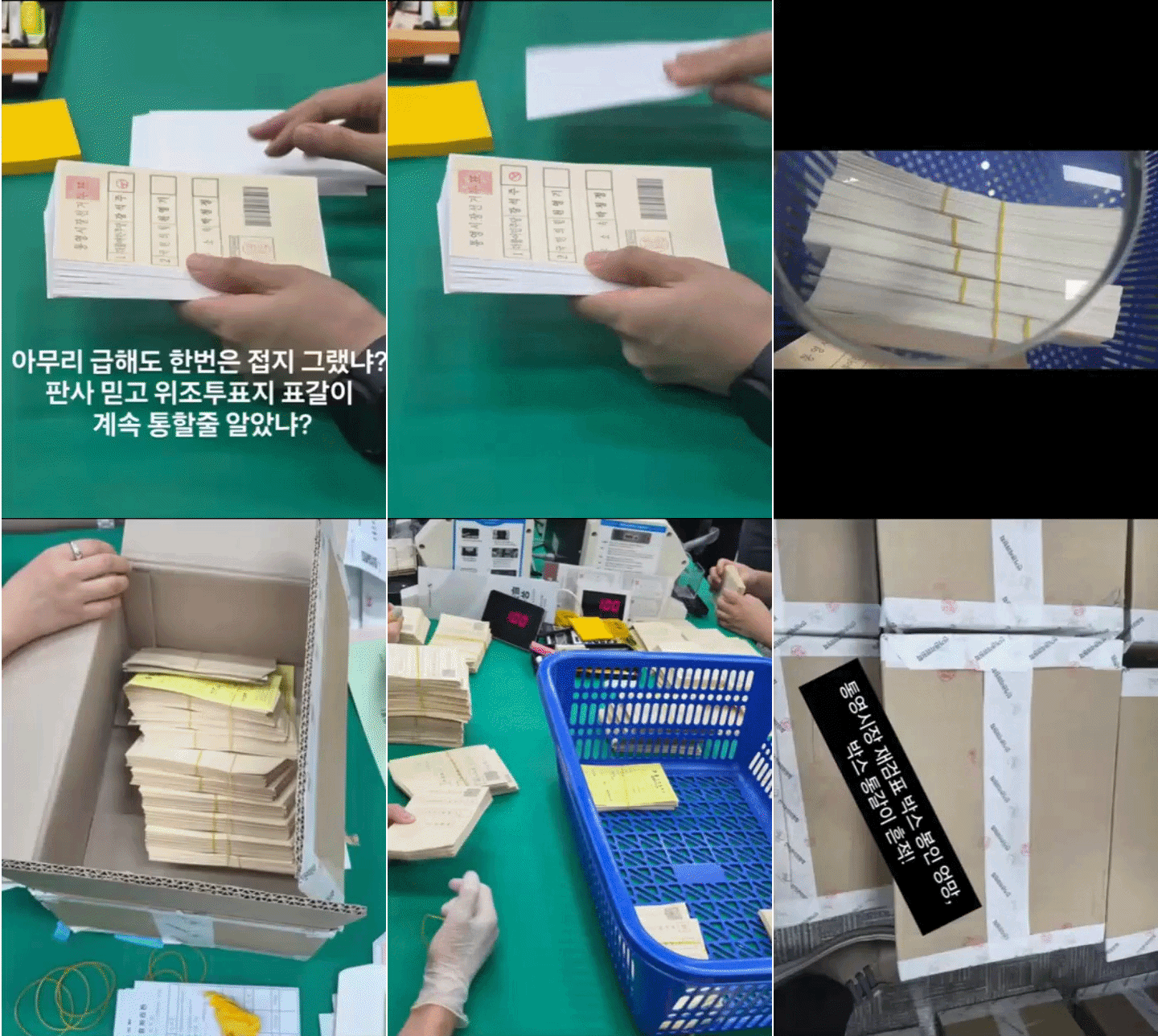 “Ignoring crisp ballots and damaged seals”… Tongyeong mayoral recount concludes with ‘no change in outcome,’ leaving suspicions and public outrage behind
Suspected counterfeit ballots discovered in Tongyeong [GIF from social media of Representative Hwang Kyo-ahn / Attorney Park Joo-hyun]During a recount of the Tongyeong mayoral election in South Gyeong
“Ignoring crisp ballots and damaged seals”… Tongyeong mayoral recount concludes with ‘no change in outcome,’ leaving suspicions and public outrage behind
Suspected counterfeit ballots discovered in Tongyeong [GIF from social media of Representative Hwang Kyo-ahn / Attorney Park Joo-hyun]During a recount of the Tongyeong mayoral election in South Gyeong
 President Yoon, regarding the first-instance ruling on the Public Official Election Act: “An excessive political verdict that distorts the facts… We will appeal immediately.”
The first-instance sentencing hearing for President Yoon Suk Yeol regarding violations of the Public Official Election Act is being broadcast live at Seoul Station on the 27th. [Photo=Yonhap News]Pres
President Yoon, regarding the first-instance ruling on the Public Official Election Act: “An excessive political verdict that distorts the facts… We will appeal immediately.”
The first-instance sentencing hearing for President Yoon Suk Yeol regarding violations of the Public Official Election Act is being broadcast live at Seoul Station on the 27th. [Photo=Yonhap News]Pres
 WSJ: "SK Hynix ADR Premium Is a Sign of AI Trading Overheat"
Advertisement for SK Hynix ADR listing in New York's Times Square [Reuters=Yonhap News file photo]The Wall Street Journal (WSJ) has pointed out that the price of SK Hynix’s American Depositary Recei
WSJ: "SK Hynix ADR Premium Is a Sign of AI Trading Overheat"
Advertisement for SK Hynix ADR listing in New York's Times Square [Reuters=Yonhap News file photo]The Wall Street Journal (WSJ) has pointed out that the price of SK Hynix’s American Depositary Recei
 'Godfather of Japanese Mystery Novels' Keigo Higashino Passes Away After Battle with Cancer at 68
Famous Japanese mystery novelist Keigo Higashino [AFP=Yonhap News]It has been belatedly reported that Keigo Higashino, the "godfather of Japanese mystery novels" and author of bestsellers such as "The
'Godfather of Japanese Mystery Novels' Keigo Higashino Passes Away After Battle with Cancer at 68
Famous Japanese mystery novelist Keigo Higashino [AFP=Yonhap News]It has been belatedly reported that Keigo Higashino, the "godfather of Japanese mystery novels" and author of bestsellers such as "The
 [Park Pil-kyu Security Column] To the Ignorant Trying to Clothe a Beast in Sheep's Clothing
Rep. Kim Byung-joo of the Democratic Party of Korea [Photo=Yonhap News]“The Air Force Academy doesn't teach you how to fly a plane!” “The Army, Navy, and Air Force academies are exactly the
[Park Pil-kyu Security Column] To the Ignorant Trying to Clothe a Beast in Sheep's Clothing
Rep. Kim Byung-joo of the Democratic Party of Korea [Photo=Yonhap News]“The Air Force Academy doesn't teach you how to fly a plane!” “The Army, Navy, and Air Force academies are exactly the
 [Issue Diagnosis] Two Effects of the Election Petition Review
 [Photo] Evidence of Election Fraud Flooding U.S. Media… Trump Had 2.7 Million Votes Stolen
 [Video] U.S. Semiquincentennial Air Show... 'Art in the Sky' streaks across New York
 [Editorial Cartoon] A Draconian Law That Undermines Freedom of Expression

 List
List









