- 'Defense Industry Essentials' Cobalt, Antimony, Tantalum, Scandium, etc… Pushing for Additional Rare Earth Procurement
 The Pentagon [AFP=Yonhap News]
The U.S. Department of Defense is pushing for a procurement project worth up to $1 billion (1.4 trillion won) to stockpile critical minerals essential for the defense industry, the Financial Times (FT) reported on the 12th (local time).
This measure comes in response to tightened export restrictions on various materials by China, which holds a dominant position in the critical minerals sector, and aims to reduce reliance on Chinese-led supply chains.
In particular, China has recently further intensified export controls on strategic minerals such as rare earths and related technologies. In response, U.S. President Donald Trump has warned that he would impose an additional 100% tariff on China.
Critical minerals are vital resources used in all weapon systems, radar, and missile detection technology. The U.S. Department of Defense considers these a top priority for stockpiling in the interest of national security.
According to the FT, this effort to strengthen mineral stockpiles is part of the Trump administration's broader critical minerals strategy and includes some metals that were not previously stockpiled.
Data from the Defense Logistics Agency (DLA), which operates under the Department of Defense, indicates that the minerals recently announced for procurement include up to $500 million in cobalt, up to $245 million in antimony, up to $100 million in tantalum, and up to $45 million in scandium. The agency is also considering the additional acquisition of rare earths, tungsten, bismuth, and indium.
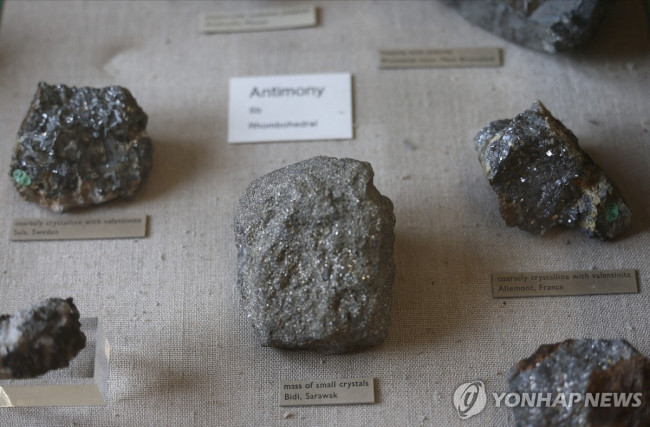 Antimony. Reuters=Yonhap News.
Commenting on this strategy, a defense industry executive stated, "The U.S. government recognizes the importance of critical minerals and intends to support domestic production capacity," adding, "While Western mineral stockpiling is still in its early stages, it is becoming increasingly focused."
The DLA currently maintains dozens of mineral types—including alloys, metals, rare earths, ores, and precious metals—in storage facilities across the country. As of 2023, the value of these assets is approximately $1.3 billion.
The Trump administration's tax cut bill, which serves as the basis for this procurement plan, includes a total budget of $7.5 billion to support critical minerals. Of that amount, $2 billion has been allocated as defense stockpile funds for the Department of Defense to execute between late 2026 and early 2027.
Furthermore, the tax cut bill allocates $5 billion for investments in critical mineral supply chains and $500 million for a Department of Defense credit program to incentivize private investment.
Some in the market are expressing concerns that the large-scale U.S. mineral stockpiling strategy could lead to supply chain overheating and sharp price spikes.
For instance, the U.S. Department of Defense is considering the acquisition of 222 tons of indium, a figure nearly equivalent to the entire U.S. annual consumption of 250 tons as of last year.
Kristina Belda, a researcher at commodity intelligence firm Argus Media, explained, "There are opinions in the market that it is unrealistic for the DLA to meet these procurement volumes within the proposed timeframe," adding, "Most of the requested volumes exceed total U.S. annual production and imports."
Yonhap News
What do you think of this article?

 Trump pressures for rate cut again ahead of FOMC... "Should be the lowest in the world"
U.S. President Donald Trump. [Photo = The White House] U.S. President Donald Trump once again pressured the Federal Reserve, the U.S. central bank, to lower interest rates on the 27th (local time
Trump pressures for rate cut again ahead of FOMC... "Should be the lowest in the world"
U.S. President Donald Trump. [Photo = The White House] U.S. President Donald Trump once again pressured the Federal Reserve, the U.S. central bank, to lower interest rates on the 27th (local time
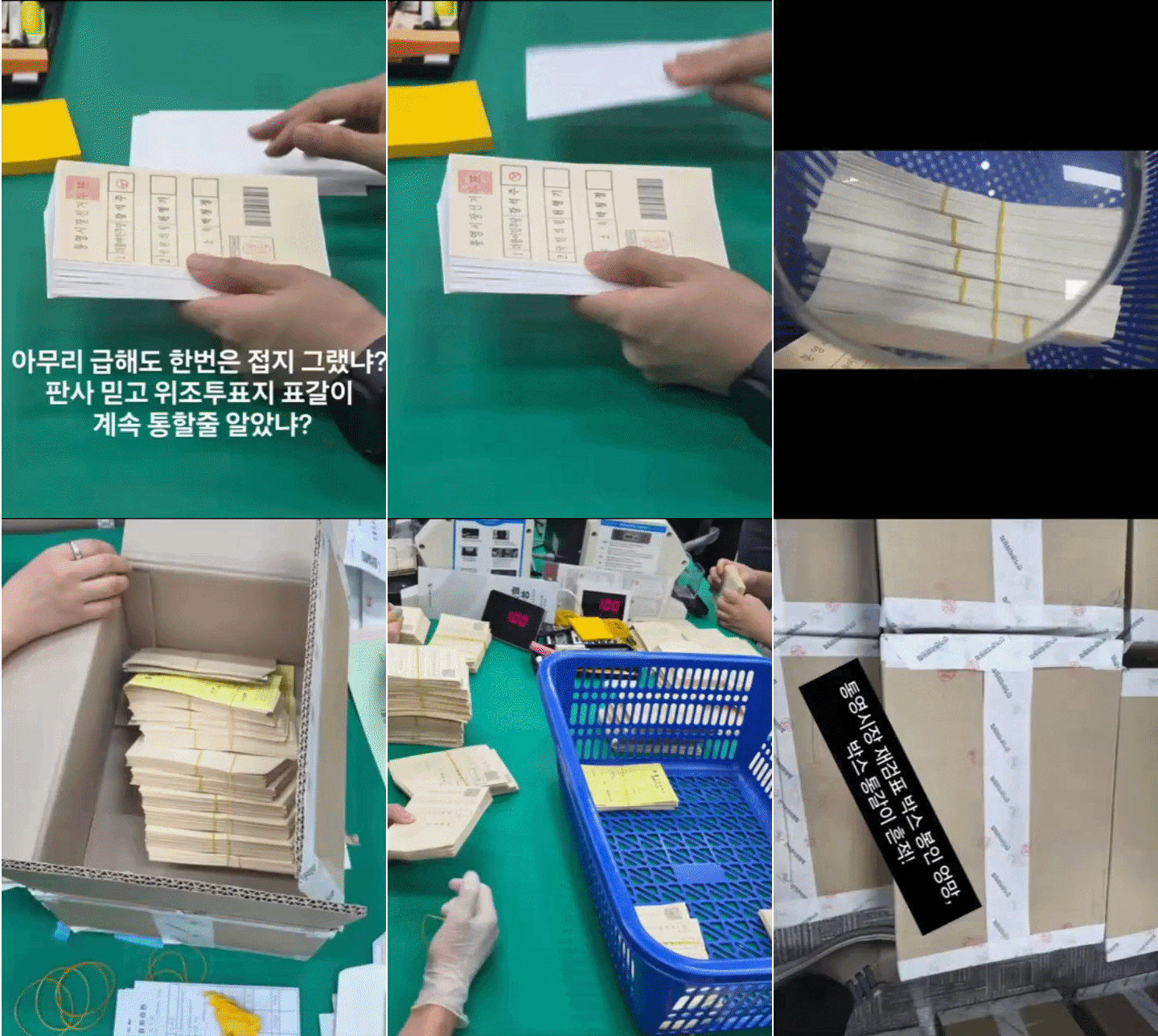 “Ignoring crisp ballots and damaged seals”… Tongyeong mayoral recount concludes with ‘no change in outcome,’ leaving suspicions and public outrage behind
Suspected counterfeit ballots discovered in Tongyeong [GIF from social media of Representative Hwang Kyo-ahn / Attorney Park Joo-hyun]During a recount of the Tongyeong mayoral election in South Gyeong
“Ignoring crisp ballots and damaged seals”… Tongyeong mayoral recount concludes with ‘no change in outcome,’ leaving suspicions and public outrage behind
Suspected counterfeit ballots discovered in Tongyeong [GIF from social media of Representative Hwang Kyo-ahn / Attorney Park Joo-hyun]During a recount of the Tongyeong mayoral election in South Gyeong
 President Yoon, regarding the first-instance ruling on the Public Official Election Act: “An excessive political verdict that distorts the facts… We will appeal immediately.”
The first-instance sentencing hearing for President Yoon Suk Yeol regarding violations of the Public Official Election Act is being broadcast live at Seoul Station on the 27th. [Photo=Yonhap News]Pres
President Yoon, regarding the first-instance ruling on the Public Official Election Act: “An excessive political verdict that distorts the facts… We will appeal immediately.”
The first-instance sentencing hearing for President Yoon Suk Yeol regarding violations of the Public Official Election Act is being broadcast live at Seoul Station on the 27th. [Photo=Yonhap News]Pres
 WSJ: "SK Hynix ADR Premium Is a Sign of AI Trading Overheat"
Advertisement for SK Hynix ADR listing in New York's Times Square [Reuters=Yonhap News file photo]The Wall Street Journal (WSJ) has pointed out that the price of SK Hynix’s American Depositary Recei
WSJ: "SK Hynix ADR Premium Is a Sign of AI Trading Overheat"
Advertisement for SK Hynix ADR listing in New York's Times Square [Reuters=Yonhap News file photo]The Wall Street Journal (WSJ) has pointed out that the price of SK Hynix’s American Depositary Recei
 'Godfather of Japanese Mystery Novels' Keigo Higashino Passes Away After Battle with Cancer at 68
Famous Japanese mystery novelist Keigo Higashino [AFP=Yonhap News]It has been belatedly reported that Keigo Higashino, the "godfather of Japanese mystery novels" and author of bestsellers such as "The
'Godfather of Japanese Mystery Novels' Keigo Higashino Passes Away After Battle with Cancer at 68
Famous Japanese mystery novelist Keigo Higashino [AFP=Yonhap News]It has been belatedly reported that Keigo Higashino, the "godfather of Japanese mystery novels" and author of bestsellers such as "The
 [Park Pil-kyu Security Column] To the Ignorant Trying to Clothe a Beast in Sheep's Clothing
Rep. Kim Byung-joo of the Democratic Party of Korea [Photo=Yonhap News]“The Air Force Academy doesn't teach you how to fly a plane!” “The Army, Navy, and Air Force academies are exactly the
[Park Pil-kyu Security Column] To the Ignorant Trying to Clothe a Beast in Sheep's Clothing
Rep. Kim Byung-joo of the Democratic Party of Korea [Photo=Yonhap News]“The Air Force Academy doesn't teach you how to fly a plane!” “The Army, Navy, and Air Force academies are exactly the
 [Issue Diagnosis] Two Effects of the Election Petition Review
 [Photo] Evidence of Election Fraud Flooding U.S. Media… Trump Had 2.7 Million Votes Stolen
 [Video] U.S. Semiquincentennial Air Show... 'Art in the Sky' streaks across New York
 [Editorial Cartoon] A Draconian Law That Undermines Freedom of Expression

 List
List