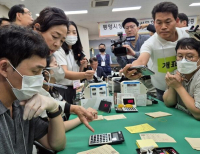
What is the Fair Compensation for News Copyright Used in AI Learning... Seminar Held in the National Assembly
"Terrestrial Broadcasting News is Valued at 70 to 110 Billion Won Annually," Claim Made
 'Seminar on Mutual Growth Strategies for Generative AI Companies and Media Creators' [Provided by Korea Broadcasters Association. Reproduction and DB prohibited]
Amid ongoing discussions about a fair compensation system for copyrighted works used in generative artificial intelligence (AI) learning, research findings have been announced presenting the level of copyright fees that AI companies should pay for learning terrestrial broadcasters' news content.
Lawmakers Lee Hoon-ki and Lee Jung-heon of the Democratic Party of Korea, along with the Korea Entertainment Law Society and the Korea Broadcasters Association, jointly hosted a seminar at the National Assembly Members' Office Building on the 22nd, under the theme of "Mutual Growth Strategies for AI Companies and Media Creators."
At the event, Professor Byun Sang-kyu of Hoseo University presented research results estimating the appropriate copyright fees that generative AI companies should pay when using news data from the three major terrestrial broadcasters for learning, employing both the revenue approach and the cost approach.
The revenue approach estimates the sales contribution of terrestrial news data by attribute and function within AI services. The cost approach calculates the proportion of costs that AI operators should reasonably bear, based on the overall news production costs of the three terrestrial broadcasters.
Professor Byun explained, "The core competitiveness of generative AI lies in its learning data. In particular, news data is evaluated as the most suitable data for training high-quality LLM (Large Language Model) AI models."
He added, "According to the analysis using the revenue approach, AI users are willing to pay 7,804 won per month for the improvement of AI's language ability through news data and 14,287 won per month for the improvement of timeliness. When extending this value to a national economic unit by applying the contribution of the three terrestrial broadcasters' news data, the annual copyright value of terrestrial news is estimated to be approximately 71.3 to 111.2 billion won for a population of one million."
He further stated that when applying the cost approach, "Based on the total news production costs of the three terrestrial broadcasters last year, which amounted to 428.3 billion won, an analysis of the utilization of broadcast news content by distribution channel revealed that the share for generative AI was approximately 20.5%. Accordingly, the cost that AI companies should bear was calculated to be around 87.76 billion won annually."
In response, Jang Ki-cheol, head of the AI Data Promotion Division at the Ministry of Science and ICT, who attended as a panelist, commented, "Just as the value of a company's technology or patent does not equate to its business performance, the value of data does not equate to the performance of AI companies. I have some doubts about whether the value of data directly translates into price."
He also anticipated that it would be difficult for AI companies to develop AI by paying large copyright fees, given that they are not yet generating profits commensurate with their investments.
Discussions on foreign legislation regarding Text and Data Mining (TDM) for AI also took place at the seminar. Currently, the European Union has an exemption provision for TDM for research purposes, and Japan has TDM regulations for cases that do not unreasonably infringe upon the rights of copyright holders.
In this regard, Professor Choi Seung-jae of Sejong University argued, "In Korea's legal environment, where the concept of 'fair use' exists, which is recognized when it does not conflict with the customary method of using copyrighted works and does not unreasonably harm the legitimate interests of the author, legislative exemption for TDM is unnecessary. Hasty legislation could further exacerbate problems and could ruin both the AI industry and the content industry."
Most attendees agreed that for the advancement of AI, the fair value of copyrighted works must be protected, creating an environment where new copyrighted works for AI to learn from can be continuously supplied.
Lee Jong-kwan, a specialized consultant at Law Firm Sejong, stated, "To continuously enhance the competitiveness of generative AI, a feedback loop is necessary where high-quality data is continuously produced, supplied, and utilized. There needs to be a certain level of incentive mechanism for creation and data production, and at the same time, to promote the advancement of generative AI, we need to allow AI model learning to occur more freely for copyrighted works that can be accessed legally." Yonhap News

 Bill Pulte to Restructure ‘Deep State’… Announces 4th Round of Layoffs at the Office of the Director of National Intelligence
Acting Director of National Intelligence Bill Pulte announced Sunday that he has carried out a fourth "deliberate and measured" reduction in personnel since taking office on June 19, as part of the Tr
Bill Pulte to Restructure ‘Deep State’… Announces 4th Round of Layoffs at the Office of the Director of National Intelligence
Acting Director of National Intelligence Bill Pulte announced Sunday that he has carried out a fourth "deliberate and measured" reduction in personnel since taking office on June 19, as part of the Tr
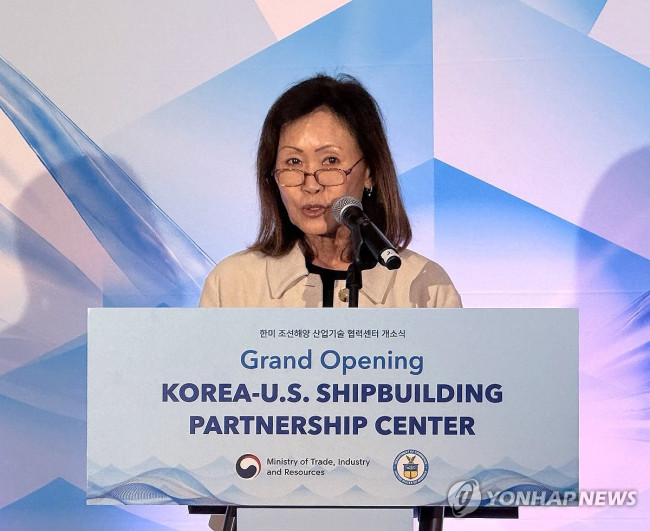 First U.S. Ambassador of Trump's Second Term to Arrive This Week… Will It Provide Momentum to Resolve Pending Issues?
U.S. Ambassador to South Korea Michelle Steel speaks at the opening ceremony of the Korea-U.S. Shipbuilding Cooperation Center held at the Mayflower Hotel in Washington, D.C., on the 23rd (local time)
First U.S. Ambassador of Trump's Second Term to Arrive This Week… Will It Provide Momentum to Resolve Pending Issues?
U.S. Ambassador to South Korea Michelle Steel speaks at the opening ceremony of the Korea-U.S. Shipbuilding Cooperation Center held at the Mayflower Hotel in Washington, D.C., on the 23rd (local time)
 President Yoon, regarding the first-instance ruling on the Public Official Election Act: “An excessive political verdict that distorts the facts… We will appeal immediately.”
The first-instance sentencing hearing for President Yoon Suk Yeol regarding violations of the Public Official Election Act is being broadcast live at Seoul Station on the 27th. [Photo=Yonhap News]Pres
President Yoon, regarding the first-instance ruling on the Public Official Election Act: “An excessive political verdict that distorts the facts… We will appeal immediately.”
The first-instance sentencing hearing for President Yoon Suk Yeol regarding violations of the Public Official Election Act is being broadcast live at Seoul Station on the 27th. [Photo=Yonhap News]Pres
 91% of Net Influx of MZ Generation Goes to Seoul Metropolitan Area… Population Migration Also Shows 'K-shaped Polarization' by Industry
[Provided by Leaders Index]Over the past four years, the MZ generation population has become increasingly concentrated in the Seoul metropolitan area and the Chungcheong region. While cities cen
91% of Net Influx of MZ Generation Goes to Seoul Metropolitan Area… Population Migration Also Shows 'K-shaped Polarization' by Industry
[Provided by Leaders Index]Over the past four years, the MZ generation population has become increasingly concentrated in the Seoul metropolitan area and the Chungcheong region. While cities cen
 'Godfather of Japanese Mystery Novels' Keigo Higashino Passes Away After Battle with Cancer at 68
Famous Japanese mystery novelist Keigo Higashino [AFP=Yonhap News]It has been belatedly reported that Keigo Higashino, the "godfather of Japanese mystery novels" and author of bestsellers such as "The
'Godfather of Japanese Mystery Novels' Keigo Higashino Passes Away After Battle with Cancer at 68
Famous Japanese mystery novelist Keigo Higashino [AFP=Yonhap News]It has been belatedly reported that Keigo Higashino, the "godfather of Japanese mystery novels" and author of bestsellers such as "The
 [Park Pil-kyu Security Column] To the Ignorant Trying to Clothe a Beast in Sheep's Clothing
Rep. Kim Byung-joo of the Democratic Party of Korea [Photo=Yonhap News]“The Air Force Academy doesn't teach you how to fly a plane!” “The Army, Navy, and Air Force academies are exactly the
[Park Pil-kyu Security Column] To the Ignorant Trying to Clothe a Beast in Sheep's Clothing
Rep. Kim Byung-joo of the Democratic Party of Korea [Photo=Yonhap News]“The Air Force Academy doesn't teach you how to fly a plane!” “The Army, Navy, and Air Force academies are exactly the
 [Issue Diagnosis] Two Effects of the Election Petition Review
 [Photo] Evidence of Election Fraud Flooding U.S. Media… Trump Had 2.7 Million Votes Stolen
 [Video] U.S. Semiquincentennial Air Show... 'Art in the Sky' streaks across New York
 [Editorial Cartoon] A Draconian Law That Undermines Freedom of Expression

 List
List