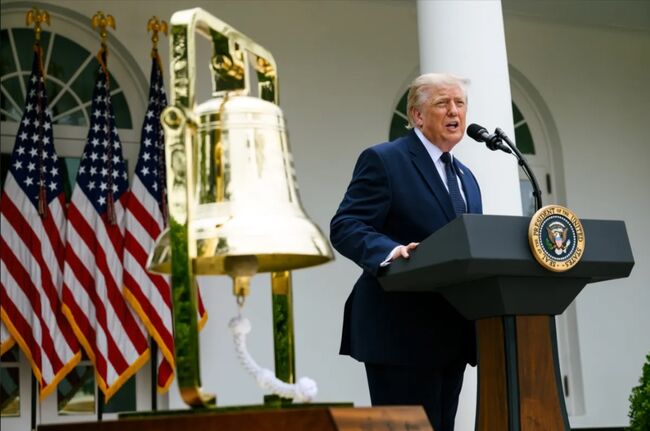
U.S. President Donald Trump emphasized that the Russia-Ukraine war, initiated by Joe Biden, could be ended if NATO member states joined in imposing 50-100% tariffs on China. / Yonhap News.
The first Asian tour of President Donald Trump's second term is structured around discussions with China, a rival in the global power competition, and strengthening alliances to support these discussions.
The itinerary for President Trump's Asian tour, announced by White House Press Secretary Caroline Levitt during a briefing on the 23rd (local time), will include visits to Malaysia, Japan, and South Korea over four nights and five days.
President Trump will depart from Washington D.C. on Air Force One on the night of the 24th (daytime of the 25th in Asia). He is scheduled to arrive in Malaysia on the morning of the 26th, hold bilateral talks with Malaysian Prime Minister Anwar Ibrahim, and then attend a working dinner for ASEAN (Association of Southeast Asian Nations) leaders.
After spending one night in Malaysia, President Trump will head to Japan on the 27th. The following day, the 28th, he will hold bilateral talks with Japanese Prime Minister Sanae Takaichi. This will be the first summit meeting between the U.S. and Japan since Prime Minister Takaichi's election.
While Prime Minister Takaichi, considered a staunch conservative politician, might have good chemistry with President Trump, she also poses a risk factor for the U.S. which needs "South Korea-U.S.-Japan cooperation," given that relations with neighboring countries like South Korea and China may not be smooth.
President Trump will spend two nights and three days in Japan before traveling to South Korea on the 29th. Although his stay in South Korea will be shorter than in Japan, lasting one night and two days, his schedule there is considered the highlight of this tour.
On the first day of his visit to South Korea, the 29th, President Trump will meet with President Lee Jae-myung. This will be the first summit between the South Korean and U.S. presidents in approximately two months since President Lee's visit to the U.S. on August 25th.
The meeting venue has been set for Gyeongju, where the Asia-Pacific Economic Cooperation (APEC) Summit is scheduled to take place. Although President Trump will not attend the APEC Summit itself, he will deliver a keynote speech at the APEC CEO Summit Luncheon on the same day and hold a working dinner with leaders that evening.
The working dinner for the leaders appears to be largely in consideration of President Trump, who will not be attending the main APEC Summit from the 31st for two days.
On the 30th, the last day of his Asian tour, President Trump will meet with Chinese President Xi Jinping, who is also visiting South Korea for the APEC meeting. This will be the first meeting between President Trump and President Xi in over six years, since the G20 summit held in Osaka, Japan, in June 2019.
Although U.S. Treasury Secretary Scott Bessent stated the previous day that the meeting between the two leaders would be a "brief encounter," President Trump said, "A very long meeting is scheduled."
Observing the schedule and itinerary of this tour, which concludes on the night of the 30th, indicates President Trump's intention to achieve two goals: security and trade.
His meetings with key ASEAN member states in Malaysia could be a move to counter China's expanding military and economic influence in Southeast Asia.
The itinerary, moving from Malaysia to the next destinations of Japan and South Korea, aligns with the "first island chain," which corresponds to the maritime defense line between the U.S. and China in the Indo-Pacific region.
Tariffs and investment are expected to be among the agenda items for President Trump's meetings with the leaders of Japan, South Korea, and China consecutively from the 28th to the 30th.
The U.S. has reached a trade agreement with Japan, but there are discussions in some quarters about the possibility of renegotiating terms, such as the $550 billion in investments in the U.S., which is one of the conditions for lowering mutual tariffs to 15%.
While it is speculated that a deal with South Korea is imminent and negotiations are in the final stages, disagreements have reportedly emerged regarding the method of $350 billion in U.S. investment, the payment period, and safeguards for the foreign exchange market.
Competition is intensifying with China over leadership in advanced and strategic industries, and the conflict between the two sides is escalating due to China's control over rare earth exports and the U.S.'s announcement of an additional 100% tariff.
President Trump is expected to attempt to reach agreements on these issues by meeting consecutively with the leaders of South Korea, Japan, and China during this tour. He has already announced his intention to discuss the Ukraine war and nuclear disarmament in his meeting with President Xi.
Another point of interest is the possibility of a meeting with North Korean leader Kim Jong Un. Although his schedule announced by the White House does not include it, it is a common view in diplomatic circles that he could propose a "lightning meeting" to Chairman Kim if he so desired.
In fact, the 2019 Panmunjom meeting was arranged through President Trump's fingertips (Twitter). President Trump has expressed his desire to meet Chairman Kim on multiple occasions, and Chairman Kim has not ruled out the possibility.
Considering the differences in stances on North Korea's denuclearization and President Trump's schedule, the likelihood of a "surprise meeting" with Chairman Kim during this tour is low, according to general expectations, but it cannot be entirely ruled out.
Yonhap News

 Trump pressures for rate cut again ahead of FOMC... "Should be the lowest in the world"
U.S. President Donald Trump. [Photo = The White House] U.S. President Donald Trump once again pressured the Federal Reserve, the U.S. central bank, to lower interest rates on the 27th (local time
Trump pressures for rate cut again ahead of FOMC... "Should be the lowest in the world"
U.S. President Donald Trump. [Photo = The White House] U.S. President Donald Trump once again pressured the Federal Reserve, the U.S. central bank, to lower interest rates on the 27th (local time
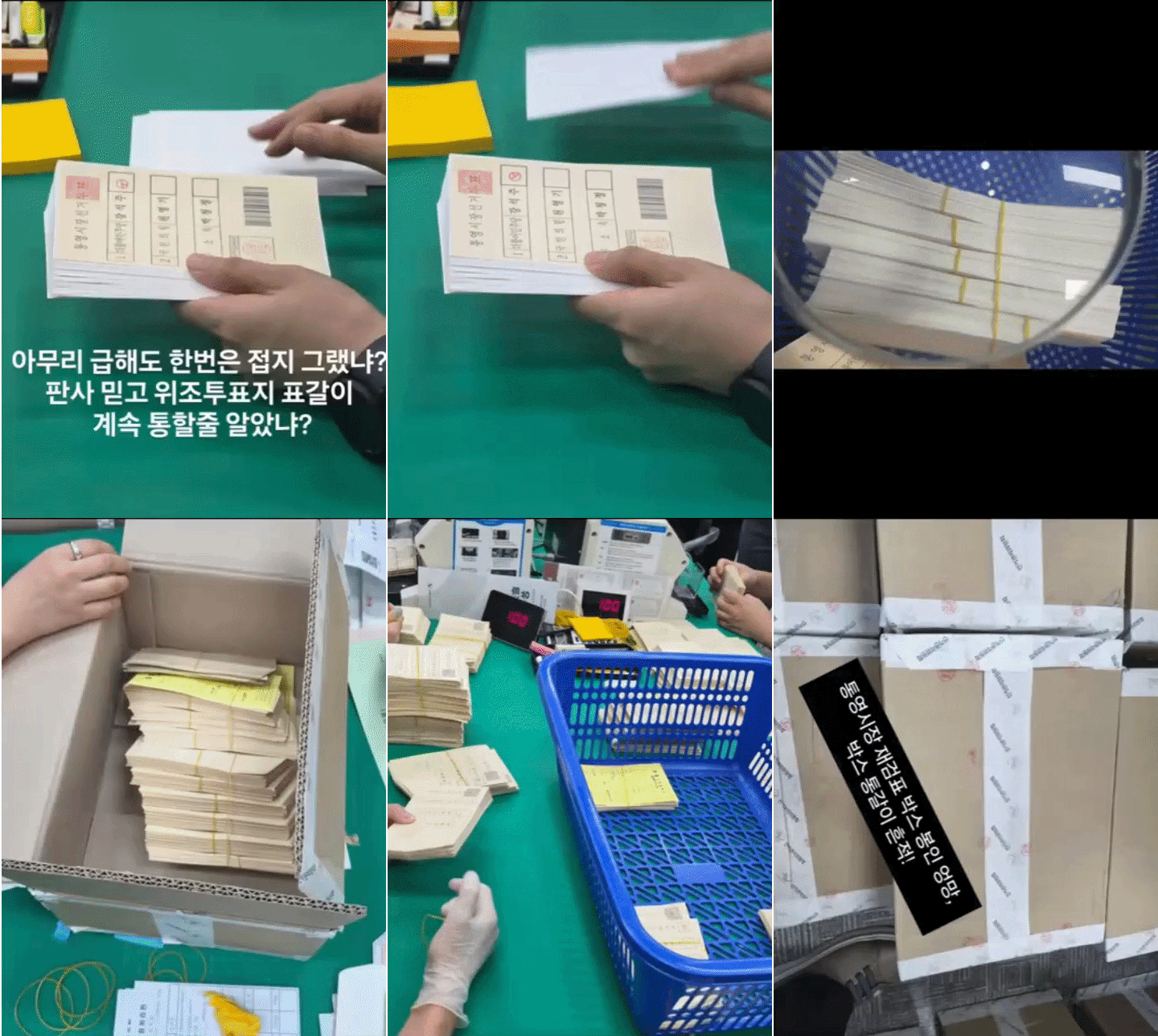 “Ignoring crisp ballots and damaged seals”… Tongyeong mayoral recount concludes with ‘no change in outcome,’ leaving suspicions and public outrage behind
Suspected counterfeit ballots discovered in Tongyeong [GIF from social media of Representative Hwang Kyo-ahn / Attorney Park Joo-hyun]During a recount of the Tongyeong mayoral election in South Gyeong
“Ignoring crisp ballots and damaged seals”… Tongyeong mayoral recount concludes with ‘no change in outcome,’ leaving suspicions and public outrage behind
Suspected counterfeit ballots discovered in Tongyeong [GIF from social media of Representative Hwang Kyo-ahn / Attorney Park Joo-hyun]During a recount of the Tongyeong mayoral election in South Gyeong
 President Yoon, regarding the first-instance ruling on the Public Official Election Act: “An excessive political verdict that distorts the facts… We will appeal immediately.”
The first-instance sentencing hearing for President Yoon Suk Yeol regarding violations of the Public Official Election Act is being broadcast live at Seoul Station on the 27th. [Photo=Yonhap News]Pres
President Yoon, regarding the first-instance ruling on the Public Official Election Act: “An excessive political verdict that distorts the facts… We will appeal immediately.”
The first-instance sentencing hearing for President Yoon Suk Yeol regarding violations of the Public Official Election Act is being broadcast live at Seoul Station on the 27th. [Photo=Yonhap News]Pres
 WSJ: "SK Hynix ADR Premium Is a Sign of AI Trading Overheat"
Advertisement for SK Hynix ADR listing in New York's Times Square [Reuters=Yonhap News file photo]The Wall Street Journal (WSJ) has pointed out that the price of SK Hynix’s American Depositary Recei
WSJ: "SK Hynix ADR Premium Is a Sign of AI Trading Overheat"
Advertisement for SK Hynix ADR listing in New York's Times Square [Reuters=Yonhap News file photo]The Wall Street Journal (WSJ) has pointed out that the price of SK Hynix’s American Depositary Recei
 'Godfather of Japanese Mystery Novels' Keigo Higashino Passes Away After Battle with Cancer at 68
Famous Japanese mystery novelist Keigo Higashino [AFP=Yonhap News]It has been belatedly reported that Keigo Higashino, the "godfather of Japanese mystery novels" and author of bestsellers such as "The
'Godfather of Japanese Mystery Novels' Keigo Higashino Passes Away After Battle with Cancer at 68
Famous Japanese mystery novelist Keigo Higashino [AFP=Yonhap News]It has been belatedly reported that Keigo Higashino, the "godfather of Japanese mystery novels" and author of bestsellers such as "The
 [Park Pil-kyu Security Column] To the Ignorant Trying to Clothe a Beast in Sheep's Clothing
Rep. Kim Byung-joo of the Democratic Party of Korea [Photo=Yonhap News]“The Air Force Academy doesn't teach you how to fly a plane!” “The Army, Navy, and Air Force academies are exactly the
[Park Pil-kyu Security Column] To the Ignorant Trying to Clothe a Beast in Sheep's Clothing
Rep. Kim Byung-joo of the Democratic Party of Korea [Photo=Yonhap News]“The Air Force Academy doesn't teach you how to fly a plane!” “The Army, Navy, and Air Force academies are exactly the
 [Issue Diagnosis] Two Effects of the Election Petition Review
 [Photo] Evidence of Election Fraud Flooding U.S. Media… Trump Had 2.7 Million Votes Stolen
 [Video] U.S. Semiquincentennial Air Show... 'Art in the Sky' streaks across New York
 [Editorial Cartoon] A Draconian Law That Undermines Freedom of Expression

 List
List