- Korea agrees to 100% market opening... Differs from explanation of 'defense against further agricultural product liberalization'
- "200 Billion Dollars to be Invested in Alaska Gas Pipeline, Critical Minerals, AI, Quantum, etc."
 U.S. Secretary of Commerce Howard Rutnik and Minister of Trade, Industry and Energy Kim Jeong-kwan hug each other just before attending the Korea-U.S. Business Roundtable held at the Gyeongju Art Center in Gyeongbuk Province on the afternoon of October 29. 2025.10.29 burning@yna.co.krThe U.S. administration under Donald Trump, while introducing a Korea-U.S. trade agreement on the 29th (local time), made claims that differ slightly from the South Korean government's explanation, leading to speculation that further coordination may be needed between the two countries regarding the detailed terms of the agreement going forward.
U.S. Secretary of Commerce Howard Rutnik stated in a post on X (formerly Twitter) on the same day, introducing the trade agreement reached during the summit between President Donald Trump and President Lee Jae-myung, that "South Korea also agreed to open its market 100% completely."
While this could be an exaggerated statement to promote trade achievements domestically, it differs from the South Korean government's explanation that it prevented further opening in agricultural markets, including rice and beef.
Secretary Rutnik also introduced the tariff rates that would apply to South Korean products under this agreement, stating, "Semiconductor tariffs are not part of this agreement."
The U.S. government is currently pursuing semiconductor tariffs and is expected to make an official announcement soon.
The South Korean government had explained that it had agreed with the U.S. on tariffs for semiconductors that would not put it at a disadvantage compared to Taiwan, its main competitor.
Considering Secretary Rutnik's remarks, there is room for interpretation that the U.S. intends to renegotiate semiconductor tariffs with South Korea during the upcoming implementation process.
Accordingly, there is a possibility that the two countries may continue to engage in a tug-of-war over the detailed application methods of tariffs for specific items, such as semiconductors, until the official documents outlining the results of this negotiation are signed.
Secretary Rutnik also introduced how South Korea's $350 billion (approximately 500 trillion won) investment in the U.S. would be utilized.
He said, "These investments will be directed and approved by the President. President Trump designated the shipbuilding industry as the first investment area, and at least $150 billion has been committed for building ships in the United States."
He revealed that President Trump had approved South Korean shipbuilders to construct nuclear-powered submarines in Philadelphia, referring to the Philadelphia Shipyard, which was acquired by Hanwha Ocean.
Secretary Rutnik continued, "Additionally, President Trump will direct another $200 billion in investments for projects being pursued in the United States, including the Alaska natural gas pipeline, energy infrastructure, critical minerals, advanced manufacturing, artificial intelligence (AI), and quantum computing."
Yonhap News
What do you think of this article?

 Trump pressures for rate cut again ahead of FOMC... "Should be the lowest in the world"
U.S. President Donald Trump. [Photo = The White House] U.S. President Donald Trump once again pressured the Federal Reserve, the U.S. central bank, to lower interest rates on the 27th (local time
Trump pressures for rate cut again ahead of FOMC... "Should be the lowest in the world"
U.S. President Donald Trump. [Photo = The White House] U.S. President Donald Trump once again pressured the Federal Reserve, the U.S. central bank, to lower interest rates on the 27th (local time
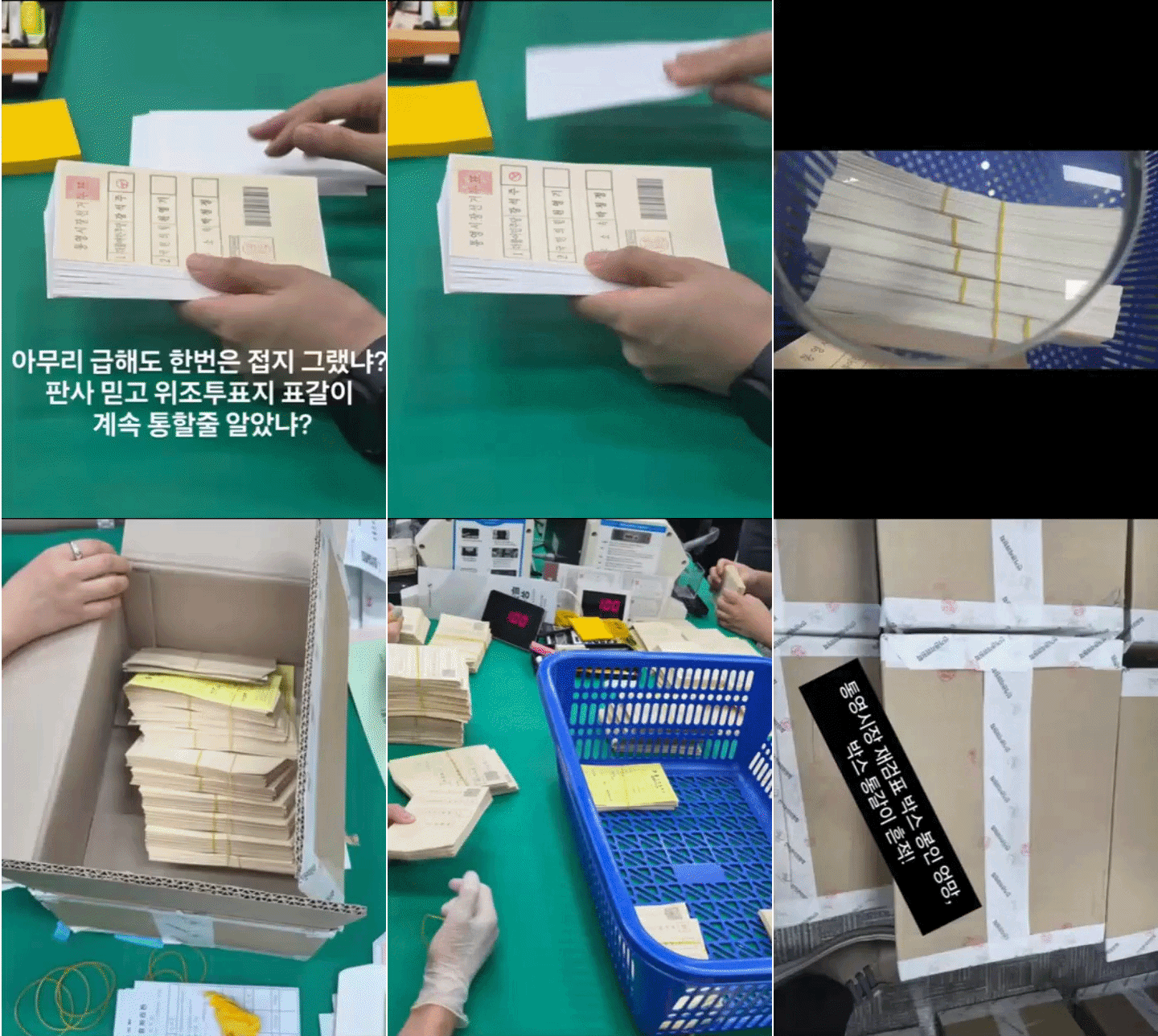 “Ignoring crisp ballots and damaged seals”… Tongyeong mayoral recount concludes with ‘no change in outcome,’ leaving suspicions and public outrage behind
Suspected counterfeit ballots discovered in Tongyeong [GIF from social media of Representative Hwang Kyo-ahn / Attorney Park Joo-hyun]During a recount of the Tongyeong mayoral election in South Gyeong
“Ignoring crisp ballots and damaged seals”… Tongyeong mayoral recount concludes with ‘no change in outcome,’ leaving suspicions and public outrage behind
Suspected counterfeit ballots discovered in Tongyeong [GIF from social media of Representative Hwang Kyo-ahn / Attorney Park Joo-hyun]During a recount of the Tongyeong mayoral election in South Gyeong
 President Yoon, regarding the first-instance ruling on the Public Official Election Act: “An excessive political verdict that distorts the facts… We will appeal immediately.”
The first-instance sentencing hearing for President Yoon Suk Yeol regarding violations of the Public Official Election Act is being broadcast live at Seoul Station on the 27th. [Photo=Yonhap News]Pres
President Yoon, regarding the first-instance ruling on the Public Official Election Act: “An excessive political verdict that distorts the facts… We will appeal immediately.”
The first-instance sentencing hearing for President Yoon Suk Yeol regarding violations of the Public Official Election Act is being broadcast live at Seoul Station on the 27th. [Photo=Yonhap News]Pres
 WSJ: "SK Hynix ADR Premium Is a Sign of AI Trading Overheat"
Advertisement for SK Hynix ADR listing in New York's Times Square [Reuters=Yonhap News file photo]The Wall Street Journal (WSJ) has pointed out that the price of SK Hynix’s American Depositary Recei
WSJ: "SK Hynix ADR Premium Is a Sign of AI Trading Overheat"
Advertisement for SK Hynix ADR listing in New York's Times Square [Reuters=Yonhap News file photo]The Wall Street Journal (WSJ) has pointed out that the price of SK Hynix’s American Depositary Recei
 'Godfather of Japanese Mystery Novels' Keigo Higashino Passes Away After Battle with Cancer at 68
Famous Japanese mystery novelist Keigo Higashino [AFP=Yonhap News]It has been belatedly reported that Keigo Higashino, the "godfather of Japanese mystery novels" and author of bestsellers such as "The
'Godfather of Japanese Mystery Novels' Keigo Higashino Passes Away After Battle with Cancer at 68
Famous Japanese mystery novelist Keigo Higashino [AFP=Yonhap News]It has been belatedly reported that Keigo Higashino, the "godfather of Japanese mystery novels" and author of bestsellers such as "The
 [Park Pil-kyu Security Column] To the Ignorant Trying to Clothe a Beast in Sheep's Clothing
Rep. Kim Byung-joo of the Democratic Party of Korea [Photo=Yonhap News]“The Air Force Academy doesn't teach you how to fly a plane!” “The Army, Navy, and Air Force academies are exactly the
[Park Pil-kyu Security Column] To the Ignorant Trying to Clothe a Beast in Sheep's Clothing
Rep. Kim Byung-joo of the Democratic Party of Korea [Photo=Yonhap News]“The Air Force Academy doesn't teach you how to fly a plane!” “The Army, Navy, and Air Force academies are exactly the
 [Issue Diagnosis] Two Effects of the Election Petition Review
 [Photo] Evidence of Election Fraud Flooding U.S. Media… Trump Had 2.7 Million Votes Stolen
 [Video] U.S. Semiquincentennial Air Show... 'Art in the Sky' streaks across New York
 [Editorial Cartoon] A Draconian Law That Undermines Freedom of Expression

 List
List