본 기사는 9월 중순부터 10월 말까지 한미 관세협상 관련 외신과 정부 발언 로그를 메타데이터로 추적한 탐사형 분석 보도입니다. ‘Upfront’의 의미, ‘현금 쇼’ 프레임의 형성과 붕괴, 그리고 펀드 통제 구조 속에 숨은 주권의 향방을 집중 해부합니다. <편집자 주>
 The stage was Gyeongju, the director Washington, and the truth emerged from the end of the "cash show." [Graphic=Hanmi Ilbo]
The government's announcement after the ROK-US summit in Gyeongju on October 29th revealed the contradictions that had existed during the negotiation process. The government insisted on the "US demand for upfront cash payment" for over a month, but such a demand never existed from the beginning.
The terms "umbrella SPC" and "progress payment" (payment for the completed portion of the contracted total construction cost), which first appeared in the briefing that day, revealed the true nature of the negotiations that had been hidden.
However, this was not a simple clarification. The US remained silent, and Korea packaged the outcome with words like "signing" and "agreement." From the place where the truth was revealed, the Lee Jae-myung administration began another play.
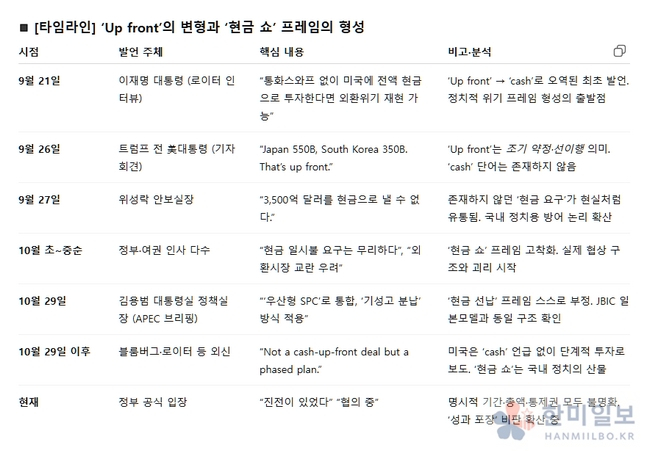
The origin of the controversy was an interview with Reuters on September 21st. President Lee Jae-myung stated, "If we invest the full amount in cash to the US without a currency swap, the 1997 foreign exchange crisis will be recreated." With this single remark, the diplomatic negotiations instantly turned into an economic thriller. "Upfront" was translated as "cash," and the public received the impression that "the US is demanding cash."
However, on September 26th, US President Donald Trump said at a press conference, "Japan 550 billion, South Korea 350 billion. That’s upfront." There was no mention of the word "cash" anywhere in his statement. "Upfront" in diplomacy and trade means "early commitment" or "proactive implementation." What was important to Trump was the speed of the promise, not the method of payment. It meant "promise now," not "pay immediately."
However, by the time that statement reached Seoul, its meaning had completely changed. On September 27th, National Security Advisor Wi Sung-lak said, "We cannot pay $350 billion in cash," and the "cash demand," which had never existed, became a reality. And at that moment, diplomacy turned into politics. The government created its own narrative of "the government that blocked unreasonable demands."
At the APEC press conference in Gyeongju on October 29th, Presidential Chief of Staff for Economic Affairs Kim Yong-beom announced, "(The investment funds will be paid) in installments based on the progress of the projects." He also mentioned "a method of bundling multiple projects into a single 'umbrella SPC.'" This single sentence overturned everything. It was as if the government itself had admitted the falsity of the "cash show."
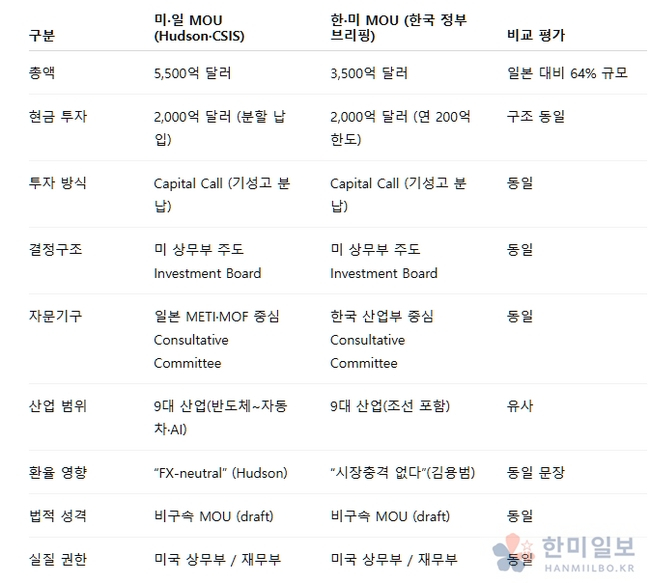
Kim continued, "The funds will be covered within an annual limit of $20 billion through overseas dollar bond issuance and profits from foreign asset management." In other words, it is an FX neutral structure that does not affect exchange rates, a method completely identical to Japan's Japan Bank for International Cooperation (JBIC) model.
Ultimately, the "cash burden" mentioned by the South Korean government was a non-existent crisis, and the "possibility of a foreign exchange crisis" mentioned by the president was a political staging. "Upfront" referred to a promise, not money. The moment that promise was misinterpreted, the negotiation turned from fact into a staged fiction.
[Fact Check 1] The Path of the "Upfront" Controversy
In Japan's case, it was a concentrated model where $100 billion of the $550 billion was executed within three and a half years, with extensions in subsequent phases. In contrast, Korea has a long-term installment structure with a total of $200 billion and an annual limit of $20 billion. It is an open system that requires at least 10 years.
The JoongAng Daily's English edition reported that Chief of Staff Kim Yong-beom said, "The investment agreement is valid until January 2029," but no other media outlets, including Yonhap News, confirmed such a statement. The sentence was written in a summarized quote format without quotation marks, indicating a high possibility of subjective interpretation by the reporter. In fact, the government's official announcements or transcripts do not specify the timeline of "until 2029."
Ultimately, Japan designed an explicit timeline, while Korea, without even a clear deadline, used the term "progress" to substitute for time. What Trump wanted was control over time, not money. What he wanted to confirm was "When do you promise?" not "How much are you paying?"
The core of this structure lies in the "Right of Control," not the funds. Although the South Korean government explained it as a "joint fund," the actual control lies with the Investment Review Board under the US Department of Commerce. This is a structure identical to Japan's JBIC model down to the bone.
In an interview with CNBC, US Secretary of Commerce Howard Luttnick said, "We give them the project, and they pay for the project." "We" refers to the party that designates the project, meaning the US holds the design and approval rights. "They" refers to the participating countries that fund each project. While the ownership of the funds remains with Korea, the US determines how the funds are disbursed.
At the press briefing, Chief of Staff Kim Yong-beom said, "Korea and the US will jointly decide on the projects." However, the term "jointly decide" sounds like a joint decision-making structure, but it was actually a diplomatic euphemism. Looking at the roles of the two committees he described, the consultative committee chaired by the Korean Minister of Trade, Industry and Energy, and the Investment Committee chaired by the US Secretary of Commerce, the structure is virtually identical to Japan's JBIC model.
It can be understood as a structure where the US first determines the investment areas, and Korea injects funds into those areas. Korea's committee can only offer advisory opinions, and the final decision-making power for project approval and allocation rests with the committee under the US Department of Commerce. Therefore, the term "jointly decide" was a subtle illusion aimed at making the public believe that we had joint decision-making power.
As with Japan's JBIC model, the structure of this ROK-US trade and investment negotiation should be understood as a system where Washington designates and Seoul executes. This structural dependency is also indirectly revealed in foreign media reports. Bloomberg reported it as "not a cash-up-front deal but a phased investment plan," and the word "cash" did not appear in the US statements in Reuters reports. The Trump administration's "Upfront" referred to early implementation, not a cash demand.
[Fact Check 2] Structural Comparison with the Japanese Model
Ultimately, the essence of this negotiation lies not in the total amount of money but in the initiative of the design. "Who promises first and controls the speed of that promise" means power. Trump controls time with "Upfront" and structure with fund decision-making power.
However, the South Korean government turned diplomacy into a political narrative by changing that language to "demand for cash payment." And on October 29th, while confessing the contradictions, the government did not fail to praise itself. The US's silence was the silence of command, and Korea's voice was a kind of theatrical dialogue. And on the day the truth was revealed, diplomacy ended with another play.
The government, which raised a mirage of an "unwanted lump-sum cash demand from the US" and staged wordplay as if it had achieved results timed with the ROK-US summit. However, the reality was the application and repetition of the Japanese model.
Furthermore, the mention by the President and the Presidential Secretariat of a "350 billion dollar lump-sum cash payment that is not possible" raises the possibility of political and legal controversy if the actual details of future negotiations are clearly revealed.
This is the truth of the ROK-US trade and investment negotiations that has been revealed so far.

 Iranian Foreign Ministry: "Continuing Message Exchanges with the U.S. and Activities of Mediating Countries"
Esmaeil Baghaei, Spokesperson for the Iranian Ministry of Foreign Affairs [Xinhua, Yonhap News file photo]Esmaeil Baghaei, spokesperson for the Iranian Ministry of Foreign Affairs, stated on the 26th
Iranian Foreign Ministry: "Continuing Message Exchanges with the U.S. and Activities of Mediating Countries"
Esmaeil Baghaei, Spokesperson for the Iranian Ministry of Foreign Affairs [Xinhua, Yonhap News file photo]Esmaeil Baghaei, spokesperson for the Iranian Ministry of Foreign Affairs, stated on the 26th
 President Yoon: "Do You Think You Are Safe from the Special Counsel?"... Final Statement Video Released
President Yoon Suk Yeol rebuking the special prosecutor on the 24th. [Court video / @birds_justice X account subtitle GIF] A video of President Yoon Suk Yeol's closing statement at his trial rega
President Yoon: "Do You Think You Are Safe from the Special Counsel?"... Final Statement Video Released
President Yoon Suk Yeol rebuking the special prosecutor on the 24th. [Court video / @birds_justice X account subtitle GIF] A video of President Yoon Suk Yeol's closing statement at his trial rega
 President Yoon, regarding the first-instance ruling on the Public Official Election Act: “An excessive political verdict that distorts the facts… We will appeal immediately.”
The first-instance sentencing hearing for President Yoon Suk Yeol regarding violations of the Public Official Election Act is being broadcast live at Seoul Station on the 27th. [Photo=Yonhap News]Pres
President Yoon, regarding the first-instance ruling on the Public Official Election Act: “An excessive political verdict that distorts the facts… We will appeal immediately.”
The first-instance sentencing hearing for President Yoon Suk Yeol regarding violations of the Public Official Election Act is being broadcast live at Seoul Station on the 27th. [Photo=Yonhap News]Pres
 WSJ: "SK Hynix ADR Premium Is a Sign of AI Trading Overheat"
Advertisement for SK Hynix ADR listing in New York's Times Square [Reuters=Yonhap News file photo]The Wall Street Journal (WSJ) has pointed out that the price of SK Hynix’s American Depositary Recei
WSJ: "SK Hynix ADR Premium Is a Sign of AI Trading Overheat"
Advertisement for SK Hynix ADR listing in New York's Times Square [Reuters=Yonhap News file photo]The Wall Street Journal (WSJ) has pointed out that the price of SK Hynix’s American Depositary Recei
 'Godfather of Japanese Mystery Novels' Keigo Higashino Passes Away After Battle with Cancer at 68
Famous Japanese mystery novelist Keigo Higashino [AFP=Yonhap News]It has been belatedly reported that Keigo Higashino, the "godfather of Japanese mystery novels" and author of bestsellers such as "The
'Godfather of Japanese Mystery Novels' Keigo Higashino Passes Away After Battle with Cancer at 68
Famous Japanese mystery novelist Keigo Higashino [AFP=Yonhap News]It has been belatedly reported that Keigo Higashino, the "godfather of Japanese mystery novels" and author of bestsellers such as "The
 [Park Pil-kyu Security Column] To the Ignorant Trying to Clothe a Beast in Sheep's Clothing
Rep. Kim Byung-joo of the Democratic Party of Korea [Photo=Yonhap News]“The Air Force Academy doesn't teach you how to fly a plane!” “The Army, Navy, and Air Force academies are exactly the
[Park Pil-kyu Security Column] To the Ignorant Trying to Clothe a Beast in Sheep's Clothing
Rep. Kim Byung-joo of the Democratic Party of Korea [Photo=Yonhap News]“The Air Force Academy doesn't teach you how to fly a plane!” “The Army, Navy, and Air Force academies are exactly the
 [Issue Diagnosis] Two Effects of the Election Petition Review
 [Photo] Evidence of Election Fraud Flooding U.S. Media… Trump Had 2.7 Million Votes Stolen
 [Video] U.S. Semiquincentennial Air Show... 'Art in the Sky' streaks across New York
 [Editorial Cartoon] A Draconian Law That Undermines Freedom of Expression

 List
List










