[US-China Summit] Tariffs, Rare Earths, Export Controls... Agreement Reached on 'Truce and De-escalation' (Comprehensive)
10%p ↓ on China Tariffs, Rare Earth Export Controls - Port Dues Deferred, Soybean Imports Resumed
Measures Escalating Tensions Since Late September 'Reversed'... Regarding Semiconductors, "A Matter Between China and Nvidia"
 End of US-China Summit (Busan=Yonhap News) Reporter Son Hyung-joo = U.S. President Donald Trump and Chinese President Xi Jinping are seen conversing as they leave the meeting room after concluding their summit at Narraemaru, the protocol hall at Gimhae Air Base in Busan, on the 30th. 2025.10.30 handbrother@yna.co.kr
At the US-China summit held at Gimhae Airport on the 30th, the United States decided to lower the punitive tariffs imposed on China for synthetic drugs like fentanyl from the current 20% to 10%. In return, China agreed to defer controls on rare earth exports for one year.
The summit's agenda, it is understood, focused primarily on trade and economic issues, with topics such as the cross-strait issue (Taiwan-China relations), which China views with extreme sensitivity, not being discussed.
According to an announcement by China's Ministry of Commerce, both sides agreed to largely reverse the measures taken amid escalating tensions after the US intensified its export controls on China in late September.
According to foreign media outlets including AFP, Reuters, and The New York Times (NYT), President Trump and President Xi met at Narraemaru, the protocol hall at Gimhae Airport Air Base, and after a meeting lasting approximately 1 hour and 40 minutes, they reached these agreements.
◇ US Lowers Fentanyl-Related Punitive Tariffs to 10%... China Responds with Deferral of Rare Earth Export Controls
First, regarding the synthetic drug fentanyl, a persistent issue raised by the United States, China agreed to take stronger measures to prevent the inflow of precursor materials used in fentanyl production into the US. In return, the US decided to lower tariffs on fentanyl-related products from China from 20% to 10%.
After the launch of his second term, President Trump had identified China as the source of precursor supplies for synthetic drug fentanyl, stating that fentanyl was heavily flowing into the US via Canada and Mexico, and had imposed a 20% tariff on fentanyl from China. President Trump announced that with the 10 percentage point reduction in fentanyl tariffs, the tariff rate on Chinese products would change "from 57% to 47%."
According to China's Ministry of Commerce, the US will continue to defer the additional 24% retaliatory tariffs on Chinese goods for one year, and China will also adjust its retaliatory measures in response.
China also agreed to immediately resume the purchase of US agricultural products, including soybeans. Soybeans are the largest agricultural export from the US to China, with China accounting for half of the total export volume.
Earlier this year, China imposed an additional 10% tariff on US soybeans in retaliation for US tariff barriers, and had virtually suspended imports ahead of the autumn harvest season, leading US farmers to demand measures.
Instead, he expressed confidence that a trade agreement with China could be signed "soon," stating that not many obstacles remained.
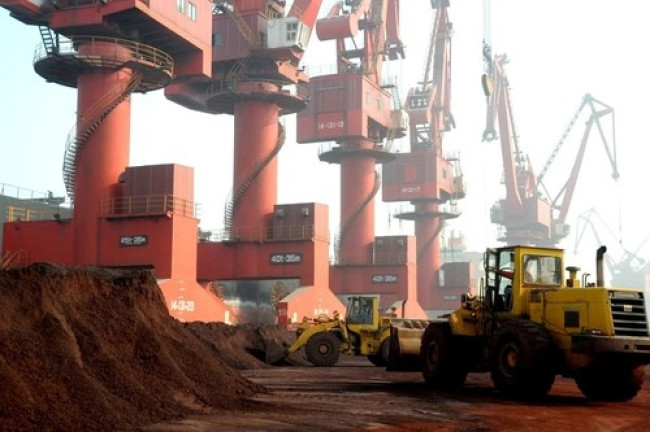 Export of rare earth-containing soil being unloaded at a port in Jiangsu Province, China [SCMP Hong Kong Capture. Republication and database prohibited]
◇ US Blacklist Expansion and China's Intensified Rare Earth Controls Also 'Reversed'
Amidst the war of nerves leading up to the summit, both countries also agreed to reverse many of the tension-escalating measures implemented since late September.
China's Ministry of Commerce announced that the US would defer the "50% pass-through principle" related to export controls, announced on September 29, for one year. China will also defer its related export control measures, announced on the 9th of this month, for one year, and detailed plans will be studied.
The US Department of Commerce's Bureau of Industry and Security (BIS) had at that time expanded its "General Blacklist" and introduced a new regulation applying export controls to subsidiaries in which controlled companies held a 50% or more stake.
This was seen as a measure to plug a loophole that allowed Chinese companies to bypass US regulations by using overseas subsidiaries.
Subsequently, on the 9th of this month, China included rare earths such as samarium and dysprosium in its export control list. In particular, it stipulated that even products manufactured overseas containing at least 0.1% of Chinese rare earths, or those using China's refining and processing technology, would require an export license from the Chinese government.
President Trump told reporters aboard Air Force One after the US-China summit that China had agreed to defer rare earth export controls for one year, and that he expected the deferral to be extended annually thereafter.
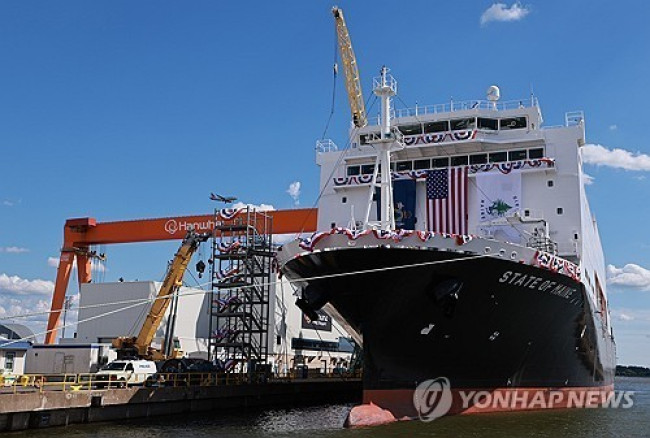 Hanwha Philadelphia Shipyard, National Security Multi-Purpose Vessel (Philadelphia=Yonhap News) Reporter Hong Hae-in = On the 26th (local time), the "State of Maine," undergoing a naming ceremony, is seen next to a crane at Hanwha Philadelphia Shipyard in Philadelphia, USA. This vessel is the third of five National Security Multi-Purpose Vessels (NSMV) ordered by the US Maritime Administration. 2025.8.27 hihong@yna.co.kr
◇ Deferral of US-China Port Dues... Will Hanwha Ocean's US Subsidiary Benefit?
President Trump also announced that the imposition of port dues on Chinese-built or Chinese-owned vessels entering the US would be deferred.
In response, China also deferred the imposition of port dues on US vessels, which it had announced as a retaliatory measure, according to the NYT.
China's Ministry of Commerce stated that the US side would defer investigations and measures under Trade Law Section 301 related to maritime, logistics, and shipbuilding industries for one year, and China would also defer its retaliatory measures in response for one year.
China's Ministry of Commerce had previously announced sanctions targeting five US subsidiaries of Hanwha Ocean, stating it was a response to the US investigation under Trade Law Section 301 related to maritime, logistics, and shipbuilding industries. It was not specified whether these sanctions would be deferred.
The Office of the United States Trade Representative (USTR) announced a policy in April to impose port dues on Chinese-operated and Chinese-built vessels, and began imposing port service charges on Chinese vessels in mid-month. In response, China also imposed port dues on vessels owned or operated by US companies, organizations, or individuals, vessels flying the US flag, and US-built vessels.
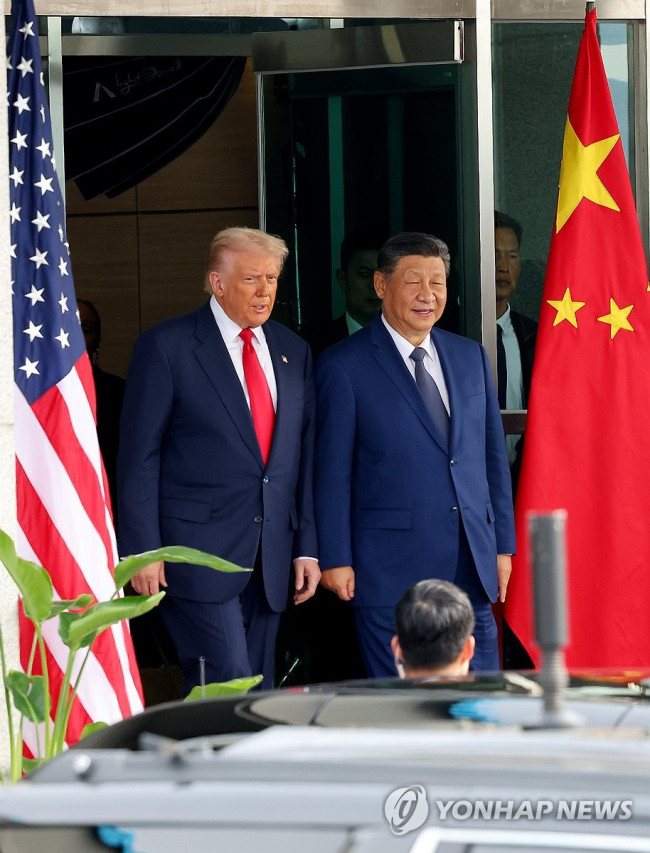 End of US-China Summit (Busan=Yonhap News) Reporter Son Hyung-joo = U.S. President Donald Trump and Chinese President Xi Jinping are seen leaving the meeting room after concluding their summit at Narraemaru, the protocol hall at Gimhae Air Base in Busan, on the 30th. 2025.10.30 handbrother@yna.co.kr
◇ Semiconductor Discussions Also Held... China: "TikTok Issue Will Be Appropriately Resolved with the US"
The two leaders also discussed semiconductors, a key component of the future artificial intelligence (AI) ecosystem.
President Trump stated that Nvidia, a semiconductor company, would discuss the issue of selling AI semiconductors to China with Chinese authorities.
The US, which is in an AI hegemony race with China, has been restricting the export of advanced chips to China. In response, Nvidia released a lower-performance chip, the H20, compliant with export control requirements for China last year, but the Trump administration banned the export of this product in April of this year.
"It's a matter between China and Nvidia," President Trump said, adding, "We are sort of mediators, judges."
There are observations that this is an attempt to distance itself from the issue of semiconductor export controls, which is one of the points of contention between the US and China, by framing it as a problem between China and Nvidia.
However, it is reported that the issue of supplying Nvidia's latest AI chip, 'Blackwell,' to China was not discussed.
"We are not talking about Blackwell, which was released just yesterday, but there are many chips," President Trump said, adding, "And that's good for us."
President Trump has argued that US semiconductor companies must sell a large number of semiconductors, excluding cutting-edge AI chips, to other countries to maintain US dominance in the AI industry.
China's Ministry of Commerce stated that regarding the issue of the US business rights for the Chinese video platform TikTok, "The Chinese side will appropriately resolve the TikTok-related issues with the US side."
It added, "The results of the (US-China) trade negotiations were hard-won," and expressed anticipation to "implement them well with the US and create more certainty and stability for US-China economic cooperation and the global economy." Yonhap News

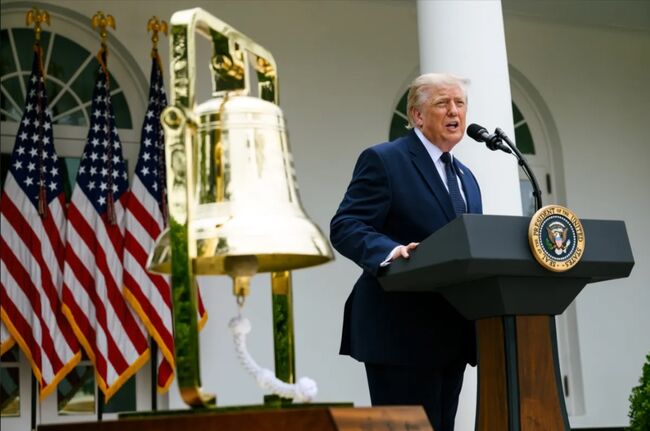 Trump pressures for rate cut again ahead of FOMC... "Should be the lowest in the world"
U.S. President Donald Trump. [Photo = The White House] U.S. President Donald Trump once again pressured the Federal Reserve, the U.S. central bank, to lower interest rates on the 27th (local time
Trump pressures for rate cut again ahead of FOMC... "Should be the lowest in the world"
U.S. President Donald Trump. [Photo = The White House] U.S. President Donald Trump once again pressured the Federal Reserve, the U.S. central bank, to lower interest rates on the 27th (local time
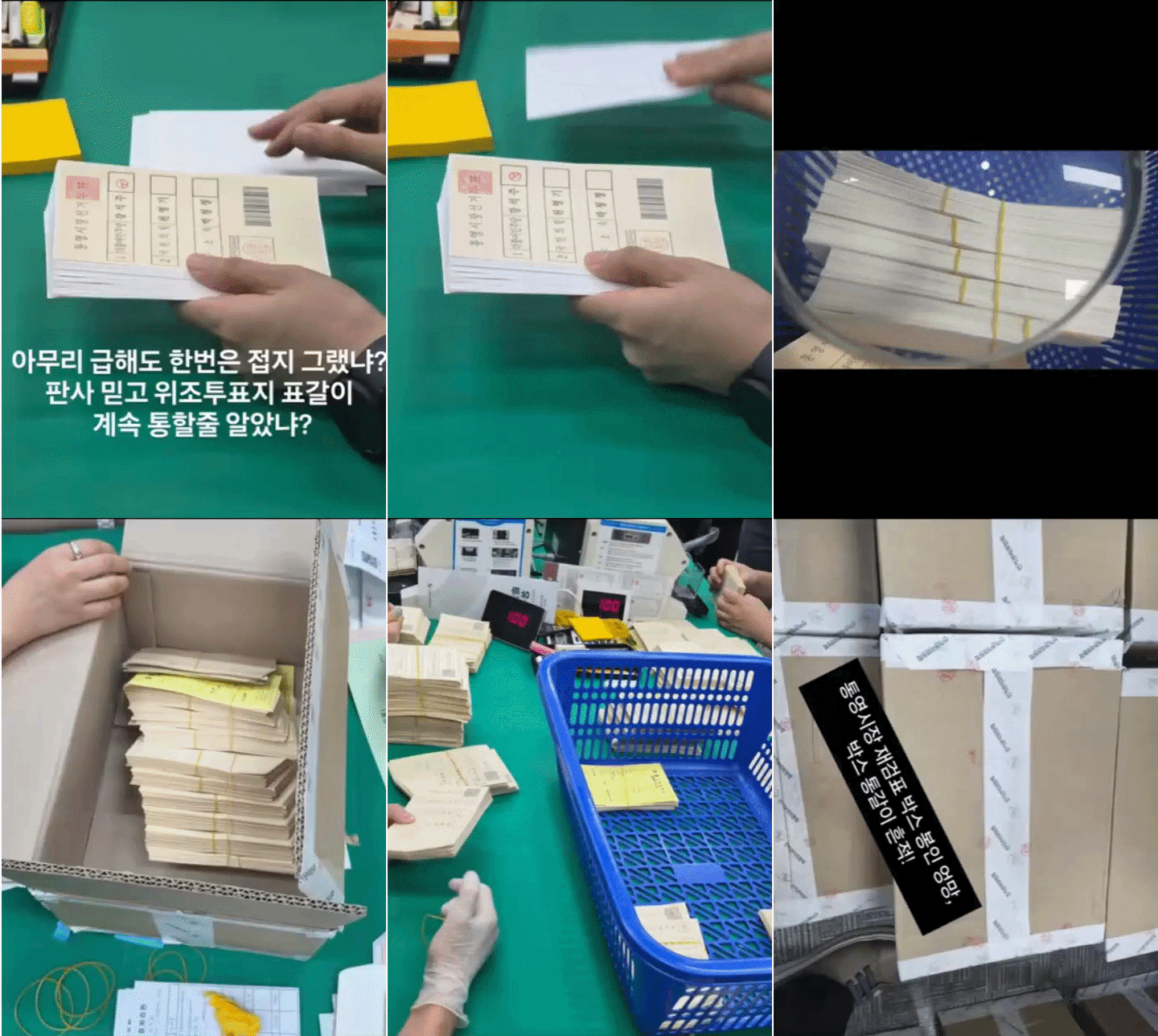 “Ignoring crisp ballots and damaged seals”… Tongyeong mayoral recount concludes with ‘no change in outcome,’ leaving suspicions and public outrage behind
Suspected counterfeit ballots discovered in Tongyeong [GIF from social media of Representative Hwang Kyo-ahn / Attorney Park Joo-hyun]During a recount of the Tongyeong mayoral election in South Gyeong
“Ignoring crisp ballots and damaged seals”… Tongyeong mayoral recount concludes with ‘no change in outcome,’ leaving suspicions and public outrage behind
Suspected counterfeit ballots discovered in Tongyeong [GIF from social media of Representative Hwang Kyo-ahn / Attorney Park Joo-hyun]During a recount of the Tongyeong mayoral election in South Gyeong
 President Yoon, regarding the first-instance ruling on the Public Official Election Act: “An excessive political verdict that distorts the facts… We will appeal immediately.”
The first-instance sentencing hearing for President Yoon Suk Yeol regarding violations of the Public Official Election Act is being broadcast live at Seoul Station on the 27th. [Photo=Yonhap News]Pres
President Yoon, regarding the first-instance ruling on the Public Official Election Act: “An excessive political verdict that distorts the facts… We will appeal immediately.”
The first-instance sentencing hearing for President Yoon Suk Yeol regarding violations of the Public Official Election Act is being broadcast live at Seoul Station on the 27th. [Photo=Yonhap News]Pres
 WSJ: "SK Hynix ADR Premium Is a Sign of AI Trading Overheat"
Advertisement for SK Hynix ADR listing in New York's Times Square [Reuters=Yonhap News file photo]The Wall Street Journal (WSJ) has pointed out that the price of SK Hynix’s American Depositary Recei
WSJ: "SK Hynix ADR Premium Is a Sign of AI Trading Overheat"
Advertisement for SK Hynix ADR listing in New York's Times Square [Reuters=Yonhap News file photo]The Wall Street Journal (WSJ) has pointed out that the price of SK Hynix’s American Depositary Recei
 'Godfather of Japanese Mystery Novels' Keigo Higashino Passes Away After Battle with Cancer at 68
Famous Japanese mystery novelist Keigo Higashino [AFP=Yonhap News]It has been belatedly reported that Keigo Higashino, the "godfather of Japanese mystery novels" and author of bestsellers such as "The
'Godfather of Japanese Mystery Novels' Keigo Higashino Passes Away After Battle with Cancer at 68
Famous Japanese mystery novelist Keigo Higashino [AFP=Yonhap News]It has been belatedly reported that Keigo Higashino, the "godfather of Japanese mystery novels" and author of bestsellers such as "The
 [Park Pil-kyu Security Column] To the Ignorant Trying to Clothe a Beast in Sheep's Clothing
Rep. Kim Byung-joo of the Democratic Party of Korea [Photo=Yonhap News]“The Air Force Academy doesn't teach you how to fly a plane!” “The Army, Navy, and Air Force academies are exactly the
[Park Pil-kyu Security Column] To the Ignorant Trying to Clothe a Beast in Sheep's Clothing
Rep. Kim Byung-joo of the Democratic Party of Korea [Photo=Yonhap News]“The Air Force Academy doesn't teach you how to fly a plane!” “The Army, Navy, and Air Force academies are exactly the
 [Issue Diagnosis] Two Effects of the Election Petition Review
 [Photo] Evidence of Election Fraud Flooding U.S. Media… Trump Had 2.7 Million Votes Stolen
 [Video] U.S. Semiquincentennial Air Show... 'Art in the Sky' streaks across New York
 [Editorial Cartoon] A Draconian Law That Undermines Freedom of Expression

 List
List