10월29일 경주에서 있었던 한미회담 직후, 국내 주요 언론은 일제히 ‘한미 관세협상 타결’이라는 제목의 기사를 내보냈다. 그러나 미국과 한국 정부 어디에도 협정문이나 공동 팩트시트는 존재하지 않았다. 외신은 “협상 중(negotiating)”이라 보도했고, 대통령실도 “발표 일정이 확정된 바 없다”고 밝혔다. 그럼에도 언론은 완료형 문장을 택했다. 이번 기획은 정치적 영향보다 더 근본적인 문제, 즉 검증 절차가 사라진 보도 구조를 짚는다. <편집자 주>
 Two flags on an empty table. There was no agreement. The South Korean and US delegations sat opposite each other, but there was no signing. The media reported "agreement reached," while foreign media stated "negotiations ongoing." [Graphics=Hanmi Ilbo]
Immediately after President Lee Jae-myung and US President Donald Trump held their first meeting in Washington D.C. on August 25, the Presidential Office declared, "Historic achievements were made in all areas of economy and security." However, the announcement at the time contained no mention of "agreement." Most of the tariffs and investment cooperation discussed by the two countries were at the level of "agreement in principle" or "further consultations scheduled." Foreign media also characterized it as a "non-binding agreement." Yet, just two months later, domestic media began using entirely different terms to describe the same issues.
On October 29, immediately after the South Korea-US summit concluded, terrestrial broadcasters and major newspapers simultaneously published articles with similar headlines. MBC reported, "Summit after 65 days... Dramatic agreement on tariff negotiations," SBS declared, "South Korea-US tariff negotiations suddenly concluded," Chosun Ilbo stated, "Dramatic tariff agreement after government's arduous efforts," and Hankyoreh and Kyunghyang Shinmun also wrote, "South Korea-US tariff negotiations concluded."
The problem was that, at that time, there was no document to prove the "agreement." Neither the US Trade Representative (USTR), the White House, nor the South Korean Presidential Office had any official text or announcement. In fact, the Presidential Office stated three days later, "The schedule for the joint fact sheet release has not been confirmed," effectively admitting that the media reports had outpaced the facts.
The statement at the time, "The drafting of the joint fact sheet is in its final stages," came from a South Korean government official. However, there was not a single official statement from the US side that day. Both USTR and the White House did not issue any related press releases or statements, and no mention of tariff negotiations or document progress was confirmed during briefings for the Washington press corps.
In other words, there was no format that could be called a "joint announcement." Although the word "joint" was used, it was essentially a unilateral announcement by the South Korean government. Despite this, domestic media framed their headlines in a way that could lead readers to misunderstand it as an outcome jointly signed or confirmed by both South Korea and the US. In the silence of foreign media, Korean media declared "agreement" first.
On the same day, Reuters reported, "South Korea and the U.S. are negotiating details of a tariff and investment package. Officials said they plan to release a joint fact sheet within days." AP reported, "The two countries have not released any document detailing the agreement yet," and Bloomberg stated, "Negotiations between Seoul and Washington are continuing." International media all used progressive tenses. There was not a single instance of the phrase "deal struck." In other words, foreign media were cautious, while Korean media were hasty.
This difference is not merely a matter of English translation or grammar but reveals the structural issue of South Korean media prioritizing "political messages" over facts. The combination of the race for breaking news and the habit of political interpretation turned unconfirmed language into fact. A single word, "ongoing" versus "agreement," distorted the diplomatic reality of a nation.
The Presidential Office stated at the time, "We plan to release a joint fact sheet within two to three days and report it to the National Assembly." The National Security Office predicted an early release, saying, "An agreement has been reached in broad terms, and details are being coordinated." However, a week later, on November 5, the spokesperson's office of the Presidential Office officially reversed its position, stating, "The schedule for the release of the joint fact sheet has not been confirmed, and there are no plans to disclose it at this time."
This shift in timing indicates a failure in the Presidential Office's message management rather than substantive progress in negotiations. Notably, the media did not reflect this change, maintaining phrases like "post-agreement coordination" or sticking to the narrative of "de facto agreement." The core of this issue is that reports continued to suggest an "agreement" even after the official denial.
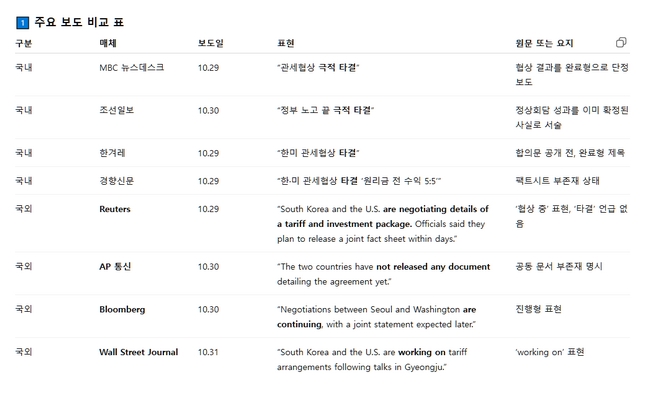 Comparison of reporting by South Korean and US media. Hanmi Ilbo graphic.
This pattern of misreporting is not new. During the South Korea-US currency swap negotiations in 2021, even after the government clarified it was "under discussion," many media outlets did not revise their headlines to "imminent agreement." Similarly, during the UAE investment agreement in 2023, despite the absence of a formal agreement, the phrase "30 billion dollar investment agreement" was prominently featured on portal sites.
This "agreement" reporting is an extension of that trend. The practice of aligning narratives with political signals rather than fact-checking, misinterpreting "a joint announcement is scheduled" as "an announcement has been made," and the collective psychology that "if everyone says it, it's not wrong" have paralyzed the media's verification function.
Some media outlets argue that "agreement" is a conventionally used term in diplomatic and trade reporting. They claim that the word "agreement" is used idiomatically when there has been a certain level of consensus or exchange of political will, even if negotiations are not fully concluded. However, this case demonstrated the limits of such conventions. The appearance of "agreement" in headlines without official documents or joint announcements went beyond the scope of convention and, when compared to foreign media's use of "negotiations ongoing," lacked prudence even by international standards.
There is also a counterargument that the Presidential Office's statements contained the nuance of an "agreement." The basis for this is the remark by a National Security Office official shortly after the meeting that "the two countries reached an agreement in broad terms." However, in diplomatic and trade negotiations, such phrasing corresponds to a political consensus, or "principled consensus," and is clearly distinct from "concluded deal," which signifies legal and administrative finalization.
Given that the Presidential Office explicitly drew a line two days later by stating, "The schedule for the release of the joint fact sheet has not been confirmed," the wording at the time should be considered at best a diplomatic euphemism, with no grounds to interpret it as a declaration that negotiations had concluded. Ultimately, the headlines reporting an "agreement" were the result of treating the nuance of the remarks as fact.
The weakening of South Korean media's verification function is also linked to industrial structure issues. In a competitive environment focused on breaking news, with reduced editorial staffs and fewer specialized journalists in diplomacy and economics, the reality where announcements become the standard for fact verification has become entrenched. In such a structure, media outlets should cross-verify facts independently in the absence of official documents, but this minimal procedure failed in this instance.
Hanmi Ilbo has decided to file a claim for corrective reporting of public interest regarding this matter with the Korea Media Mediation Arbitration Board. Article 14 of the Press Arbitration Act stipulates that "corrective reporting may be requested in the public interest." This is a procedure to rectify infringements on the public's right to know, rather than personal defamation.
Legal circles view the possibility of this claim being accepted as high, as it has been objectively confirmed that no fact sheet exists and the government has officially denied it. If a corrective reporting decision is made, this case could be recorded as a precedent for public interest media mediation.
In addition to the corrective reporting procedure with the Korea Media Mediation Arbitration Board, Hanmi Ilbo also plans to concurrently file a request for information disclosure with the Presidential Office regarding documents related to South Korea-US trade negotiations.
The purpose of the disclosure request is not merely to obtain data but to conduct a public interest investigation to verify the transparency between the government's official announcements and the actual negotiation content. Hanmi Ilbo intends to initiate objection and administrative appeal procedures under Article 3 of the Act on Disclosure of Information by Public Institutions if the Presidential Office does not clearly state the existence of the documents.
In negotiations concerning a nation's destiny, the damage inflicted upon the public by exaggeration or falsehoods, whether by the government or the media, can be immeasurable. A single line of incorrect information can shake diplomatic trust, alter market direction, and impact a nation's credit and security.
Diplomacy and trade are orders of trust built on facts, and it is often an inaccurate word, not an enemy, that shakes that order. Therefore, media verification and government transparency are two pillars that check each other and the last safety net supporting public trust.
There was no "agreement." What remained was the inertia of reporting language that had abandoned verification. And this linguistic habit is once again eroding trust in the South Korean media.

 Iranian Foreign Ministry: "Continuing Message Exchanges with the U.S. and Activities of Mediating Countries"
Esmaeil Baghaei, Spokesperson for the Iranian Ministry of Foreign Affairs [Xinhua, Yonhap News file photo]Esmaeil Baghaei, spokesperson for the Iranian Ministry of Foreign Affairs, stated on the 26th
Iranian Foreign Ministry: "Continuing Message Exchanges with the U.S. and Activities of Mediating Countries"
Esmaeil Baghaei, Spokesperson for the Iranian Ministry of Foreign Affairs [Xinhua, Yonhap News file photo]Esmaeil Baghaei, spokesperson for the Iranian Ministry of Foreign Affairs, stated on the 26th
 President Yoon: "Do You Think You Are Safe from the Special Counsel?"... Final Statement Video Released
President Yoon Suk Yeol rebuking the special prosecutor on the 24th. [Court video / @birds_justice X account subtitle GIF] A video of President Yoon Suk Yeol's closing statement at his trial rega
President Yoon: "Do You Think You Are Safe from the Special Counsel?"... Final Statement Video Released
President Yoon Suk Yeol rebuking the special prosecutor on the 24th. [Court video / @birds_justice X account subtitle GIF] A video of President Yoon Suk Yeol's closing statement at his trial rega
 President Yoon, regarding the first-instance ruling on the Public Official Election Act: “An excessive political verdict that distorts the facts… We will appeal immediately.”
The first-instance sentencing hearing for President Yoon Suk Yeol regarding violations of the Public Official Election Act is being broadcast live at Seoul Station on the 27th. [Photo=Yonhap News]Pres
President Yoon, regarding the first-instance ruling on the Public Official Election Act: “An excessive political verdict that distorts the facts… We will appeal immediately.”
The first-instance sentencing hearing for President Yoon Suk Yeol regarding violations of the Public Official Election Act is being broadcast live at Seoul Station on the 27th. [Photo=Yonhap News]Pres
 WSJ: "SK Hynix ADR Premium Is a Sign of AI Trading Overheat"
Advertisement for SK Hynix ADR listing in New York's Times Square [Reuters=Yonhap News file photo]The Wall Street Journal (WSJ) has pointed out that the price of SK Hynix’s American Depositary Recei
WSJ: "SK Hynix ADR Premium Is a Sign of AI Trading Overheat"
Advertisement for SK Hynix ADR listing in New York's Times Square [Reuters=Yonhap News file photo]The Wall Street Journal (WSJ) has pointed out that the price of SK Hynix’s American Depositary Recei
 'Godfather of Japanese Mystery Novels' Keigo Higashino Passes Away After Battle with Cancer at 68
Famous Japanese mystery novelist Keigo Higashino [AFP=Yonhap News]It has been belatedly reported that Keigo Higashino, the "godfather of Japanese mystery novels" and author of bestsellers such as "The
'Godfather of Japanese Mystery Novels' Keigo Higashino Passes Away After Battle with Cancer at 68
Famous Japanese mystery novelist Keigo Higashino [AFP=Yonhap News]It has been belatedly reported that Keigo Higashino, the "godfather of Japanese mystery novels" and author of bestsellers such as "The
 [Park Pil-kyu Security Column] To the Ignorant Trying to Clothe a Beast in Sheep's Clothing
Rep. Kim Byung-joo of the Democratic Party of Korea [Photo=Yonhap News]“The Air Force Academy doesn't teach you how to fly a plane!” “The Army, Navy, and Air Force academies are exactly the
[Park Pil-kyu Security Column] To the Ignorant Trying to Clothe a Beast in Sheep's Clothing
Rep. Kim Byung-joo of the Democratic Party of Korea [Photo=Yonhap News]“The Air Force Academy doesn't teach you how to fly a plane!” “The Army, Navy, and Air Force academies are exactly the
 [Issue Diagnosis] Two Effects of the Election Petition Review
 [Photo] Evidence of Election Fraud Flooding U.S. Media… Trump Had 2.7 Million Votes Stolen
 [Video] U.S. Semiquincentennial Air Show... 'Art in the Sky' streaks across New York
 [Editorial Cartoon] A Draconian Law That Undermines Freedom of Expression

 List
List










