 University lecture hall. The photo is unrelated to the article content. Yonhap News.
A collective cheating incident has been discovered during a midterm exam in a Yonsei University course, causing a stir on campus. Notably, it is known that a considerable number of students used AI, such as ChatGPT, in this process.
According to a comprehensive report by Yonhap News on the 9th, the professor of "Natural Language Processing (NLP) and ChatGPT," a course for third-year students at Yonsei University's Sinchon campus, recently announced, "Numerous instances of student cheating have been discovered. Students who confess will have their midterm exam scores marked as zero, while those who deny it will face academic probation in accordance with university regulations."
This course, which teaches generative AI such as natural language processing and large language models (LLMs), is reportedly attended by approximately 600 students. Due to the large enrollment, classes are conducted remotely. The midterm exam, held remotely on the 15th of last month, is where the incident occurred.
Measures were in place to prevent cheating. The exam involved answering multiple-choice questions by accessing an online site. Test-takers were required to submit videos of their computer screens, hands, and faces throughout the exam duration.
However, it is reported that some students engaged in cheating by adjusting their camera angles to create blind spots or by overlaying multiple programs on their computer screens. Some students also reportedly captured exam questions or continuously changed their screen windows and programs.
In response, the professor, after a thorough review of the videos with teaching assistants, identified these suspicious activities and encouraged students to "confess."
While the exact number of students who cheated is unknown, there are whispers among students that it could be more than half. One student posted a poll on the university community board "Everytime" titled "Let's vote honestly." As of that day, out of 387 respondents who identified as not being enrolled in the course, 211 voted "cheated" and 176 voted "solved it myself."
It is suspected that a significant number of students secretly used AI during the cheating process. Student A (25), a student in this course, told Yonhap News, "Most people use ChatGPT for the exam. It's a calculation that it would be difficult to get a good grade if I'm the only one not using it." Student B, who took the course last semester, also confessed, "Many of my friends, including myself, took the exam while searching with AI."
In relation to this, a Yonsei University official stated, "So far, about 40 students have confessed to cheating, and 10 students whose cheating is suspected have not yet confessed. If cheating is confirmed for students who have not confessed, disciplinary action may be considered."
 Generative AI infiltrating various aspects of daily life [Yonhap News archival photo]
Although it has been three years since generative AI became widespread, the confusion in universities appears to be growing. As AI capabilities rapidly advance and surpass the level of mere learning aids, university policies and ethical discussions on AI usage are failing to keep pace with the speed of development.
Last year, 91.7% of 726 university students from four- and six-year programs reported having used AI for assignments or research (survey by the Korea Research Institute for Vocational Education and Training). However, 71.1% of 131 universities nationwide had not yet established guidelines for generative AI (Korean Council for University Education).
There are also concerns that students' increasing reliance on AI is diminishing their ability to think independently.
Professor Jeong Gi-in of the Department of Korean Language and Literature at Kyung Hee University stated, "It's like students who need to learn how to walk are riding motorcycles (with AI). We are emphasizing the risks of AI dependency, but it's not easy."
Arguments are also being made for redefining educational and assessment methods in the AI era. Suggestions include actively permitting AI use while requiring transparent disclosure of sources.
Kim Myung-joo, Director of the AI Safety Research Institute, said, "We need to educate students on critical thinking by having them submit not only AI-generated results but also their personal opinions." Choi Byung-ho, Director of the Korea University AI Research Institute, suggested, "We need to develop new educational methods such as in-person presentations and in-depth discussions."
Yonhap News

 Trump pressures for rate cut again ahead of FOMC... "Should be the lowest in the world"
U.S. President Donald Trump. [Photo = The White House] U.S. President Donald Trump once again pressured the Federal Reserve, the U.S. central bank, to lower interest rates on the 27th (local time
Trump pressures for rate cut again ahead of FOMC... "Should be the lowest in the world"
U.S. President Donald Trump. [Photo = The White House] U.S. President Donald Trump once again pressured the Federal Reserve, the U.S. central bank, to lower interest rates on the 27th (local time
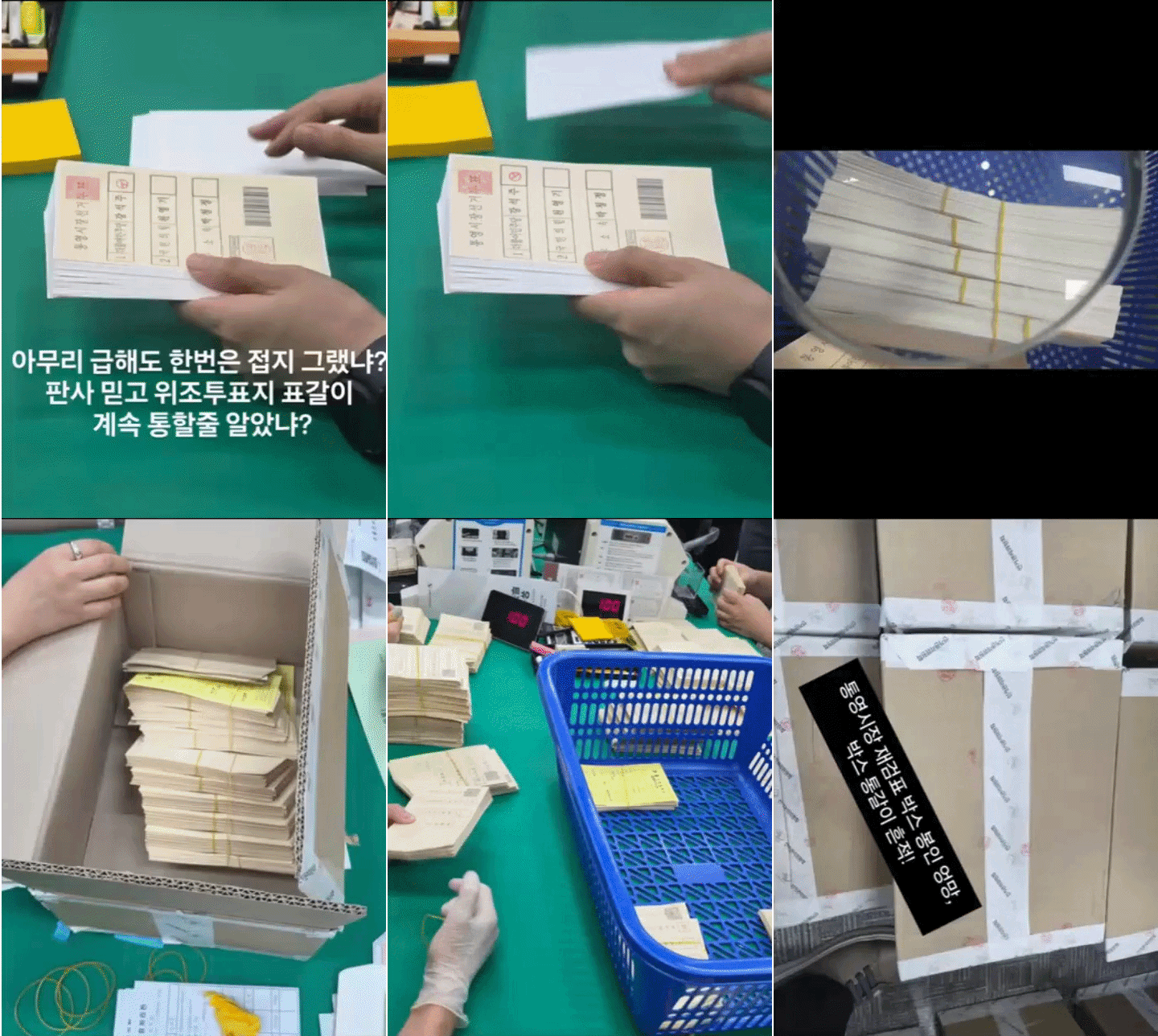 “Ignoring crisp ballots and damaged seals”… Tongyeong mayoral recount concludes with ‘no change in outcome,’ leaving suspicions and public outrage behind
Suspected counterfeit ballots discovered in Tongyeong [GIF from social media of Representative Hwang Kyo-ahn / Attorney Park Joo-hyun]During a recount of the Tongyeong mayoral election in South Gyeong
“Ignoring crisp ballots and damaged seals”… Tongyeong mayoral recount concludes with ‘no change in outcome,’ leaving suspicions and public outrage behind
Suspected counterfeit ballots discovered in Tongyeong [GIF from social media of Representative Hwang Kyo-ahn / Attorney Park Joo-hyun]During a recount of the Tongyeong mayoral election in South Gyeong
 President Yoon, regarding the first-instance ruling on the Public Official Election Act: “An excessive political verdict that distorts the facts… We will appeal immediately.”
The first-instance sentencing hearing for President Yoon Suk Yeol regarding violations of the Public Official Election Act is being broadcast live at Seoul Station on the 27th. [Photo=Yonhap News]Pres
President Yoon, regarding the first-instance ruling on the Public Official Election Act: “An excessive political verdict that distorts the facts… We will appeal immediately.”
The first-instance sentencing hearing for President Yoon Suk Yeol regarding violations of the Public Official Election Act is being broadcast live at Seoul Station on the 27th. [Photo=Yonhap News]Pres
 WSJ: "SK Hynix ADR Premium Is a Sign of AI Trading Overheat"
Advertisement for SK Hynix ADR listing in New York's Times Square [Reuters=Yonhap News file photo]The Wall Street Journal (WSJ) has pointed out that the price of SK Hynix’s American Depositary Recei
WSJ: "SK Hynix ADR Premium Is a Sign of AI Trading Overheat"
Advertisement for SK Hynix ADR listing in New York's Times Square [Reuters=Yonhap News file photo]The Wall Street Journal (WSJ) has pointed out that the price of SK Hynix’s American Depositary Recei
 'Godfather of Japanese Mystery Novels' Keigo Higashino Passes Away After Battle with Cancer at 68
Famous Japanese mystery novelist Keigo Higashino [AFP=Yonhap News]It has been belatedly reported that Keigo Higashino, the "godfather of Japanese mystery novels" and author of bestsellers such as "The
'Godfather of Japanese Mystery Novels' Keigo Higashino Passes Away After Battle with Cancer at 68
Famous Japanese mystery novelist Keigo Higashino [AFP=Yonhap News]It has been belatedly reported that Keigo Higashino, the "godfather of Japanese mystery novels" and author of bestsellers such as "The
 [Park Pil-kyu Security Column] To the Ignorant Trying to Clothe a Beast in Sheep's Clothing
Rep. Kim Byung-joo of the Democratic Party of Korea [Photo=Yonhap News]“The Air Force Academy doesn't teach you how to fly a plane!” “The Army, Navy, and Air Force academies are exactly the
[Park Pil-kyu Security Column] To the Ignorant Trying to Clothe a Beast in Sheep's Clothing
Rep. Kim Byung-joo of the Democratic Party of Korea [Photo=Yonhap News]“The Air Force Academy doesn't teach you how to fly a plane!” “The Army, Navy, and Air Force academies are exactly the
 [Issue Diagnosis] Two Effects of the Election Petition Review
 [Photo] Evidence of Election Fraud Flooding U.S. Media… Trump Had 2.7 Million Votes Stolen
 [Video] U.S. Semiquincentennial Air Show... 'Art in the Sky' streaks across New York
 [Editorial Cartoon] A Draconian Law That Undermines Freedom of Expression

 List
List










