Students are working on their final problems at Inhwa Girls' High School in Michuhol-gu, Incheon, on November 13, the day of the 2026 College Scholastic Ability Test (CSAT). Yonhap News.
The Korean language, mathematics, and English sections of the 2026 College Scholastic Ability Test (CSAT), administered on November 13, were evaluated as slightly more difficult than the previous year, with problems designed to differentiate high-achieving students.
In Korean, the 'Reading Comprehension' section was noted for its high difficulty, while mathematics was analyzed as having questions that appropriately secured differentiation among top-tier students.
English was expected to be at a similar difficulty level to the September mock evaluation, with the rate of first-grade students (scoring 90 points or above) at only 4.5%.
Kim Chang-won, professor at Kyung-in National University of Education and head of the 2026 CSAT exam committee, stated at a briefing held at the Government Complex Sejong on the same day, "We have evenly distributed questions of appropriate difficulty to ensure differentiation solely based on content covered in public education. We have excluded questions that would favor students who have learned problem-solving techniques and repeatedly practiced them in private tutoring institutions."
The CSAT Steering Committee stated that, similar to last year, this year's CSAT also excluded "killer questions" (extremely difficult questions) and focused on questions of appropriate difficulty tailored to the content and level of the high school curriculum.
◇ "Korean 'Reading Comprehension' Difficulty High, Math Differentiates Top Performers... English Similar to September Mock Exam Level"
Yoon Yoon-gu, a professor at the University of Education, Korea National University of Education, and head of the EBS Field Teacher Group, commented, "The overall difficulty of the 2026 CSAT was assessed as similar to last year's exam, but questions designed to differentiate the very top-tier students were slightly more difficult compared to the previous year's CSAT, so students likely felt it was somewhat more difficult than the 2025 CSAT."
Professor Yoon added, "Overall, the difficulty is similar to the previous year, but the questions to differentiate the very top and top-tier students were a bit more detailed."
Last year's CSAT was praised for achieving differentiation across all sections without killer questions, avoiding being labeled as either too easy ("water CSAT") or too difficult ("fire CSAT").
Looking at individual sections, Han Byung-hoon, a representative Korean language instructor for EBS at Deoksan High School in Chungnam, said, "The difficulty of reading comprehension increased, but the difficulty of literature and elective subjects decreased. Overall, the difficulty appears to be somewhat close to last year's CSAT and similar to the September mock evaluation by the Korea Institute for Curriculum and Evaluation."
Sim Ju-seok, a representative mathematics instructor for EBS at Haneul High School in Incheon, reported, "Mathematics is generally similar to last year's CSAT, but questions designed to differentiate top performers appear to have been appropriately included."
Kim Ye-ryeong, a representative English instructor for EBS at Daewon Foreign Language High School, stated, "In English, while overly complex and difficult passages were excluded, the attractiveness of incorrect answer choices was generally increased to ensure differentiation. We judge it to be somewhat more difficult than last year's CSAT and similar to the September mock evaluation."
In the Korea Institute for Curriculum and Evaluation's September mock evaluation, the percentage of students achieving first grade in English (scoring 90 points or above) was 4.50%, which was lower than the 4.71% in the previous year's CSAT, the lowest first-grade percentage for the main CSAT since English became a subject with absolute grading in 2018.
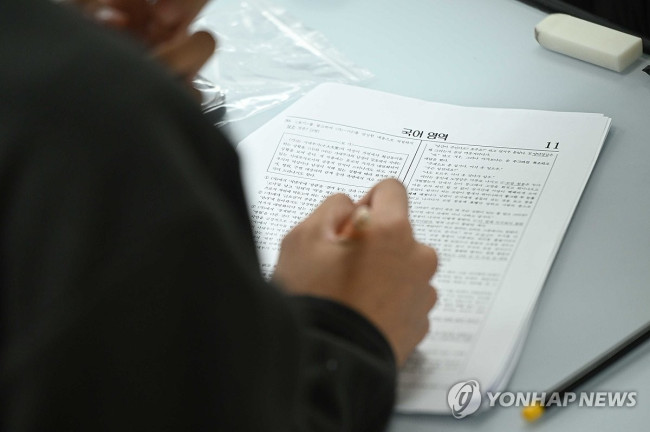 Students prepare for the exam at a testing center set up at Gyeongbok High School in Jongno-gu, Seoul, on November 13, the day of the 2026 College Scholastic Ability Test (CSAT). Yonhap News.
University admissions consulting firms also echoed the sentiment of the EBS field teachers, stating that the exam was more difficult than last year's CSAT.
Kim Won-jung, head of the admissions strategy department at Daesung Academy, analyzed, "The 2026 CSAT was definitively more difficult across Korean, mathematics, and English compared to last year. Korean and mathematics were administered at a similar difficulty level to the September mock evaluation, and English was administered at a slightly higher difficulty level than the September mock evaluation, thus strengthening differentiation."
He added, "Overall, it is assessed as an exam that has secured sufficient differentiation within the integrated curriculum system for science and humanities."
Jongro Academy stated, "Both Korean and mathematics were administered at a somewhat difficult level with differentiation. It is estimated to be similar to or slightly more difficult than last year's CSAT, and if it is at last year's level, it is sufficient to secure differentiation among top performers."
Kim Byung-jin, director of the Leetos Education Evaluation Research Institute, also commented, "Korean, mathematics, and English all appear to have been administered at a somewhat more difficult level than the previous year's CSAT. This is due to the inclusion of questions with a certain level of difficulty to secure differentiation, and it is highly likely that time management was challenging for students who had to solve problems within a set time."
Overall, while the exam was evaluated as similar to or more difficult than last year's CSAT without killer questions, it is expected that grades will vary among top performers based on how they solved the differentiating questions.
In Korean, question 12 in 'Reading Comprehension', which required understanding the meaning and relationships of various concepts related to thermal expansion, was considered a particularly challenging problem for students.
In mathematics, questions 22 (Mathematics I) and 21 (Mathematics II) in the common subjects, as well as questions 30 in Probability and Statistics, 30 in Calculus, and 30 in Geometry, were analyzed as having relatively high differentiation.
In English, question 39, a sentence insertion problem, and question 34, a blank-filling inference problem, were assessed as difficult.
 Families of students and Buddhists pray at Jogyesa Temple in Jongno-gu, Seoul, on November 13, the day of the 2026 College Scholastic Ability Test (CSAT). Yonhap News.
◇ Admissions Consulting Firms: "Increase in Current High School Seniors Makes Graduates Disadvantaged"
In the 2026 college admissions, a significant factor is expected to be the increase in the number of current high school seniors applying, while university recruitment numbers remain largely unchanged and the medical school enrollment quota has been returned to its pre-increase level.
This year's CSAT applicants numbered 554,174, an increase of 31,504 (6.0%) from the previous year, marking the highest number in seven years since the 2019 CSAT (594,924).
With the "Golden Pig Year" cohort of 2007, known for its high birth rate, now in their final year of high school and taking the CSAT, the number of current students increased by 31,120 to 371,897 (67.1%), while the number of graduates decreased by 1,862 to 159,922 (28.9%).
The medical school enrollment quota for 2026 has been reduced by 1,487 from the previous year to 3,123, returning to its pre-increase level. This is expected to intensify competition among the very top-tier applicants applying for natural science fields.
Another observation is that the "Social Studies Run" phenomenon, where students aspiring to enter engineering fields choose social studies instead of science studies, recognizing that social studies can be accepted as a CSAT subject for natural science departments at major universities, is expected to become a critical factor in admission decisions.
Yu-웨이, a university admissions consulting firm, predicted, "With the increase in current high school seniors and the return of medical school enrollment quotas to their original levels, the number of graduate applicants is decreasing, making graduates relatively more disadvantaged. With a large number of current high school seniors, if their proportion increases in regular admissions, the available slots for graduates will likely decrease."
 Students who have finished the exam leave the testing center at Yeongbok Girls' High School in Paldal-gu, Suwon-si, Gyeonggi Province, on November 13, the day of the 2026 College Scholastic Ability Test. Yonhap News.
Yonhap News

 Trump pressures for rate cut again ahead of FOMC... "Should be the lowest in the world"
U.S. President Donald Trump. [Photo = The White House] U.S. President Donald Trump once again pressured the Federal Reserve, the U.S. central bank, to lower interest rates on the 27th (local time
Trump pressures for rate cut again ahead of FOMC... "Should be the lowest in the world"
U.S. President Donald Trump. [Photo = The White House] U.S. President Donald Trump once again pressured the Federal Reserve, the U.S. central bank, to lower interest rates on the 27th (local time
 “Ignoring crisp ballots and damaged seals”… Tongyeong mayoral recount concludes with ‘no change in outcome,’ leaving suspicions and public outrage behind
Suspected counterfeit ballots discovered in Tongyeong [GIF from social media of Representative Hwang Kyo-ahn / Attorney Park Joo-hyun]During a recount of the Tongyeong mayoral election in South Gyeong
“Ignoring crisp ballots and damaged seals”… Tongyeong mayoral recount concludes with ‘no change in outcome,’ leaving suspicions and public outrage behind
Suspected counterfeit ballots discovered in Tongyeong [GIF from social media of Representative Hwang Kyo-ahn / Attorney Park Joo-hyun]During a recount of the Tongyeong mayoral election in South Gyeong
 President Yoon, regarding the first-instance ruling on the Public Official Election Act: “An excessive political verdict that distorts the facts… We will appeal immediately.”
The first-instance sentencing hearing for President Yoon Suk Yeol regarding violations of the Public Official Election Act is being broadcast live at Seoul Station on the 27th. [Photo=Yonhap News]Pres
President Yoon, regarding the first-instance ruling on the Public Official Election Act: “An excessive political verdict that distorts the facts… We will appeal immediately.”
The first-instance sentencing hearing for President Yoon Suk Yeol regarding violations of the Public Official Election Act is being broadcast live at Seoul Station on the 27th. [Photo=Yonhap News]Pres
 WSJ: "SK Hynix ADR Premium Is a Sign of AI Trading Overheat"
Advertisement for SK Hynix ADR listing in New York's Times Square [Reuters=Yonhap News file photo]The Wall Street Journal (WSJ) has pointed out that the price of SK Hynix’s American Depositary Recei
WSJ: "SK Hynix ADR Premium Is a Sign of AI Trading Overheat"
Advertisement for SK Hynix ADR listing in New York's Times Square [Reuters=Yonhap News file photo]The Wall Street Journal (WSJ) has pointed out that the price of SK Hynix’s American Depositary Recei
 'Godfather of Japanese Mystery Novels' Keigo Higashino Passes Away After Battle with Cancer at 68
Famous Japanese mystery novelist Keigo Higashino [AFP=Yonhap News]It has been belatedly reported that Keigo Higashino, the "godfather of Japanese mystery novels" and author of bestsellers such as "The
'Godfather of Japanese Mystery Novels' Keigo Higashino Passes Away After Battle with Cancer at 68
Famous Japanese mystery novelist Keigo Higashino [AFP=Yonhap News]It has been belatedly reported that Keigo Higashino, the "godfather of Japanese mystery novels" and author of bestsellers such as "The
 [Park Pil-kyu Security Column] To the Ignorant Trying to Clothe a Beast in Sheep's Clothing
Rep. Kim Byung-joo of the Democratic Party of Korea [Photo=Yonhap News]“The Air Force Academy doesn't teach you how to fly a plane!” “The Army, Navy, and Air Force academies are exactly the
[Park Pil-kyu Security Column] To the Ignorant Trying to Clothe a Beast in Sheep's Clothing
Rep. Kim Byung-joo of the Democratic Party of Korea [Photo=Yonhap News]“The Air Force Academy doesn't teach you how to fly a plane!” “The Army, Navy, and Air Force academies are exactly the
 [Issue Diagnosis] Two Effects of the Election Petition Review
 [Photo] Evidence of Election Fraud Flooding U.S. Media… Trump Had 2.7 Million Votes Stolen
 [Video] U.S. Semiquincentennial Air Show... 'Art in the Sky' streaks across New York
 [Editorial Cartoon] A Draconian Law That Undermines Freedom of Expression

 List
List