 Demilitarized Zone (DMZ). Yonhap News TV Capture
 Guest Columnist, Korea Military Academy Class of '80"Gray zone tactics," frequently mentioned among military and security terms recently, are an evolved military approach that blurs the opponent's legal and military standards, making immediate response difficult and gradually securing strategic interests. This is an asymmetric tactic that paralyzes the enemy's system without fighting, and an "enemy-defeating" method that persistently breaks the opponent's will and induces chaos without direct confrontation, leading them to collapse on their own.
1. Roots and Cases of Gray Zone Tactics
The common goal of gray zone tactics is to win without fighting, to delay the opponent's response by subtly crossing the boundaries of international norms, and to gradually expand influence through encroachment.
Gray zone tactics originate from the strategy of "winning without fighting" (不戰而勝) in ancient China's "The Art of War." China, observing the Gulf War (1991) and the Kosovo War (1999), determined that conventional military-centric strategies alone were insufficient to respond. While keenly feeling the need for asymmetric and non-military strategies that transcend the "warfare concept centered on military power," Chinese military personnel (Zhang Liang and Wang Xiangxu) established the theory of "unrestricted warfare," which transcends the limitations of traditional warfare by utilizing both military and non-military means.
China's unrestricted warfare encompasses a wide range of activities, from "Belt and Road" economic encroachment against neighboring countries to intervention in the national elections of influential nations and even physical incursions. By constructing artificial islands in the South China Sea and then deploying maritime police and militia, they have blurred the lines between civilian and military forces, effectively securing territorial rights. They repeatedly engage in high-intensity provocations that exploit legal ambiguity, such as installing two illegal steel offshore structures in the provisional measure zone of the West Sea and threatening our Coast Guard while they are inspecting Chinese fishing vessels.
Russia, during the annexation of Crimea in 2014, deployed "little green men" who were not identified as regular military forces, thereby delaying Ukraine's response. This is a gray zone tactic that combines military force with cyber and psychological warfare under the concept of "hybrid warfare."
2. North Korea's Gray Zone Tactics Cases
North Korea is also undermining our legal and military standards through provocations that are not quite wars, such as repeated ballistic missile provocations, incursions and firefights across the DMZ boundary, GPS jamming, and provocations at the NLL. They are employing gray zone tactics that create an ambiguous space, shaking our judgment and response standards, making it difficult for us to respond.
North Korea is not ignorant of the demarcation line. By crossing it back and forth, they are measuring our response speed, warning levels, and rules of engagement. They meticulously record how quickly our GP border patrol forces move, what tone warning broadcasts are made in, and to what extent the international community reacts. This is not an error but an accumulation of combat data for surprise attacks during a contingency and a survey of the combat space.
Has the Ministry of National Defense recently become unaware of North Korea's gray zone tactics? Or is it due to a sophisticated objective that we are unaware of, even though they know? Many of the Military Demarcation Line (MDL) markers installed immediately after the Armistice Agreement have been lost, causing confusion in the border perception between North and South Korea. Because of this, North Korean troops have repeatedly crossed in and out of the DMZ. Therefore, the Ministry proposed a military meeting to confirm the markers and re-establish the baseline.
South Korea is currently influenced by North Korea, China, and Russia, who employ gray zone tactics. The DMZ has transformed from a border area into a gray zone, a stage for psychological warfare. If conflicts arise from blurred boundaries, they can be resolved by erecting markers. However, if this is not "confusion of markers" but "strategic pressure to induce accidental clashes," we are falling into a tremendous scheme. After declaring "relations between two adversarial states" last year, North Korea has begun to borderize the DMZ area, repeatedly crossing the line in units of dozens of people, systematically testing the South Korean military's response methods. What is needed now is not dialogue but "automatic engagement rules" where warnings, interdiction, and suppression automatically activate based on the distance, scale, and armament of border crossings.
3. Defeating Gray Zone Tactics with "Quantum Technology" Strategy as the "Final Observer"
Gray zone tactics weaponize ambiguity and invisibility. To defeat them, we need a strategic team within the National Security Office capable of real-time detection and analysis of all threats from the position of the "final observer," the core of quantum technology, and a quantum technology-based surveillance and control system. The strategic team must analyze provocations from the enemy's perspective and adhere to clear positions and rules of engagement to avoid being deceived by the enemy's dual tactics.
We must analyze and disclose gray zone tactics early through advanced, multi-dimensional analysis such as quantum sensors, quantum cryptography communication, and quantum radar, and respond strategically and agilely. We must eliminate the ambiguity and uncertainty, which are the core of gray zone strategies, with insights that make the enemy's invisible dual threats "visible." To break through the trick of delaying our response by exploiting legal and military ambiguity based on technological superiority and non-military deterrence strategies, we must:
First, clearly establish rules and response criteria and build "automatic engagement rules." Second, respond swiftly and decisively from the initial stage of provocation to block gray zone infiltration. Third, counter disinformation and psychological warfare with fact-based rebuttals and strengthened cyber defenses. Fourth, we need joint responses centered on international cooperation and alliances, as well as convergent strategies combining diplomacy, economy, and technology in addition to military power.
We must respond precisely to North Korea's provocations and address China's encroachment with diplomatic diversification and an integrated security strategy. We must abandon the simplistic mindset of viewing the battlefield solely through a military lens and issue strategic guidelines by sector. The military must establish detailed response guidelines and conduct training for all areas, including measures for responding to and controlling maritime encroachment, responding to cyber and GPS jamming and infiltration, military information security, and protection of economic and industrial technology, so that we are no longer fooled by gray zone tactics. The military is urged to devise clearer countermeasures as the boundaries become more blurred.
Guest Columnist, Hankook Ilbo

 Trump pressures for rate cut again ahead of FOMC... "Should be the lowest in the world"
U.S. President Donald Trump. [Photo = The White House] U.S. President Donald Trump once again pressured the Federal Reserve, the U.S. central bank, to lower interest rates on the 27th (local time
Trump pressures for rate cut again ahead of FOMC... "Should be the lowest in the world"
U.S. President Donald Trump. [Photo = The White House] U.S. President Donald Trump once again pressured the Federal Reserve, the U.S. central bank, to lower interest rates on the 27th (local time
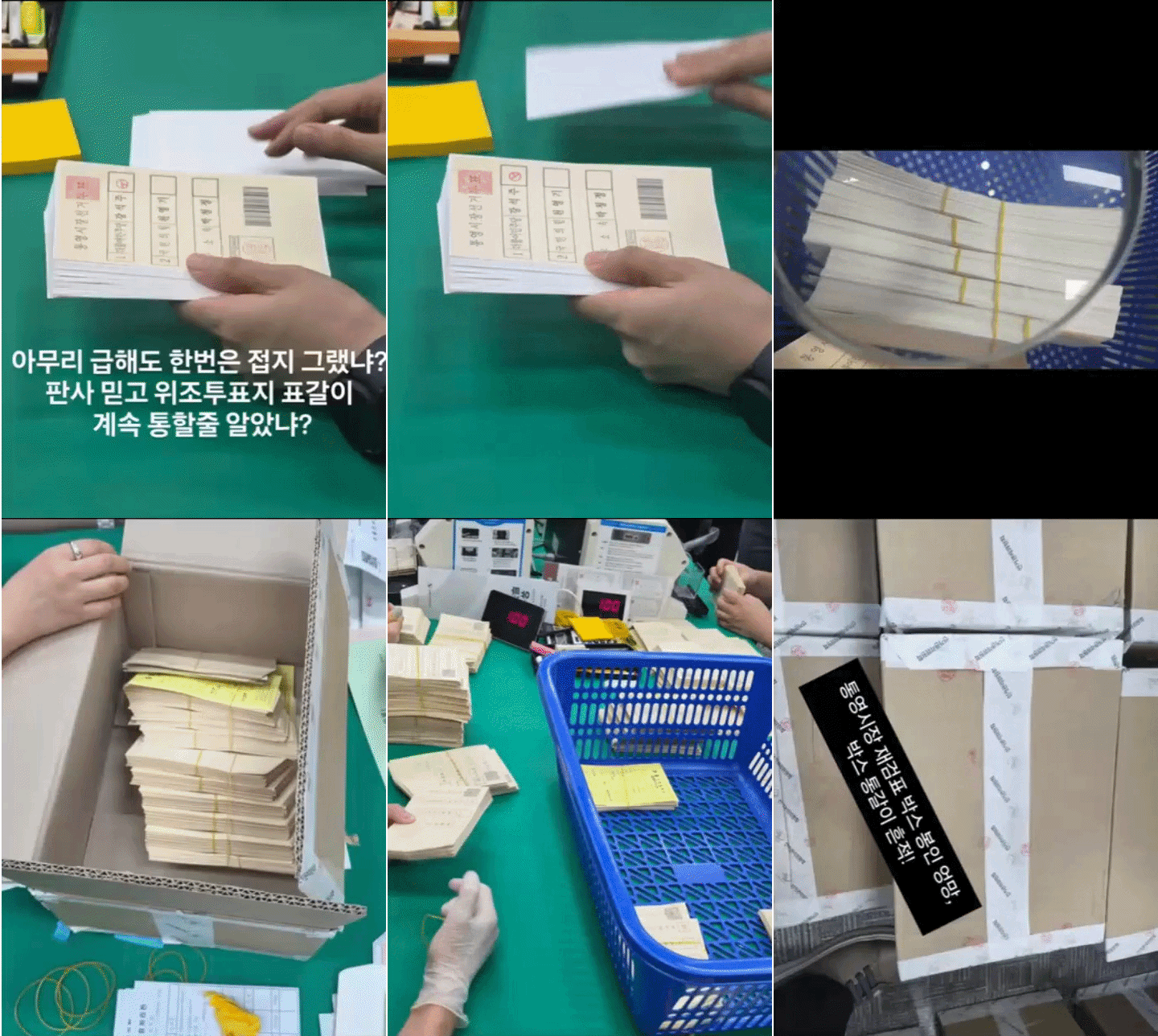 “Ignoring crisp ballots and damaged seals”… Tongyeong mayoral recount concludes with ‘no change in outcome,’ leaving suspicions and public outrage behind
Suspected counterfeit ballots discovered in Tongyeong [GIF from social media of Representative Hwang Kyo-ahn / Attorney Park Joo-hyun]During a recount of the Tongyeong mayoral election in South Gyeong
“Ignoring crisp ballots and damaged seals”… Tongyeong mayoral recount concludes with ‘no change in outcome,’ leaving suspicions and public outrage behind
Suspected counterfeit ballots discovered in Tongyeong [GIF from social media of Representative Hwang Kyo-ahn / Attorney Park Joo-hyun]During a recount of the Tongyeong mayoral election in South Gyeong
 President Yoon, regarding the first-instance ruling on the Public Official Election Act: “An excessive political verdict that distorts the facts… We will appeal immediately.”
The first-instance sentencing hearing for President Yoon Suk Yeol regarding violations of the Public Official Election Act is being broadcast live at Seoul Station on the 27th. [Photo=Yonhap News]Pres
President Yoon, regarding the first-instance ruling on the Public Official Election Act: “An excessive political verdict that distorts the facts… We will appeal immediately.”
The first-instance sentencing hearing for President Yoon Suk Yeol regarding violations of the Public Official Election Act is being broadcast live at Seoul Station on the 27th. [Photo=Yonhap News]Pres
 WSJ: "SK Hynix ADR Premium Is a Sign of AI Trading Overheat"
Advertisement for SK Hynix ADR listing in New York's Times Square [Reuters=Yonhap News file photo]The Wall Street Journal (WSJ) has pointed out that the price of SK Hynix’s American Depositary Recei
WSJ: "SK Hynix ADR Premium Is a Sign of AI Trading Overheat"
Advertisement for SK Hynix ADR listing in New York's Times Square [Reuters=Yonhap News file photo]The Wall Street Journal (WSJ) has pointed out that the price of SK Hynix’s American Depositary Recei
 'Godfather of Japanese Mystery Novels' Keigo Higashino Passes Away After Battle with Cancer at 68
Famous Japanese mystery novelist Keigo Higashino [AFP=Yonhap News]It has been belatedly reported that Keigo Higashino, the "godfather of Japanese mystery novels" and author of bestsellers such as "The
'Godfather of Japanese Mystery Novels' Keigo Higashino Passes Away After Battle with Cancer at 68
Famous Japanese mystery novelist Keigo Higashino [AFP=Yonhap News]It has been belatedly reported that Keigo Higashino, the "godfather of Japanese mystery novels" and author of bestsellers such as "The
 [Park Pil-kyu Security Column] To the Ignorant Trying to Clothe a Beast in Sheep's Clothing
Rep. Kim Byung-joo of the Democratic Party of Korea [Photo=Yonhap News]“The Air Force Academy doesn't teach you how to fly a plane!” “The Army, Navy, and Air Force academies are exactly the
[Park Pil-kyu Security Column] To the Ignorant Trying to Clothe a Beast in Sheep's Clothing
Rep. Kim Byung-joo of the Democratic Party of Korea [Photo=Yonhap News]“The Air Force Academy doesn't teach you how to fly a plane!” “The Army, Navy, and Air Force academies are exactly the
 [Issue Diagnosis] Two Effects of the Election Petition Review
 [Photo] Evidence of Election Fraud Flooding U.S. Media… Trump Had 2.7 Million Votes Stolen
 [Video] U.S. Semiquincentennial Air Show... 'Art in the Sky' streaks across New York
 [Editorial Cartoon] A Draconian Law That Undermines Freedom of Expression

 List
List









