The economy sent a warning, but the regime chose power. [Graphic=Korea Economic Daily]
South Korea's politics and economy had been in turmoil since early 2025. President Yoon Suk-yeol's impeachment process and the "December 3rd Incident" shook the nation's governance system, leaving South Korean society in a state of severe uncertainty.
However, amidst that chaos, the public held onto a glimmer of hope. The expectation was that with the end of the presidential election and the inauguration of a new administration, at least the political uncertainty would be reduced, and the economic situation would return to a predictable trajectory. This was because despite the significant turmoil, normalization seemed possible.
Yet, the reality that unfolded after the inauguration of the Lee Jae-myung administration was the complete opposite of these expectations. From the very moment the administration took office, it prioritized "political survival" over "economic stability."
A series of measures, including the neutralization of the prosecution, the abolition of policy audits by the Board of Audit and Inspection, intensified personnel vetting akin to election organizing within the public sector, an increase in Supreme Court justices, and the deletion of provisions regarding false statements in election law, were all aimed at "reform" but in practice, at the goals of seizing control of power institutions and monopolizing the interpretation of law.
While predictability, accountability, and consistency are essential for a nation's economy, the administration chose a path that easily enabled defensive measures, control, and immunity.
The market accurately detected this. This is why the exchange rate has normalized around the 1450-1500 won range.
The international financial markets began to view the administration's chosen methods as a greater risk than South Korea's structural limitations. Household credit reached an all-time high of 1,968 trillion won, and surpassing 2,000 trillion won was only a matter of time. Despite the increasing risk of real estate project financing (PF) defaults spreading throughout the financial sector, restructuring had not begun. Furthermore, while the money supply (M2)/Gross Domestic Product (GDP) ratio had expanded abnormally, liquidity normalization was postponed due to political burdens.
The economy demanded restructuring, and the market was sounding alarm bells, yet the administration ignored these signals. The incompetent administration, unwilling to bear responsibility despite a clear answer, blocked all decisions leading toward that answer.
However, the market is intelligent. If the administration evades choices, the market makes different ones.
Businesses began to prefer dollars over won and reduced domestic investment, while foreign investors started to add a "regime risk premium" to the exchange rate. Trapped in a situation where interest rates could neither be raised nor lowered, policy tools were effectively rendered powerless. This is because they recognized that PF defaults were being left unaddressed, generating zombie bonds and exacerbating the shock to the financial system.
When hope turns to disappointment, the market shifts its stage of activity. This is why the statement that the South Korean economy is "on the brink of crisis" is gaining traction.
The solutions the economy requires are clear, but the Lee Jae-myung administration, fearful of the responsibility it would have to bear if it chose those solutions, is seeking more institutional control mechanisms instead of making a choice. The historical pattern that "when the economy falters, politics leans towards dictatorship" is repeating itself in South Korea.
The structure where economic crisis leads to political authoritarianism is not confined to a specific country. Historical experiences repeat themselves identically everywhere and deliver the same message.
Looking at the cases of Latin America in the 1970s and 80s, Turkey in the 1990s following its financial crisis, and Hungary and Venezuela in the 2010s, it is evident that as economies faltered, political power shifted towards control and subjugation.
The moment a regime avoids painful restructuring, it becomes preoccupied with maintaining short-term power rather than long-term stability. Consequently, as institutional checks weaken, the state system naturally leans towards dictatorship. The various signs emerging in South Korea today precisely and structurally align with this historical pattern.
While there have been many factors shaking South Korea's politics and economy, the most painful among them is that, unlike conservative regimes, the progressive regime knew the solutions but did not choose them. And that avoidance made the entire system more fragile. The income-led growth policy that began under the Moon Jae-in administration has entered a phase of structuralizing the crisis under the Lee Jae-myung administration.
The "normalization" that the public desired after the change in administration has not been realized, and the administration has undermined even the predictability of the economy and the stability of politics.
The crisis was not spontaneous but a result of choices. The administration avoided decisions that entailed responsibility, and as the evasion of responsibility was repeated, the economy faltered. As the economy faltered, the center of gravity in politics shifted towards the concentration of power. This is the current state of South Korea.
"Before blaming the economy for its current state, one should first reflect on why such an administration was chosen."
#TheEconomySpokeTheTruth #TheRegimeEvadedResponsibility #OnTheBrinkOfCrisis #PoliticsLeaningTowardsDictatorship #PolicyDistrust #IgnoringEconomicWarnings #SouthKoreanEconomicRisk #KimYounghanMichalColumn

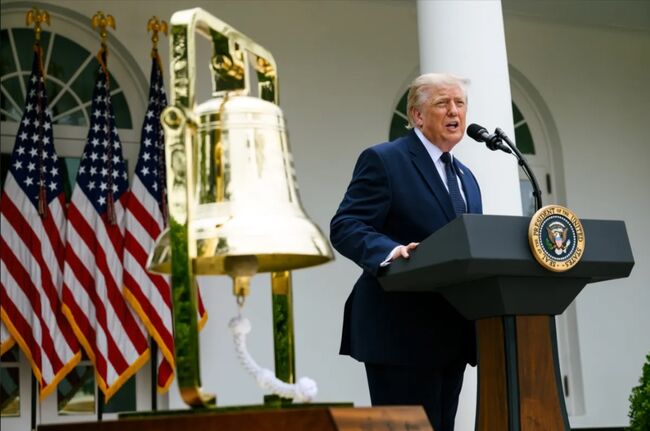 Trump pressures for rate cut again ahead of FOMC... "Should be the lowest in the world"
U.S. President Donald Trump. [Photo = The White House] U.S. President Donald Trump once again pressured the Federal Reserve, the U.S. central bank, to lower interest rates on the 27th (local time
Trump pressures for rate cut again ahead of FOMC... "Should be the lowest in the world"
U.S. President Donald Trump. [Photo = The White House] U.S. President Donald Trump once again pressured the Federal Reserve, the U.S. central bank, to lower interest rates on the 27th (local time
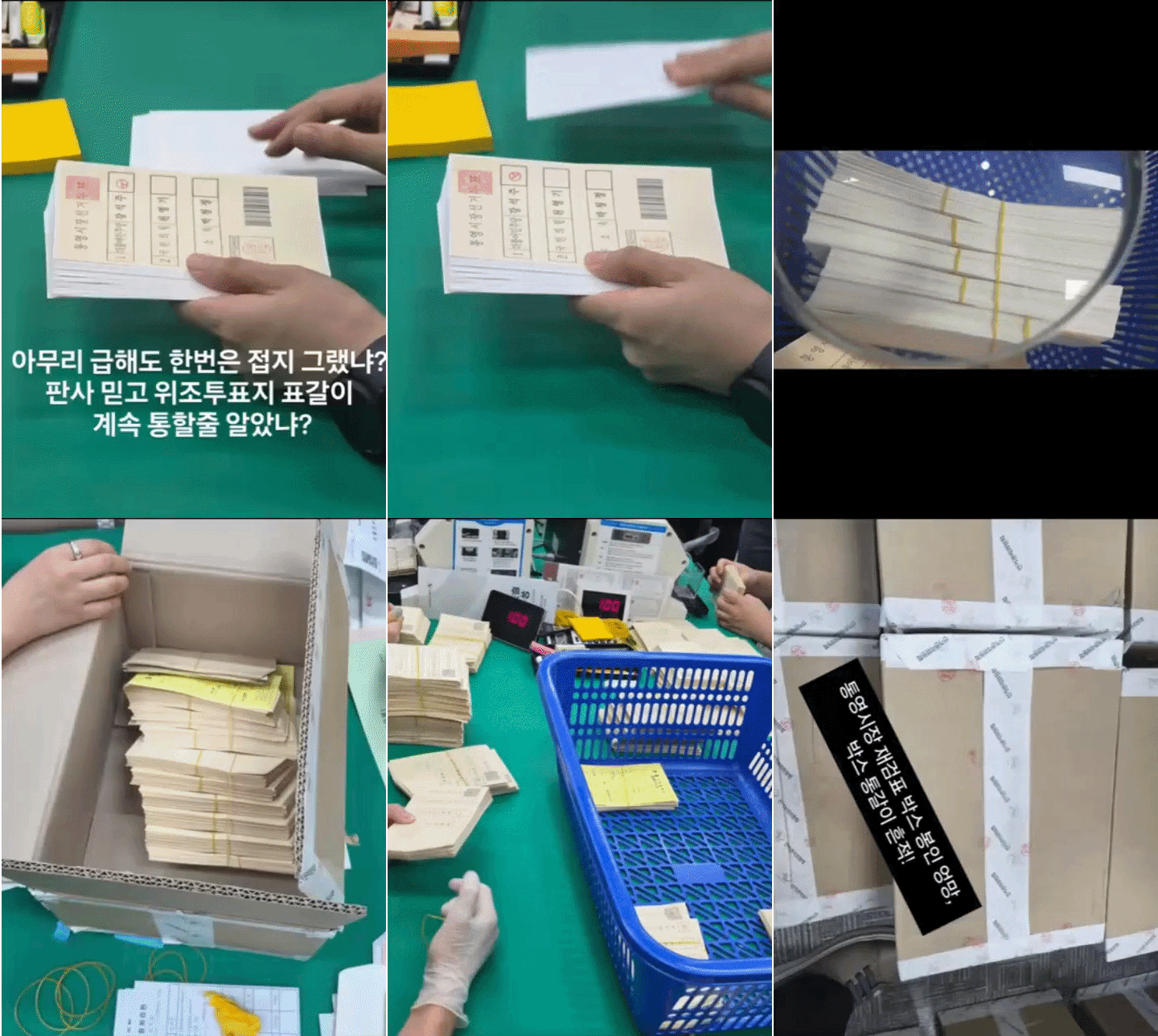 “Ignoring crisp ballots and damaged seals”… Tongyeong mayoral recount concludes with ‘no change in outcome,’ leaving suspicions and public outrage behind
Suspected counterfeit ballots discovered in Tongyeong [GIF from social media of Representative Hwang Kyo-ahn / Attorney Park Joo-hyun]During a recount of the Tongyeong mayoral election in South Gyeong
“Ignoring crisp ballots and damaged seals”… Tongyeong mayoral recount concludes with ‘no change in outcome,’ leaving suspicions and public outrage behind
Suspected counterfeit ballots discovered in Tongyeong [GIF from social media of Representative Hwang Kyo-ahn / Attorney Park Joo-hyun]During a recount of the Tongyeong mayoral election in South Gyeong
 President Yoon, regarding the first-instance ruling on the Public Official Election Act: “An excessive political verdict that distorts the facts… We will appeal immediately.”
The first-instance sentencing hearing for President Yoon Suk Yeol regarding violations of the Public Official Election Act is being broadcast live at Seoul Station on the 27th. [Photo=Yonhap News]Pres
President Yoon, regarding the first-instance ruling on the Public Official Election Act: “An excessive political verdict that distorts the facts… We will appeal immediately.”
The first-instance sentencing hearing for President Yoon Suk Yeol regarding violations of the Public Official Election Act is being broadcast live at Seoul Station on the 27th. [Photo=Yonhap News]Pres
 WSJ: "SK Hynix ADR Premium Is a Sign of AI Trading Overheat"
Advertisement for SK Hynix ADR listing in New York's Times Square [Reuters=Yonhap News file photo]The Wall Street Journal (WSJ) has pointed out that the price of SK Hynix’s American Depositary Recei
WSJ: "SK Hynix ADR Premium Is a Sign of AI Trading Overheat"
Advertisement for SK Hynix ADR listing in New York's Times Square [Reuters=Yonhap News file photo]The Wall Street Journal (WSJ) has pointed out that the price of SK Hynix’s American Depositary Recei
 'Godfather of Japanese Mystery Novels' Keigo Higashino Passes Away After Battle with Cancer at 68
Famous Japanese mystery novelist Keigo Higashino [AFP=Yonhap News]It has been belatedly reported that Keigo Higashino, the "godfather of Japanese mystery novels" and author of bestsellers such as "The
'Godfather of Japanese Mystery Novels' Keigo Higashino Passes Away After Battle with Cancer at 68
Famous Japanese mystery novelist Keigo Higashino [AFP=Yonhap News]It has been belatedly reported that Keigo Higashino, the "godfather of Japanese mystery novels" and author of bestsellers such as "The
 [Park Pil-kyu Security Column] To the Ignorant Trying to Clothe a Beast in Sheep's Clothing
Rep. Kim Byung-joo of the Democratic Party of Korea [Photo=Yonhap News]“The Air Force Academy doesn't teach you how to fly a plane!” “The Army, Navy, and Air Force academies are exactly the
[Park Pil-kyu Security Column] To the Ignorant Trying to Clothe a Beast in Sheep's Clothing
Rep. Kim Byung-joo of the Democratic Party of Korea [Photo=Yonhap News]“The Air Force Academy doesn't teach you how to fly a plane!” “The Army, Navy, and Air Force academies are exactly the
 [Issue Diagnosis] Two Effects of the Election Petition Review
 [Photo] Evidence of Election Fraud Flooding U.S. Media… Trump Had 2.7 Million Votes Stolen
 [Video] U.S. Semiquincentennial Air Show... 'Art in the Sky' streaks across New York
 [Editorial Cartoon] A Draconian Law That Undermines Freedom of Expression

 List
List