Although we are in an era of 1 trillion KRW AI budgets, it is pointed out that actual investment is focused on administrative labeling rather than data center and GPU infrastructure. [Graphic=Hanmi Ilbo]
While the Lee Jae-myung administration allocated a "1 trillion KRW AI package" in the 2026 budget, encompassing the AI Innovation Fund, Public AX (AI transformation of administration), and ministry-specific AI projects, stating it as "national strategic investment for the AI era," the National Assembly's budget review has raised opposing views, claiming "budgets are being inflated under the guise of AI."
The core issues are condensed into how to design for redundancy, performance indicators, and inter-ministerial coordination mechanisms. What is needed now is not an "AI slogan" but a structural verification of whether AI budgets actually lead to innovation.
The AI Innovation Fund, the first item presented by the government, is planned to be established with a scale of 100 billion KRW, aiming for concentrated investment in AI startups and new technology companies. However, its investment targets and objectives are nearly identical to the "AI, semiconductor, and bio" fields already announced by the National Growth Fund, making redundancy disputes unavoidable.
The opposition party pointed out conflicts of roles with policy financial institutions, a lack of recovery strategies, and the absence of risk management criteria, evaluating it as "a smaller version of the National Growth Fund" or "a policy fund's AI version." The criticism is that it's not a new design for innovation, but merely a rebranding of existing funds.
The Public AX budget, intended to transition administrative systems to an AI basis, is also allocated at 100 billion KRW, but there are no quantitative indicators anywhere to measure the project's performance. Improvements in administrative productivity can be measured by reduced work hours, faster complaint resolution, or the effect of personnel reallocation, but the government has not provided any criteria for these.
There are also strong criticisms of redundancy with existing digital transformation budgets within ministries. While all ministries, including the Ministry of the Interior and Safety, Ministry of Economy and Finance, Ministry of Science and ICT, and Ministry of Health and Welfare, operate DX projects, no blueprint has been presented to differentiate Public AX from existing projects.
Conflicts with private cloud and data standards remain unresolved issues. Public AX is evaluated as having had its budget appropriated without clarifying "what it is innovating" or "what it is conflicting with."
The surge in ministry-specific AI projects also shows many cases that appear to be "signboard changes" rather than "innovation synergies."
While there are over 20 projects with the name "AI," most are re-packaged forms of existing data maintenance, R&D tasks, and public system improvement projects under the AI category.
This includes simple upgrades of public databases being rephrased as "advanced AI analysis," complaint chatbot improvement projects being expanded to "AI-based smart complaint systems," and existing technology development tasks being incorporated as "AI applications."
Given that these are projects with the form of AI but the same content, the People Power Party lawmakers on the National Assembly's Budget and Accounts Subcommittee have labeled this as "AI Washing."
The core issue is that AI labeling is increasing faster than the growth of AI budgets. The investment targets for the National Growth Fund, the AI Innovation Fund, and ministry-specific AI projects are mixed, making it difficult to avoid redundancy. With the AI Committee, Ministry of Science and ICT, Ministry of the Interior and Safety, and Ministry of Trade, Industry and Energy each independently pursuing projects, the coordination mechanism is virtually in a state of vacuum. Due to the absence of a performance verification system, there is only budget input and no structure to measure policy effects.
The computing power, model development capabilities, and high-performance computing (HPC) infrastructure, which actually determine a nation's AI competitiveness, remain at OECD average levels, leading to further criticisms that budget expansion is preceding technological leadership.
The background to the rapid increase in AI budgets lies in the powerful phrase "AI is future competitiveness." While this phrase is true, when it operates in a way that nullifies verification, budgets end up following slogans rather than structure.
This is why questions are being raised about whether the government's various AI projects have been expanded based on the logic of political legitimacy rather than policy necessity. As analyzed by Hanmi Ilbo, Korea's current problem is closer to a structure where AI slogans are abundant, but AI strategy is absent.
Ultimately, the risk of AI budgets is not "insufficiency" but "indiscriminate allocation."
While large-scale investment is inevitable for Korea to create a definite turning point in the AI field, the current approach is more likely to generate redundancy than innovation.
Unless there is clear demarcation between the National Growth Fund and the AI Innovation Fund, establishment of performance indicators for Public AX, realignment of ministry-specific R&D and data projects, and the explicit establishment of a dedicated coordination body, Korea's AI budgets will inevitably be cemented into a "structure where budgets increase simply by attaching the name AI."
The questions needed now are not "how much are we spending" but "where, in what structure, and in a responsible manner are we spending it."
#AIbudget #AIInnovationFund #PublicAX #AIWashing #RedundantBudget #LackofPerformanceIndicators #SemiconductorStrategy #LackofHPC #WasteofFundsControversy #HanmiIlbo

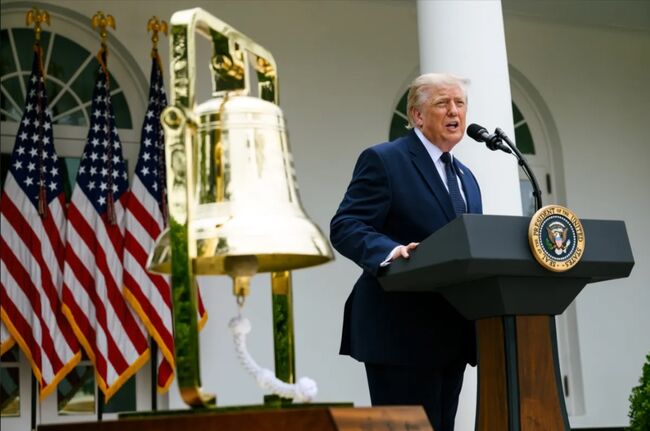 Trump pressures for rate cut again ahead of FOMC... "Should be the lowest in the world"
U.S. President Donald Trump. [Photo = The White House] U.S. President Donald Trump once again pressured the Federal Reserve, the U.S. central bank, to lower interest rates on the 27th (local time
Trump pressures for rate cut again ahead of FOMC... "Should be the lowest in the world"
U.S. President Donald Trump. [Photo = The White House] U.S. President Donald Trump once again pressured the Federal Reserve, the U.S. central bank, to lower interest rates on the 27th (local time
 “Ignoring crisp ballots and damaged seals”… Tongyeong mayoral recount concludes with ‘no change in outcome,’ leaving suspicions and public outrage behind
Suspected counterfeit ballots discovered in Tongyeong [GIF from social media of Representative Hwang Kyo-ahn / Attorney Park Joo-hyun]During a recount of the Tongyeong mayoral election in South Gyeong
“Ignoring crisp ballots and damaged seals”… Tongyeong mayoral recount concludes with ‘no change in outcome,’ leaving suspicions and public outrage behind
Suspected counterfeit ballots discovered in Tongyeong [GIF from social media of Representative Hwang Kyo-ahn / Attorney Park Joo-hyun]During a recount of the Tongyeong mayoral election in South Gyeong
 President Yoon, regarding the first-instance ruling on the Public Official Election Act: “An excessive political verdict that distorts the facts… We will appeal immediately.”
The first-instance sentencing hearing for President Yoon Suk Yeol regarding violations of the Public Official Election Act is being broadcast live at Seoul Station on the 27th. [Photo=Yonhap News]Pres
President Yoon, regarding the first-instance ruling on the Public Official Election Act: “An excessive political verdict that distorts the facts… We will appeal immediately.”
The first-instance sentencing hearing for President Yoon Suk Yeol regarding violations of the Public Official Election Act is being broadcast live at Seoul Station on the 27th. [Photo=Yonhap News]Pres
 WSJ: "SK Hynix ADR Premium Is a Sign of AI Trading Overheat"
Advertisement for SK Hynix ADR listing in New York's Times Square [Reuters=Yonhap News file photo]The Wall Street Journal (WSJ) has pointed out that the price of SK Hynix’s American Depositary Recei
WSJ: "SK Hynix ADR Premium Is a Sign of AI Trading Overheat"
Advertisement for SK Hynix ADR listing in New York's Times Square [Reuters=Yonhap News file photo]The Wall Street Journal (WSJ) has pointed out that the price of SK Hynix’s American Depositary Recei
 'Godfather of Japanese Mystery Novels' Keigo Higashino Passes Away After Battle with Cancer at 68
Famous Japanese mystery novelist Keigo Higashino [AFP=Yonhap News]It has been belatedly reported that Keigo Higashino, the "godfather of Japanese mystery novels" and author of bestsellers such as "The
'Godfather of Japanese Mystery Novels' Keigo Higashino Passes Away After Battle with Cancer at 68
Famous Japanese mystery novelist Keigo Higashino [AFP=Yonhap News]It has been belatedly reported that Keigo Higashino, the "godfather of Japanese mystery novels" and author of bestsellers such as "The
 [Park Pil-kyu Security Column] To the Ignorant Trying to Clothe a Beast in Sheep's Clothing
Rep. Kim Byung-joo of the Democratic Party of Korea [Photo=Yonhap News]“The Air Force Academy doesn't teach you how to fly a plane!” “The Army, Navy, and Air Force academies are exactly the
[Park Pil-kyu Security Column] To the Ignorant Trying to Clothe a Beast in Sheep's Clothing
Rep. Kim Byung-joo of the Democratic Party of Korea [Photo=Yonhap News]“The Air Force Academy doesn't teach you how to fly a plane!” “The Army, Navy, and Air Force academies are exactly the
 [Issue Diagnosis] Two Effects of the Election Petition Review
 [Photo] Evidence of Election Fraud Flooding U.S. Media… Trump Had 2.7 Million Votes Stolen
 [Video] U.S. Semiquincentennial Air Show... 'Art in the Sky' streaks across New York
 [Editorial Cartoon] A Draconian Law That Undermines Freedom of Expression

 List
List