Trump and Kim Jong Un met in Panmunjom in 2019. Yonhap News
Attention is focused on the background as the United States and China have recently omitted references to "denuclearization of the Korean Peninsula" as a goal in their major security documents, which is a departure from their previous stances.
Given that the U.S. and China can exert the greatest influence in inducing North Korea to re-engage in denuclearization talks, there is speculation that these omissions reflect a change in the two countries' commitment or attitude towards the denuclearization of the Korean Peninsula.
The National Security Strategy (NSS) released by the U.S. Donald Trump administration on the 5th (local time) did not mention the denuclearization of the Korean Peninsula at all, unlike the NSS published by the preceding Joe Biden administration and the first Trump administration.
The NSS sets the administration's key security goals and priorities and presents the general direction of strategies to achieve them. North Korea itself was not mentioned in this NSS.
This difference is considered unusual, as North Korea has always been mentioned as a major security threat, along with China, Russia, and Iran.
In contrast, the Biden administration's 2022 NSS stated, "We will pursue sustained diplomacy with North Korea to make visible progress toward the complete denuclearization of the Korean Peninsula, while also strengthening extended deterrence against North Korea's weapons of mass destruction (WMD) and missile threats."
The NSS released by the first Trump administration in 2017 also stated, "We are prepared to respond to North Korean aggression with overwhelming force and will enhance our options for compelling denuclearization of the Korean Peninsula," setting denuclearization as a task.
This has led to various interpretations, ranging from the view that the priority of denuclearization of the Korean Peninsula has been lowered in the Trump administration to the interpretation that it may be an effort to maintain diplomatic flexibility to avoid provoking North Korea in preparation for future dialogue resumption.
However, the Trump administration's second term has consistently reaffirmed its stance that the complete denuclearization of North Korea is the administration's policy objective towards North Korea, and this was also explicitly stated in the joint fact sheet of the ROK-U.S. summit released on the 13th of last month.
This NSS not only omits the denuclearization of the Korean Peninsula but also the expression "nuclear non-proliferation," which previous administrations consistently mentioned as a goal.
The strategic direction set in the NSS is to be further elaborated in the subsequent National Defense Strategy (NDS). Given that the fact that North Korea's nuclear weapons pose a substantial threat has not changed, it is anticipated that it will be addressed in some form in the NDS.
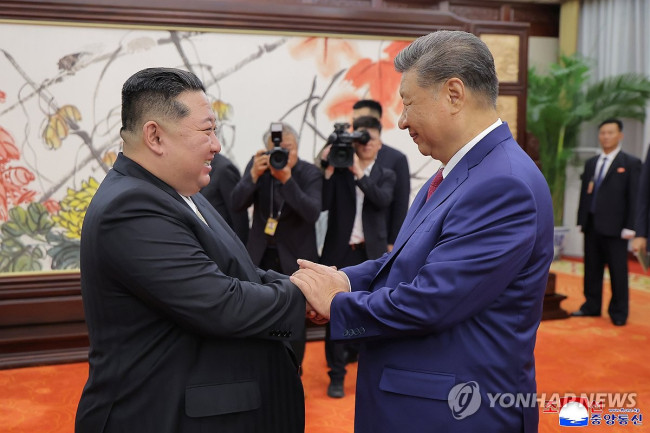 Kim Jong Un, Chairman of the State Affairs Commission of North Korea, and Xi Jinping, President of China. KCNA/Yonhap News
Amidst this, the South China Morning Post (SCMP) reported on the 6th that a white paper titled "China's Arms Control, Disarmament, and Non-Proliferation in the New Era," released by China on the 27th of last month, also omitted the phrase "support for the denuclearization of the Korean Peninsula."
The phrase "support for claims by relevant countries to establish nuclear-weapon-free zones in the Korean Peninsula, South Asia, Southeast Asia, the Middle East, etc.," which was present in the previous white paper published in September 2005, has been removed.
Instead, the white paper released this time stated, "China upholds a fair position and the right direction on the Korean Peninsula issue, has always strived for peace, stability, and prosperity on the peninsula, and is committed to the political resolution process of the peninsula issue."
It further stated, "China urges relevant parties to cease threats and pressure, resume dialogue and negotiations to promote political resolution, and play a constructive role in achieving long-term stability and peace on the Korean Peninsula."
Compared to 2018-2019, when North Korea-U.S. denuclearization talks were ongoing, China has been mentioning "denuclearization of the Korean Peninsula" less frequently not only in this arms control white paper but also in other official statements and policy documents.
In the joint declaration of the ROK-China-Japan trilateral summit held in Seoul in May of last year, the phrase "denuclearization of the Korean Peninsula is the goal," which was included in almost every previous summit, was absent, with reports indicating this was due to China's opposition.
Furthermore, during the five meetings between Chinese President Xi Jinping and North Korean Chairman Kim Jong Un in 2018-2019, denuclearization-related content was included in the outcome documents of each meeting. However, when the two leaders met in September, "denuclearization of the Korean Peninsula" was not mentioned.
These changes are leading to assessments that China, prioritizing strategic competition over cooperation with the United States, is changing its previous stance of "no tolerance for North Korean nuclear weapons" and is "implicitly accepting" North Korea as a nuclear-armed state to counter the U.S.

 First U.S. Ambassador of Trump's Second Term to Arrive This Week… Will It Provide Momentum to Resolve Pending Issues?
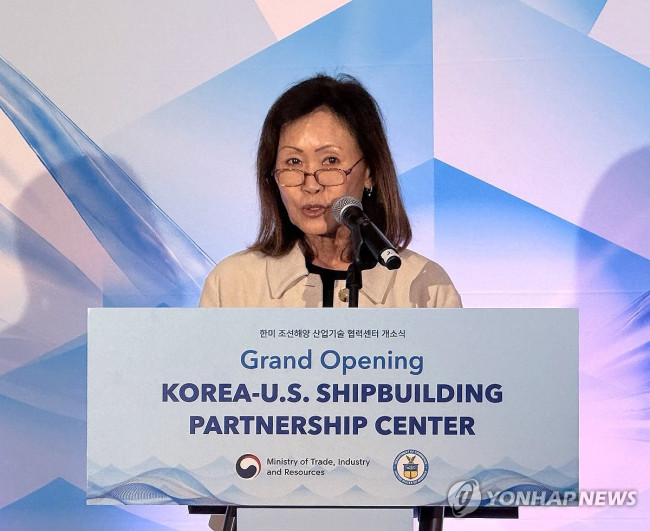
U.S. Ambassador to South Korea Michelle Steel speaks at the opening ceremony of the Korea-U.S. Shipbuilding Cooperation Center held at the Mayflower Hotel in Washington, D.C., on the 23rd (local time)
First U.S. Ambassador of Trump's Second Term to Arrive This Week… Will It Provide Momentum to Resolve Pending Issues?
U.S. Ambassador to South Korea Michelle Steel speaks at the opening ceremony of the Korea-U.S. Shipbuilding Cooperation Center held at the Mayflower Hotel in Washington, D.C., on the 23rd (local time)
 President Yoon, regarding the first-instance ruling on the Public Official Election Act: “An excessive political verdict that distorts the facts… We will appeal immediately.”
The first-instance sentencing hearing for President Yoon Suk Yeol regarding violations of the Public Official Election Act is being broadcast live at Seoul Station on the 27th. [Photo=Yonhap News]Pres
President Yoon, regarding the first-instance ruling on the Public Official Election Act: “An excessive political verdict that distorts the facts… We will appeal immediately.”
The first-instance sentencing hearing for President Yoon Suk Yeol regarding violations of the Public Official Election Act is being broadcast live at Seoul Station on the 27th. [Photo=Yonhap News]Pres
 Fire at Hyundai Motor Group Battery Research Facility in Uiwang… Ignited in Waste Storage Room
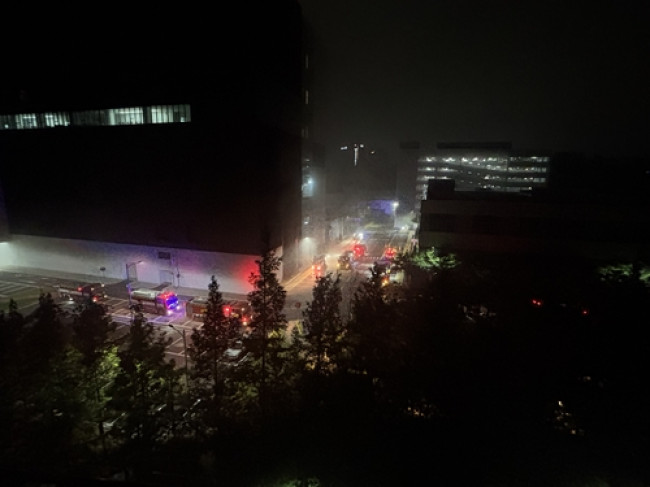
A fire broke out at the Hyundai Motor Group battery research building at its Uiwang Research Center in Sam-dong, Uiwang-si, Gyeonggi-do, at 12:48 a.m. on the 28th and was extinguished after approximat
Fire at Hyundai Motor Group Battery Research Facility in Uiwang… Ignited in Waste Storage Room
A fire broke out at the Hyundai Motor Group battery research building at its Uiwang Research Center in Sam-dong, Uiwang-si, Gyeonggi-do, at 12:48 a.m. on the 28th and was extinguished after approximat
 'Godfather of Japanese Mystery Novels' Keigo Higashino Passes Away After Battle with Cancer at 68
Famous Japanese mystery novelist Keigo Higashino [AFP=Yonhap News]It has been belatedly reported that Keigo Higashino, the "godfather of Japanese mystery novels" and author of bestsellers such as "The
'Godfather of Japanese Mystery Novels' Keigo Higashino Passes Away After Battle with Cancer at 68
Famous Japanese mystery novelist Keigo Higashino [AFP=Yonhap News]It has been belatedly reported that Keigo Higashino, the "godfather of Japanese mystery novels" and author of bestsellers such as "The
 [Park Pil-kyu Security Column] To the Ignorant Trying to Clothe a Beast in Sheep's Clothing
Rep. Kim Byung-joo of the Democratic Party of Korea [Photo=Yonhap News]“The Air Force Academy doesn't teach you how to fly a plane!” “The Army, Navy, and Air Force academies are exactly the
[Park Pil-kyu Security Column] To the Ignorant Trying to Clothe a Beast in Sheep's Clothing
Rep. Kim Byung-joo of the Democratic Party of Korea [Photo=Yonhap News]“The Air Force Academy doesn't teach you how to fly a plane!” “The Army, Navy, and Air Force academies are exactly the
 [Issue Diagnosis] Two Effects of the Election Petition Review
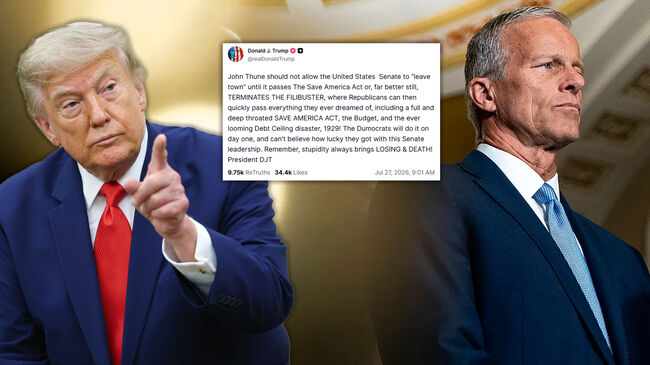 Trump Demands Passage of ‘SAVE Act’ Before Senate Recess
 [Photo] Evidence of Election Fraud Flooding U.S. Media… Trump Had 2.7 Million Votes Stolen
 [Video] U.S. Semiquincentennial Air Show... 'Art in the Sky' streaks across New York
 [Editorial Cartoon] A Draconian Law That Undermines Freedom of Expression

 List
List