- New Security Strategy Explained… Seems to be a message demanding expanded ROK roles and investments regarding North Korea defense.
- "Korea, Latest Case of Meeting New Alliance Defense Spending Criteria"
 A National Day reception hosted by the Korean Embassy in Washington D.C. was held at the Andrew Mellon Auditorium in Washington D.C., United States. Elbridge Colby, Deputy Assistant Secretary of Defense for Strategy and Force Development at the U.S. Department of Defense, is delivering congratulatory remarks. Yonhap News
Elbridge Colby, Deputy Assistant Secretary of Defense for Strategy and Force Development at the U.S. Department of Defense, emphasized on the 8th (local time) that Asian allies must make greater efforts for their own defense to maintain stability in the Indo-Pacific region.
In a post on his X (formerly Twitter) account on the 8th, explaining the intent of the Trump administration's new National Security Strategy (NSS) released on the 5th, Colby wrote, "Crucially, securing stability in the Indo-Pacific will require our Asian allies to do more to defend themselves."
Applying this to South Korea, it is interpreted that while the U.S. will 'selectively focus' its capabilities on preparations for contingencies in Taiwan, which is given the most weight in the NSS's Asia-related sections, South Korea will need to invest more capabilities than before in building conventional deterrence against North Korea and preventing North Korean provocations.
Colby added that the NSS's Asia section states, "We will build forces capable of deterring aggression anywhere along the first island chain (from Okinawa to Taiwan to the Philippines to the Strait of Malacca). But the United States cannot, and should not, do this alone. Allies must increase their defense spending and, more importantly, do much more for collective defense."
Regarding the NSS's declaration that deterring China's invasion of Taiwan by maintaining military superiority is a U.S. priority in Asia, Colby argued that it reflects President Trump's "America First approach to the Indo-Pacific."
Colby also stated that President Trump's global defense spending benchmark "is the heart of the NSS's burden-sharing and burden-shifting discussion," and similar to how North Atlantic Treaty Organization (NATO) members have pledged to spend 5% of their gross domestic product (GDP) on defense, "other countries are already stepping up to meet this new global standard, most recently South Korea."
Previously, in his congratulatory speech at a reception for Korea's National Day and Armed Forces Day held in Washington D.C. on November 14th, Colby described South Korea's decision to increase its defense spending to 3.5% of GDP as truly being a "model ally."
What do you think of this article?

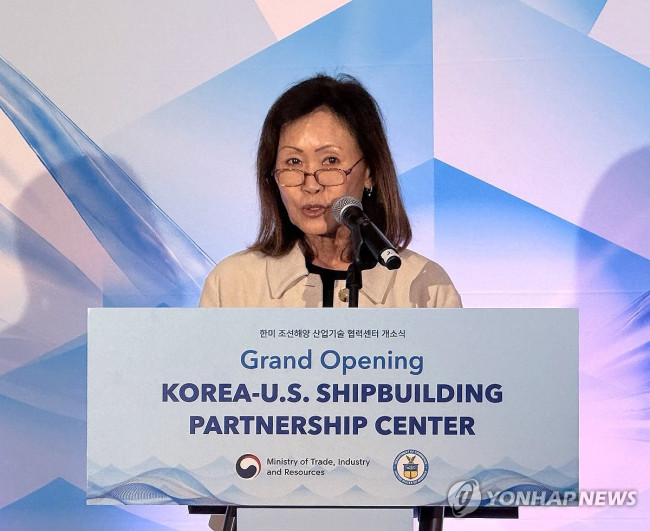 First U.S. Ambassador of Trump's Second Term to Arrive This Week… Will It Provide Momentum to Resolve Pending Issues?
U.S. Ambassador to South Korea Michelle Steel speaks at the opening ceremony of the Korea-U.S. Shipbuilding Cooperation Center held at the Mayflower Hotel in Washington, D.C., on the 23rd (local time)
First U.S. Ambassador of Trump's Second Term to Arrive This Week… Will It Provide Momentum to Resolve Pending Issues?
U.S. Ambassador to South Korea Michelle Steel speaks at the opening ceremony of the Korea-U.S. Shipbuilding Cooperation Center held at the Mayflower Hotel in Washington, D.C., on the 23rd (local time)
 President Yoon, regarding the first-instance ruling on the Public Official Election Act: “An excessive political verdict that distorts the facts… We will appeal immediately.”
The first-instance sentencing hearing for President Yoon Suk Yeol regarding violations of the Public Official Election Act is being broadcast live at Seoul Station on the 27th. [Photo=Yonhap News]Pres
President Yoon, regarding the first-instance ruling on the Public Official Election Act: “An excessive political verdict that distorts the facts… We will appeal immediately.”
The first-instance sentencing hearing for President Yoon Suk Yeol regarding violations of the Public Official Election Act is being broadcast live at Seoul Station on the 27th. [Photo=Yonhap News]Pres
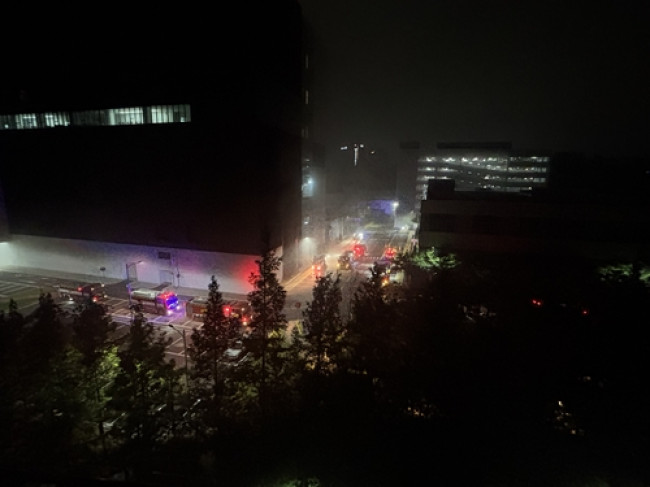 Fire at Hyundai Motor Group Battery Research Facility in Uiwang… Ignited in Waste Storage Room
A fire broke out at the Hyundai Motor Group battery research building at its Uiwang Research Center in Sam-dong, Uiwang-si, Gyeonggi-do, at 12:48 a.m. on the 28th and was extinguished after approximat
Fire at Hyundai Motor Group Battery Research Facility in Uiwang… Ignited in Waste Storage Room
A fire broke out at the Hyundai Motor Group battery research building at its Uiwang Research Center in Sam-dong, Uiwang-si, Gyeonggi-do, at 12:48 a.m. on the 28th and was extinguished after approximat
 'Godfather of Japanese Mystery Novels' Keigo Higashino Passes Away After Battle with Cancer at 68
Famous Japanese mystery novelist Keigo Higashino [AFP=Yonhap News]It has been belatedly reported that Keigo Higashino, the "godfather of Japanese mystery novels" and author of bestsellers such as "The
'Godfather of Japanese Mystery Novels' Keigo Higashino Passes Away After Battle with Cancer at 68
Famous Japanese mystery novelist Keigo Higashino [AFP=Yonhap News]It has been belatedly reported that Keigo Higashino, the "godfather of Japanese mystery novels" and author of bestsellers such as "The
 [Park Pil-kyu Security Column] To the Ignorant Trying to Clothe a Beast in Sheep's Clothing
Rep. Kim Byung-joo of the Democratic Party of Korea [Photo=Yonhap News]“The Air Force Academy doesn't teach you how to fly a plane!” “The Army, Navy, and Air Force academies are exactly the
[Park Pil-kyu Security Column] To the Ignorant Trying to Clothe a Beast in Sheep's Clothing
Rep. Kim Byung-joo of the Democratic Party of Korea [Photo=Yonhap News]“The Air Force Academy doesn't teach you how to fly a plane!” “The Army, Navy, and Air Force academies are exactly the
 [Issue Diagnosis] Two Effects of the Election Petition Review
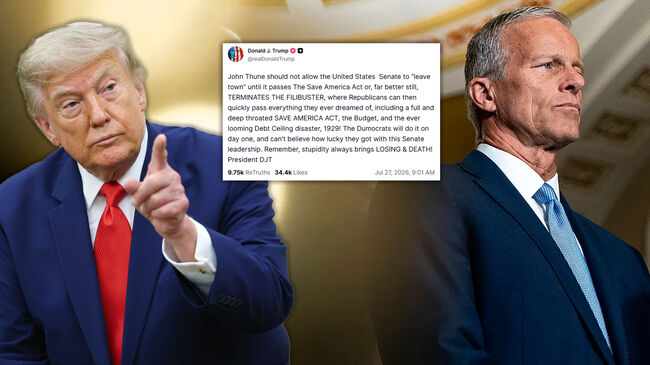 Trump Demands Passage of ‘SAVE Act’ Before Senate Recess
 [Photo] Evidence of Election Fraud Flooding U.S. Media… Trump Had 2.7 Million Votes Stolen
 [Video] U.S. Semiquincentennial Air Show... 'Art in the Sky' streaks across New York
 [Editorial Cartoon] A Draconian Law That Undermines Freedom of Expression

 List
List