- Republican 'Alternative Bill' and Democratic 'Extension Bill' Fail to Reach '60 Votes' Despite Successive Votes
- With stark differences in opinion between the two parties, next year's insurance premiums are expected to surge and become a major issue in the midterm elections.
 The U.S. Capitol Building in Washington D.C. [EPA Yonhap News file photo. Resale and database prohibited]
A bill submitted to the U.S. Senate to resolve the impending expiration of subsidies for health insurance premiums under the Affordable Care Act (ACA), also known as "Obamacare," was defeated on the 11th (local time), with both proposals from the ruling and opposition parties failing to pass.
The Senate held a vote in a plenary session that day on the bills submitted separately by the ruling Republican Party and the opposition Democratic Party.
The Republican bill, voted on first, was defeated with 51 votes in favor and 48 votes against. All 47 Democratic senators and Senator Rand Paul (Kentucky) of the Republican Party voted against it. The bill required at least 60 votes to pass.
This bill was jointly sponsored by Senator Bill Cassidy (Louisiana), Chairman of the Senate Committee on Health, Education, Labor, and Pensions, and Senator Mike Crapo (Idaho), Chairman of the Senate Finance Committee.
The core of the bill was to eliminate the Obamacare subsidies and instead expand Health Savings Accounts (HSAs), which offer tax benefits, while directly providing up to $1,500 (approximately 2.21 million Korean won) to low-income individuals.
President Donald Trump of the United States, who has consistently opposed providing Obamacare subsidies to insurance companies and advocated for providing subsidies directly to citizens so they can choose their own health insurance, had supported this bill.
In a subsequent vote, the Democratic bill also failed to pass. This bill, which proposed a three-year extension of Obamacare subsidy payments, was also defeated with 51 votes in favor and 48 votes against.
Four Republican senators, Susan Collins (Maine), Lisa Murkowski (Alaska), Dan Sullivan (Alaska), and Josh Hawley (Missouri), cast their votes in favor along with the Democrats. However, they did not garner the 60 votes needed for passage.
With stark disagreements between the two parties regarding Obamacare subsidies, the two bills, both expected to be defeated on this day, ultimately failed to pass the Senate, making it highly likely that Obamacare subsidies will expire at the end of this year.
Consequently, health insurance premium costs are expected to surge in the United States starting next year, which is anticipated to become a major political issue ahead of the midterm elections next year.
CNN reported that according to KFF, a non-partisan health policy research organization, the expiration of subsidies is projected to cause an average increase of more than double, or approximately $1,000, in enrollees' premiums. Furthermore, the Congressional Budget Office (CBO) estimated that approximately 2 million people would become uninsured next year if the subsidies expire.
What do you think of this article?

 First U.S. Ambassador of Trump's Second Term to Arrive This Week… Will It Provide Momentum to Resolve Pending Issues?
U.S. Ambassador to South Korea Michelle Steel speaks at the opening ceremony of the Korea-U.S. Shipbuilding Cooperation Center held at the Mayflower Hotel in Washington, D.C., on the 23rd (local time)
First U.S. Ambassador of Trump's Second Term to Arrive This Week… Will It Provide Momentum to Resolve Pending Issues?
U.S. Ambassador to South Korea Michelle Steel speaks at the opening ceremony of the Korea-U.S. Shipbuilding Cooperation Center held at the Mayflower Hotel in Washington, D.C., on the 23rd (local time)
 President Yoon, regarding the first-instance ruling on the Public Official Election Act: “An excessive political verdict that distorts the facts… We will appeal immediately.”
The first-instance sentencing hearing for President Yoon Suk Yeol regarding violations of the Public Official Election Act is being broadcast live at Seoul Station on the 27th. [Photo=Yonhap News]Pres
President Yoon, regarding the first-instance ruling on the Public Official Election Act: “An excessive political verdict that distorts the facts… We will appeal immediately.”
The first-instance sentencing hearing for President Yoon Suk Yeol regarding violations of the Public Official Election Act is being broadcast live at Seoul Station on the 27th. [Photo=Yonhap News]Pres
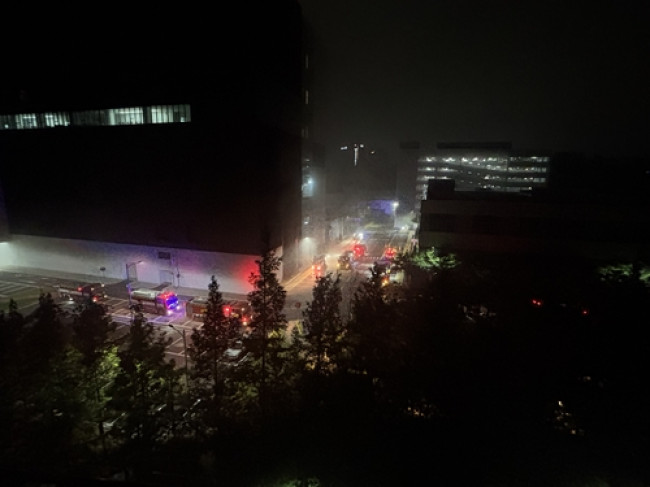 Fire at Hyundai Motor Group Battery Research Facility in Uiwang… Ignited in Waste Storage Room
A fire broke out at the Hyundai Motor Group battery research building at its Uiwang Research Center in Sam-dong, Uiwang-si, Gyeonggi-do, at 12:48 a.m. on the 28th and was extinguished after approximat
Fire at Hyundai Motor Group Battery Research Facility in Uiwang… Ignited in Waste Storage Room
A fire broke out at the Hyundai Motor Group battery research building at its Uiwang Research Center in Sam-dong, Uiwang-si, Gyeonggi-do, at 12:48 a.m. on the 28th and was extinguished after approximat
 'Godfather of Japanese Mystery Novels' Keigo Higashino Passes Away After Battle with Cancer at 68
Famous Japanese mystery novelist Keigo Higashino [AFP=Yonhap News]It has been belatedly reported that Keigo Higashino, the "godfather of Japanese mystery novels" and author of bestsellers such as "The
'Godfather of Japanese Mystery Novels' Keigo Higashino Passes Away After Battle with Cancer at 68
Famous Japanese mystery novelist Keigo Higashino [AFP=Yonhap News]It has been belatedly reported that Keigo Higashino, the "godfather of Japanese mystery novels" and author of bestsellers such as "The
 [Park Pil-kyu Security Column] To the Ignorant Trying to Clothe a Beast in Sheep's Clothing
Rep. Kim Byung-joo of the Democratic Party of Korea [Photo=Yonhap News]“The Air Force Academy doesn't teach you how to fly a plane!” “The Army, Navy, and Air Force academies are exactly the
[Park Pil-kyu Security Column] To the Ignorant Trying to Clothe a Beast in Sheep's Clothing
Rep. Kim Byung-joo of the Democratic Party of Korea [Photo=Yonhap News]“The Air Force Academy doesn't teach you how to fly a plane!” “The Army, Navy, and Air Force academies are exactly the
 [Issue Diagnosis] Two Effects of the Election Petition Review
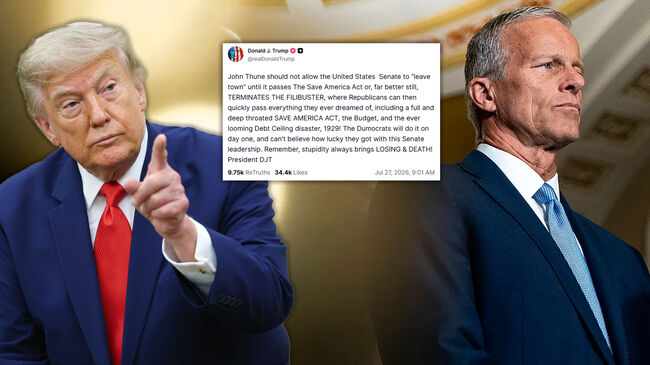 Trump Demands Passage of ‘SAVE Act’ Before Senate Recess
 [Photo] Evidence of Election Fraud Flooding U.S. Media… Trump Had 2.7 Million Votes Stolen
 [Video] U.S. Semiquincentennial Air Show... 'Art in the Sky' streaks across New York
 [Editorial Cartoon] A Draconian Law That Undermines Freedom of Expression

 List
List