‘Gallery Yesulsum’ exhibition hall with a view of the New Year’s sunrise at Jisepo Port. [Photo=Reporter Lim Yo-hee]
If you only remember Geojedo for famous tourist spots like Haegumgang, Windy Hill, and Oedo Botania, you only know a part of Geoje, Gyeongnam. Geoje has more cultural and artistic travel destinations hidden throughout than you might think.
Representative examples include the ‘Haejo-eum Museum of Art’, which houses the most works by artists from the Gyeongnam region, and ‘Gallery Yesulsum’, which exhibits works by contemporary artists. These two places offer a new perspective on appreciating art, in addition to the essence of Geoje’s blue sea.
Capturing the Sound of the Sea in Paintings ‘Haejo-eum Museum of Art’
Haejo-eum Museum of Art (Director Im Ho-geon), which has been quietly gaining word-of-mouth among recent Geoje travelers, allows you to encounter works that artistically reinterpret Geoje's natural landscape with the theme of ‘the sound of ocean waves (Haejo-eum)’.
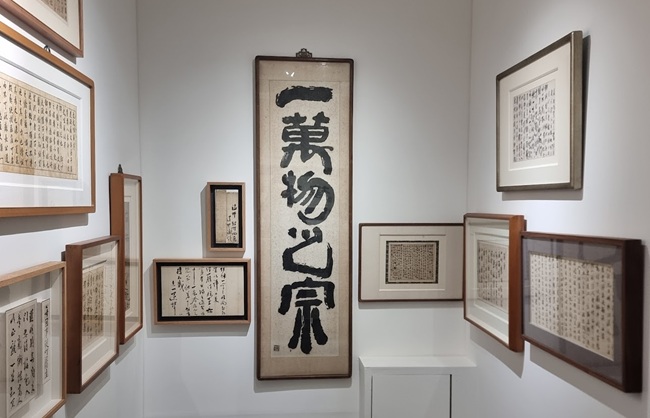
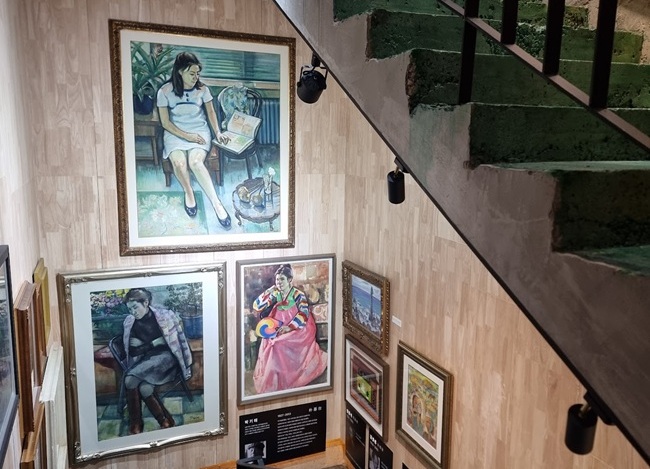 Chusa Kim Jeong-hui exhibition hall inside the Haejo-eum Museum of Art (above). The museum utilizes even the hallways as gallery spaces. [Photo=Reporter Lim Yo-hee]
Located on Chilcheon-ro, Hacheong-myeon, in the northern part of Geoje Island, Gyeongnam, the Haejo-eum Museum of Art is a permanent exhibition hall of modern art that opened in August. It was established by art collector Im Ho-geon, CEO of Gayatuksu Co., Ltd., who gathered about 430 works by 70 artists that he had collected over the years on his residential property.
Director Im began to take an interest in artists from the Busan and Gyeongnam regions ten years ago when he settled in Geoje Island, and has been consistently collecting their works.
The museum exhibits works imbued with the spirit of artists from the Gyeongnam region, spanning from the ‘Urge for Life’ era of the 1940s-1950s, through the ‘Discovery of Avant-garde Art’ era of the 1960s, to the ‘Beginning of Korean Abstract Art’ era of the 1970s.
One of the three buildings of the museum was where Director Im had lived for 10 years.
“While looking around to build a museum, I realized that the answer was right under my nose, and decided to remodel my home. Coincidentally, my neighbor asked me to buy their house, so I took over that property as well, and it became the current Haejo-eum Museum of Art.”
Haejo-eum Museum of Art primarily exhibits works by first and 1.5 generation artists from Busan and Gyeongnam. Director Im personally handled everything from selecting the artworks to the museum’s display before its opening.
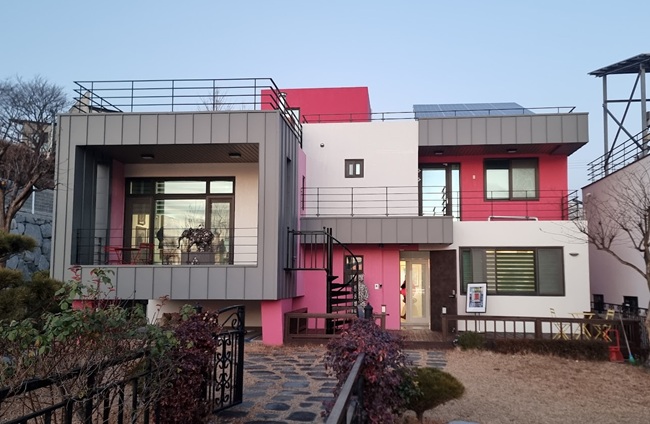
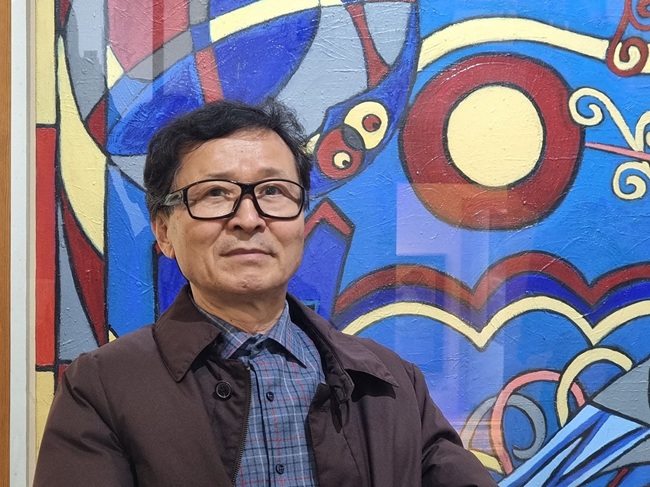 The main building of Haejo-eum Museum of Art (above) and Director Im Ho-geon being interviewed with a painting by artist Jeon Hyuk-lim in the background. [Photo=Reporter Lim Yo-hee]
Regarding his special focus on collecting works by artists from the Gyeongnam region, Director Im stated, “Initially, I didn’t limit myself to domestic or international artists, but as I am originally from Busan, I became interested in artists from this area and started collecting their works. Also, since there wasn’t a dedicated space to exhibit Busan artists, I decided to create one myself and opened this museum.”
“Geoje receives about 10 million visitors a year, and most of them think they’ve seen it all after visiting ‘Windy Hill’ and ‘Haegumgang’. However, I thought that visiting a local art museum while in Geoje could be a special memory. It would be even better if they could see the works of Gyeongnam artists before leaving.”
Even without Director Im’s words, tours of local museums and art galleries are now considered an essential part of local travel.
Exhibition Hall Specializing in Regional Hub Artists
Within Korea, visiting the Park Soo-keun Museum when in Yanggu, Gangwon-do, or exploring the Dangrim Museum of Art, which commemorates artist Lee Jong-moo, when in Asan, Chungcheongnam-do, has become a common itinerary. In March of this year, the ‘Kim Whanki Floating Museum’ is set to open in Sinan, Jeollanam-do.
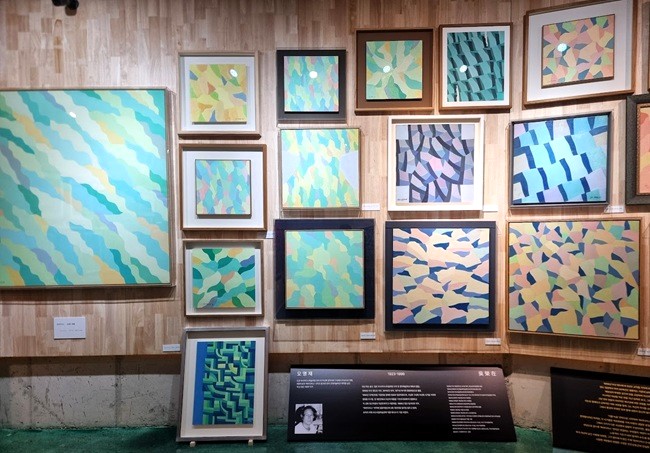 Paintings by artist Oh Young-jae, known as a pioneer of color field abstraction. [Photo=Reporter Lim Yo-hee]
Visiting a region and exploring the works of local artists enhances an outing that might otherwise be limited to seeing a few tourist attractions and sampling local cuisine, making it a more enriching and meaningful trip.
When asked if he had any particular favorite artists among the roughly 70 he collects, Director Im pointed to painters Kim Jong-sik, Yang Dal-seok, and Oh Young-jae.
He particularly favors the gentle paintings of Mr. Oh Young-jae. Artist Oh Young-jae, known as a pioneer of color field abstraction, focused on ‘Paradise’ as the theme for his later works.
“Paradise, in Buddhism, is ‘Jeongto’ (Pure Land). Mr. Oh Young-jae spent his life painting a paradise where freedom, peace, and happiness coexist. His unique color field segmentation possesses both Eastern lyricism and modern sophistication. Despite his poverty, he dedicated himself solely to his art, not holding a solo exhibition until he was over sixty. He was a person who strived to capture the essence beyond form on his canvas, viewing the world through the eyes of a poet.”
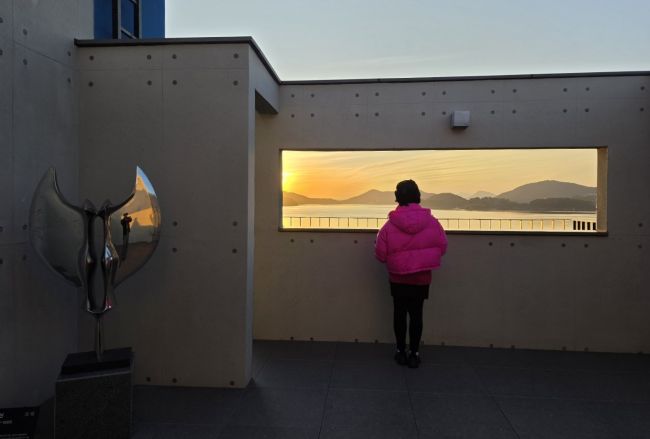 The rooftop of the annex of Haejo-eum Museum of Art offers another canvas that brings nature indoors. [Photo=Reporter Lim Yo-hee]
It seemed likely that some artworks were particularly difficult to acquire. Director Im mentioned that Mr. Kim Jong-sik’s works were unexpectedly hard to obtain.
“Although he was from Busan, his paintings were truly difficult to find. He came from a well-off family and was a professor, so he didn’t paint much (for a living). Even when he did paint, he didn’t sell them often.”
Director Im personally handled the museum’s display. He couldn’t entrust the task of adjusting the lighting for each artwork to someone else, adhering to his belief that ‘lighting is the completion of an exhibition’.
Thus, he changed his initial plan of displaying only about 200 pieces and instead arranged twice that amount, making the display appear somewhat dense. It took him a month and a half to exhibit all 430 pieces.
‘Gallery Yesulsum’: A Cultural and Artistic Hub for the Region
Gallery Yesulsum, located in Sodong-ri, Ilun-myeon, Geoje-si, is an art exhibition space that captures the region’s natural environment and island identity.
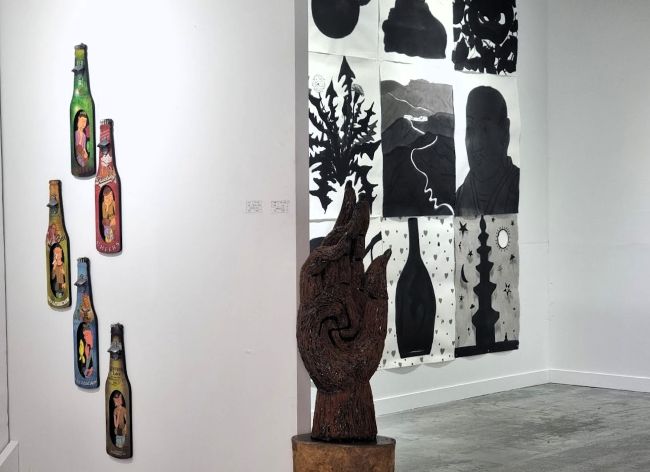
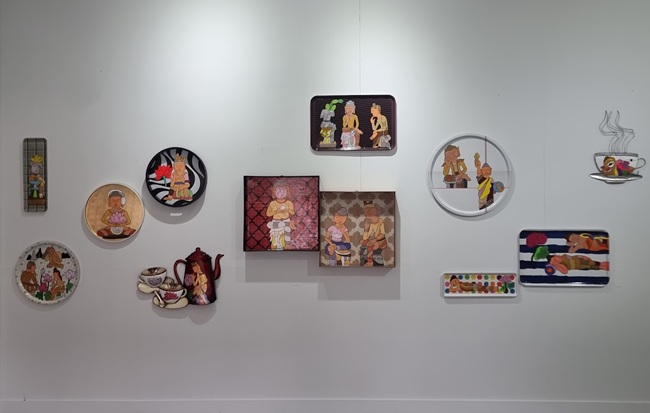
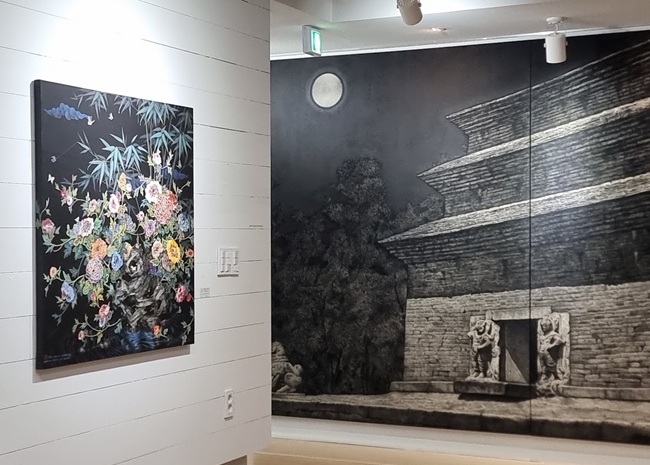 Gallery Yesulsum exhibition hall. [Photo=Reporter Lim Yo-hee]
Gallery Yesulsum opened in September last year with the ambition to exhibit ‘the ultimate luxury on Earth’ - art - in Jisepo Port, a location blessed with a magnificent natural environment.
After holding a joint exhibition of five artists, including Lee Jae-hyo, Chooni Park, Jang Tae-mook, Lee Gil-rae, and Lee In-ui, titled ‘Geoje Art Trip, Culture and Tourism’ for its opening exhibition, it recently hosted ‘Black Extinction, White Flourishing: A Thousand Years of Contemplation Exhibition’ featuring △Kwon Hak-jun △Park Bong-ki △Han-China Art Project SAYA △Yanbin △Wi Se-bok △Lee Jae-sam △Lee Ji-hoon △Jang Yi △Georgean Hong △Gio Choi △Chooni Park △Hwang Ju-ri.
Notably, it expanded the scope of art appreciation by exhibiting video works such as artist Jang Yi’s ‘Impermanence of All Things’. This work, created by mixing clay from Taihua Pond on Zhongtai Mountain in China’s Five Dynasties period and crafting a Buddhist monk’s bust using traditional methods, tracks its process of weathering and returning to nature in the outdoors of Five Dynasties Mountain for 60 days.
Artist Hwang Ju-ri, who accompanied the Geoje coverage, shared her exhibition thoughts regarding her ‘Buddha Within You’ series, referred to as the ‘Hwang Ju-ri style’: “The various forms of Buddha drawn on objects are also my feelings imbued in the objects. Among the things in the world, whether precious and expensive, or common and cheap, as time passes, they become limited editions that are no longer produced and decay into antiques. While embodying Buddha in objects, the artist has shed all worldly worries and attained rest and freedom.”
Gallery Yesulsum operates with three exhibition spaces: ‘Art Space 1’, ‘Art Space 2’, and ‘Art Forest’, and also runs the Sodong Yeonga Pension.
Artworks Created by Nature ‘Eastern Sunrise’
The large eastern windows in Sodong Yeonga Pension and the exhibition hall are canvases in themselves. If you are an early riser, you can have a special experience of capturing Jisepo Port’s sunrise in the same frame as the gallery’s exhibits.
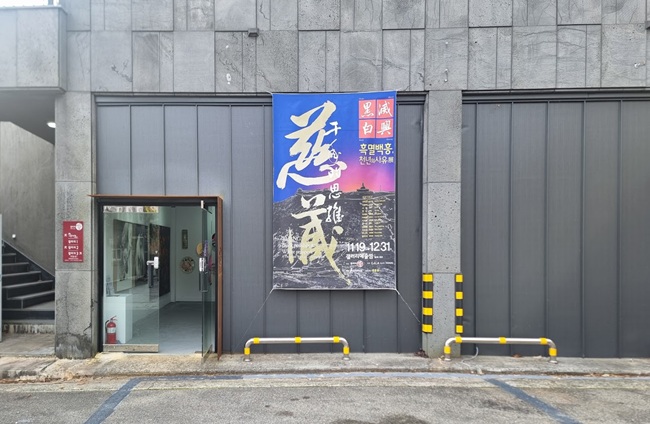
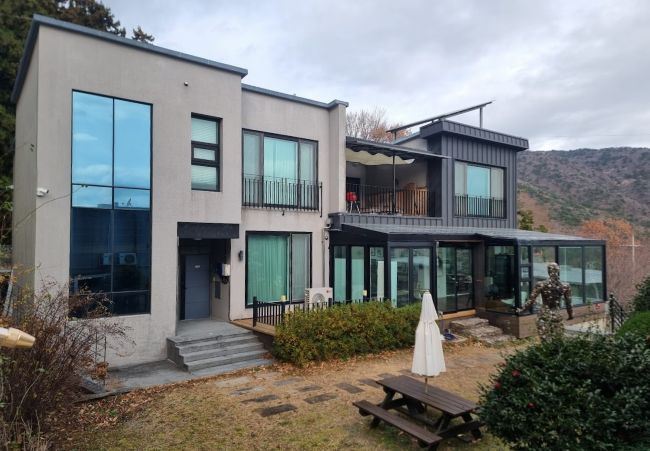
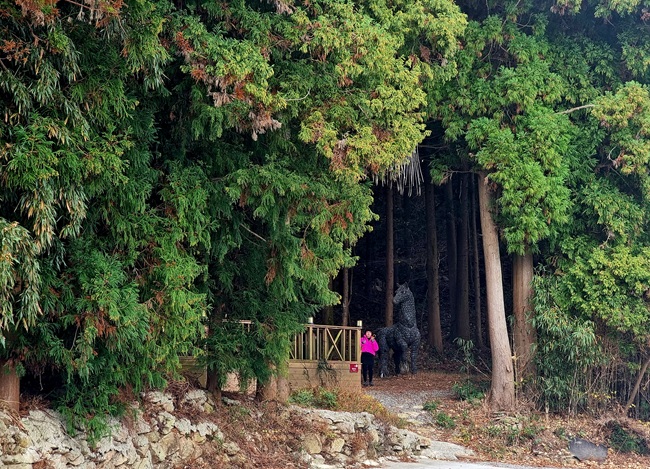
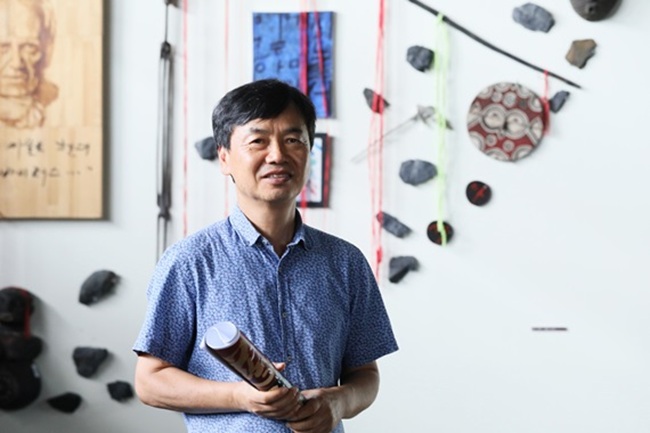 From top to bottom: △Gallery Yesulsum main exhibition hall △Sodong Yeonga Pension △Art Forest outdoor exhibition hall △Director Kim Hyung-seok. [Photo=Reporter Lim Yo-hee]
Additionally, the third exhibition space, ‘Art Forest’, offers a place to appreciate various sculptures against the backdrop of a dense cedar forest. This cedar forest, reminiscent of Jeju Island’s Saryeoni Forest (cedar forest), was originally planted during the Japanese colonial period for shipbuilding materials.
However, with the changes in eras and the replacement of wood with steel and plastic for shipbuilding, the cedar forest lost its purpose and was neglected. Director Kim Hyung-seok’s discerning eye, which sees value in all things, played a significant role in transforming such a place into an outdoor exhibition space.
Director Kim Hyung-seok, a graduate of Busan National University’s College of Fine Arts, was the originator of the 1991 Busan Sea Festival. He also successfully led major projects such as the artistic director of the 2018 Pyeongchang Culture Olympics Fire Art Festa. His connection to Geoje began when he worked as the director of the Geoje Culture and Arts Center.
He stated, “My dream is to make Gallery Yesulsum a tourism product that promotes local culture and art. I hope many people will visit Geoje, be embraced by the beautiful nature, and comfortably enjoy appreciating sculpture and painting works.”
Reporter Lim Yo-hee

 Iranian Foreign Ministry: "Continuing Message Exchanges with the U.S. and Activities of Mediating Countries"
Esmaeil Baghaei, Spokesperson for the Iranian Ministry of Foreign Affairs [Xinhua, Yonhap News file photo]Esmaeil Baghaei, spokesperson for the Iranian Ministry of Foreign Affairs, stated on the 26th
Iranian Foreign Ministry: "Continuing Message Exchanges with the U.S. and Activities of Mediating Countries"
Esmaeil Baghaei, Spokesperson for the Iranian Ministry of Foreign Affairs [Xinhua, Yonhap News file photo]Esmaeil Baghaei, spokesperson for the Iranian Ministry of Foreign Affairs, stated on the 26th
 President Yoon: "Do You Think You Are Safe from the Special Counsel?"... Final Statement Video Released
President Yoon Suk Yeol rebuking the special prosecutor on the 24th. [Court video / @birds_justice X account subtitle GIF] A video of President Yoon Suk Yeol's closing statement at his trial rega
President Yoon: "Do You Think You Are Safe from the Special Counsel?"... Final Statement Video Released
President Yoon Suk Yeol rebuking the special prosecutor on the 24th. [Court video / @birds_justice X account subtitle GIF] A video of President Yoon Suk Yeol's closing statement at his trial rega
 President Yoon, regarding the first-instance ruling on the Public Official Election Act: “An excessive political verdict that distorts the facts… We will appeal immediately.”
The first-instance sentencing hearing for President Yoon Suk Yeol regarding violations of the Public Official Election Act is being broadcast live at Seoul Station on the 27th. [Photo=Yonhap News]Pres
President Yoon, regarding the first-instance ruling on the Public Official Election Act: “An excessive political verdict that distorts the facts… We will appeal immediately.”
The first-instance sentencing hearing for President Yoon Suk Yeol regarding violations of the Public Official Election Act is being broadcast live at Seoul Station on the 27th. [Photo=Yonhap News]Pres
 WSJ: "SK Hynix ADR Premium Is a Sign of AI Trading Overheat"
Advertisement for SK Hynix ADR listing in New York's Times Square [Reuters=Yonhap News file photo]The Wall Street Journal (WSJ) has pointed out that the price of SK Hynix’s American Depositary Recei
WSJ: "SK Hynix ADR Premium Is a Sign of AI Trading Overheat"
Advertisement for SK Hynix ADR listing in New York's Times Square [Reuters=Yonhap News file photo]The Wall Street Journal (WSJ) has pointed out that the price of SK Hynix’s American Depositary Recei
 'Godfather of Japanese Mystery Novels' Keigo Higashino Passes Away After Battle with Cancer at 68
Famous Japanese mystery novelist Keigo Higashino [AFP=Yonhap News]It has been belatedly reported that Keigo Higashino, the "godfather of Japanese mystery novels" and author of bestsellers such as "The
'Godfather of Japanese Mystery Novels' Keigo Higashino Passes Away After Battle with Cancer at 68
Famous Japanese mystery novelist Keigo Higashino [AFP=Yonhap News]It has been belatedly reported that Keigo Higashino, the "godfather of Japanese mystery novels" and author of bestsellers such as "The
 [Park Pil-kyu Security Column] To the Ignorant Trying to Clothe a Beast in Sheep's Clothing
Rep. Kim Byung-joo of the Democratic Party of Korea [Photo=Yonhap News]“The Air Force Academy doesn't teach you how to fly a plane!” “The Army, Navy, and Air Force academies are exactly the
[Park Pil-kyu Security Column] To the Ignorant Trying to Clothe a Beast in Sheep's Clothing
Rep. Kim Byung-joo of the Democratic Party of Korea [Photo=Yonhap News]“The Air Force Academy doesn't teach you how to fly a plane!” “The Army, Navy, and Air Force academies are exactly the
 [Issue Diagnosis] Two Effects of the Election Petition Review
 [Photo] Evidence of Election Fraud Flooding U.S. Media… Trump Had 2.7 Million Votes Stolen
 [Video] U.S. Semiquincentennial Air Show... 'Art in the Sky' streaks across New York
 [Editorial Cartoon] A Draconian Law That Undermines Freedom of Expression

 List
List