President Trump and Chairman of the Joint Chiefs of Staff General Mark Milley explain the operation to apprehend Venezuelan President Nicolás Maduro. [AFP=Yonhap News]
The US military's surprise capture and extradition of Venezuelan President Nicolás Maduro on the 3rd (local time) marked the second major foreign military operation since the launch of Donald Trump's second administration (January 20 last year), occurring less than a year after its inauguration.
There have been several military operations targeting areas within foreign territories since the start of Trump's second administration, including airstrikes on Islamic State (IS) strongholds in Nigeria on the 25th of last month, coinciding with Christmas, and strikes targeting IS-related sites in Syria on the 19th of last month in retaliation for US soldiers killed by IS followers.
However, considering the magnitude of the impact based on the importance of the target and the risks the United States had to bear, this operation, along with the "Midnight Hammer" operation in June last year, which destroyed three major Iranian nuclear facilities in Fordow, Natanz, and Isfahan using B-2 bombers, can be considered the second "major military operation" of the Trump second administration.
This operation, codenamed "Firm Resolve," involved special forces to capture and extradite a head of state within their own territory. This is considered more dangerous and audacious than last year's military operation against Iran, which relied solely on airstrikes without ground troop deployment.
The reason these military operations, carried out since the launch of Trump's second term, are drawing attention is that a core tenet of "America First," which President Trump has advocated since entering politics, is the "minimization of foreign military intervention."
The history of the 21st century, where the US spent thousands of American lives and astronomical military expenditures on full-scale invasions and 10-20 year military occupations in Iraq and Afghanistan, yet failed to achieve "specific goals" such as establishing pro-US democratic regimes in the Middle East, is considered one of the factors explaining the starting point of "Trumpism."
In that regard, the proposition that "President Trump refrains from foreign military intervention" now faces significant counterarguments. This is because it has been confirmed through the cases of Iran and Venezuela that he will engage in bold military intervention using overwhelming military power if he deems it to be in America's national interest.
However, as seen in the two military operations, "surgical" and one-off military operations to achieve limited objectives, rather than full-scale military actions that can be called "war," have become a characteristic of Trump-style military intervention.
The operation to assassinate Qassem Soleimani, the commander of the elite Quds Force of Iran's Islamic Revolutionary Guard Corps (IRGC), in January 2020 during Trump's first term, can also be categorized similarly.
Furthermore, it is noteworthy that both Iran last year, which engaged in a purely symbolic retaliatory attack, and Venezuela, whose head of state was "arrested" without effective resistance, are countries that do not possess nuclear weapons, which could serve as a deterrent against overwhelming US military power.
In that respect, the attacks carried out against Iran and Venezuela since the start of Trump's second term are expected to send a message to other countries with difficult or adversarial relations with the US, such as China, North Korea, and Cuba, regardless of President Trump's intentions.
In particular, President Trump issued a warning-like message at a press conference on this day, not ruling out the possibility of Cuba and Colombia being the "next targets." Similar to Venezuela, these two countries are located in America's "backyard" and do not possess nuclear weapons. For their leaders, President Trump is poised to become an unpredictable "terror" who may, if necessary, launch an operation to oust them, disregarding international law controversies.
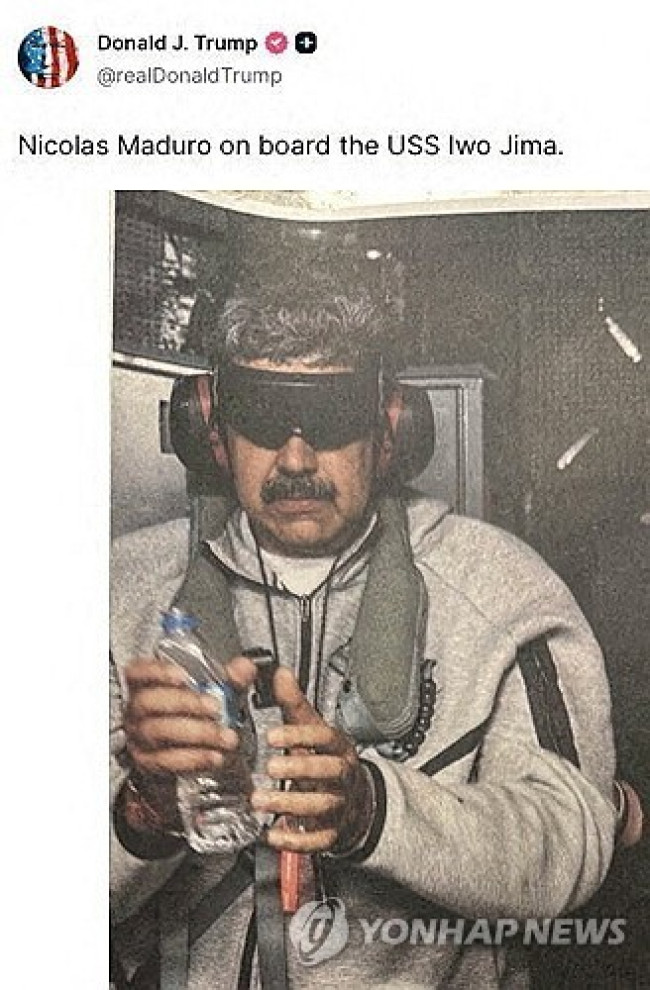 Nicolás Maduro is escorted after his arrest and extradition to the United States. [Reuters=Yonhap News, captured from Truth Social]
The message to North Korea, which possesses nuclear weapons but is not a neighboring country in the "Western Hemisphere" that President Trump prioritizes, is expected to be complex.
Observers believe that Kim Jong Un, the Chairman of North Korea's State Affairs Commission, who has repeatedly witnessed the pathetic downfall of anti-US leaders without nuclear weapons, such as Saddam Hussein of Iraq and Muammar Gaddafi of Libya, followed by Maduro of Venezuela, now has even less incentive to give up his nuclear weapons.
It is highly probable that he will focus all his efforts on increasing and diversifying the quantity and quality of nuclear weapons and improving the precision and variety of delivery systems (missiles), based on the judgment that nuclear weapons are the only "sword of Damocles" that guarantees his safety.
However, analysis suggests that Chairman Kim, given President Trump's continued interest in resuming summit diplomacy with him, whom he met three times during his first term, may consider engaging in dialogue with President Trump as a form of "insurance" against an unpredictable adversary.

 Iranian Foreign Ministry: "Continuing Message Exchanges with the U.S. and Activities of Mediating Countries"
Esmaeil Baghaei, Spokesperson for the Iranian Ministry of Foreign Affairs [Xinhua, Yonhap News file photo]Esmaeil Baghaei, spokesperson for the Iranian Ministry of Foreign Affairs, stated on the 26th
Iranian Foreign Ministry: "Continuing Message Exchanges with the U.S. and Activities of Mediating Countries"
Esmaeil Baghaei, Spokesperson for the Iranian Ministry of Foreign Affairs [Xinhua, Yonhap News file photo]Esmaeil Baghaei, spokesperson for the Iranian Ministry of Foreign Affairs, stated on the 26th
 President Yoon: "Do You Think You Are Safe from the Special Counsel?"... Final Statement Video Released
President Yoon Suk Yeol rebuking the special prosecutor on the 24th. [Court video / @birds_justice X account subtitle GIF] A video of President Yoon Suk Yeol's closing statement at his trial rega
President Yoon: "Do You Think You Are Safe from the Special Counsel?"... Final Statement Video Released
President Yoon Suk Yeol rebuking the special prosecutor on the 24th. [Court video / @birds_justice X account subtitle GIF] A video of President Yoon Suk Yeol's closing statement at his trial rega
 President Yoon, regarding the first-instance ruling on the Public Official Election Act: “An excessive political verdict that distorts the facts… We will appeal immediately.”
The first-instance sentencing hearing for President Yoon Suk Yeol regarding violations of the Public Official Election Act is being broadcast live at Seoul Station on the 27th. [Photo=Yonhap News]Pres
President Yoon, regarding the first-instance ruling on the Public Official Election Act: “An excessive political verdict that distorts the facts… We will appeal immediately.”
The first-instance sentencing hearing for President Yoon Suk Yeol regarding violations of the Public Official Election Act is being broadcast live at Seoul Station on the 27th. [Photo=Yonhap News]Pres
 WSJ: "SK Hynix ADR Premium Is a Sign of AI Trading Overheat"
Advertisement for SK Hynix ADR listing in New York's Times Square [Reuters=Yonhap News file photo]The Wall Street Journal (WSJ) has pointed out that the price of SK Hynix’s American Depositary Recei
WSJ: "SK Hynix ADR Premium Is a Sign of AI Trading Overheat"
Advertisement for SK Hynix ADR listing in New York's Times Square [Reuters=Yonhap News file photo]The Wall Street Journal (WSJ) has pointed out that the price of SK Hynix’s American Depositary Recei
 'Godfather of Japanese Mystery Novels' Keigo Higashino Passes Away After Battle with Cancer at 68
Famous Japanese mystery novelist Keigo Higashino [AFP=Yonhap News]It has been belatedly reported that Keigo Higashino, the "godfather of Japanese mystery novels" and author of bestsellers such as "The
'Godfather of Japanese Mystery Novels' Keigo Higashino Passes Away After Battle with Cancer at 68
Famous Japanese mystery novelist Keigo Higashino [AFP=Yonhap News]It has been belatedly reported that Keigo Higashino, the "godfather of Japanese mystery novels" and author of bestsellers such as "The
 [Park Pil-kyu Security Column] To the Ignorant Trying to Clothe a Beast in Sheep's Clothing
Rep. Kim Byung-joo of the Democratic Party of Korea [Photo=Yonhap News]“The Air Force Academy doesn't teach you how to fly a plane!” “The Army, Navy, and Air Force academies are exactly the
[Park Pil-kyu Security Column] To the Ignorant Trying to Clothe a Beast in Sheep's Clothing
Rep. Kim Byung-joo of the Democratic Party of Korea [Photo=Yonhap News]“The Air Force Academy doesn't teach you how to fly a plane!” “The Army, Navy, and Air Force academies are exactly the
 [Issue Diagnosis] Two Effects of the Election Petition Review
 [Photo] Evidence of Election Fraud Flooding U.S. Media… Trump Had 2.7 Million Votes Stolen
 [Video] U.S. Semiquincentennial Air Show... 'Art in the Sky' streaks across New York
 [Editorial Cartoon] A Draconian Law That Undermines Freedom of Expression

 List
List