 President Trump and Secretary of State Rubio [AP Yonhap News]
Donald Trump, the US President who declared that the United States would temporarily run Venezuela's state affairs, appears to be leaning towards policy intervention using military power as leverage rather than direct governance.
Direct governance would inevitably involve the deployment of military forces, including ground troops on a much larger scale than an operation to arrest President Nicolás Maduro, and carries a significant political burden. Therefore, it is observed that the US will first attempt dialogue with the Venezuelan government led by President Maduro's associates.
According to a compilation of interviews conducted by Marco Rubio, the US Secretary of State, with multiple American media outlets on the 4th (local time), it is evident that the United States intends to pressure the current Venezuelan government to induce policy changes in areas of US interest, rather than immediately forming a new government in Venezuela.
In an interview with NBC on the same day, when asked "Who is running Venezuela?", Secretary Rubio responded, "It is running policies, not the country," adding, "We want Venezuela to move in a certain direction."
He stated, "The policy objective is to bring about changes in Venezuela that are beneficial to the United States more than anything else," citing the blockage of influence by forces hostile to the US, such as Iran, the cessation of drug trafficking to the US, and the restructuring of the oil industry as objectives.
Secretary Rubio warned that US pressure, including the blockade of oil exports to Venezuela, attacks on drug-carrying vessels, and the seizure of vessels violating sanctions, would continue until these pending issues are resolved according to US desires.
In an interview with ABC, after mentioning that US naval fleets remain in the Caribbean to prevent oil exports, on which Venezuela's economy depends, he said, "That leverage continues, and we expect it to lead to results."
Secretary Rubio stated that he intends to deal with the current Venezuelan government, not the Venezuelan opposition leader María Corina Machado or Edmundo González, who ran against President Maduro in the 2024 Venezuelan presidential election, for now.
Currently, key positions in Venezuela are held by individuals associated with Maduro, including Vice President Delcy Rodríguez, who is serving as acting president.
Secretary Rubio spoke with Vice President Rodríguez, who assumed the interim presidency after President Maduro, the previous day.
President Trump stated at a press conference the previous day that Vice President Rodríguez had agreed to cooperate with US demands. However, on the same day, Vice President Rodríguez declared at an emergency cabinet meeting, "Venezuela will not be a colony of any country," expressing her intention to refuse US 'governance' interference, leading to observations that the two countries might be heading for a confrontation.
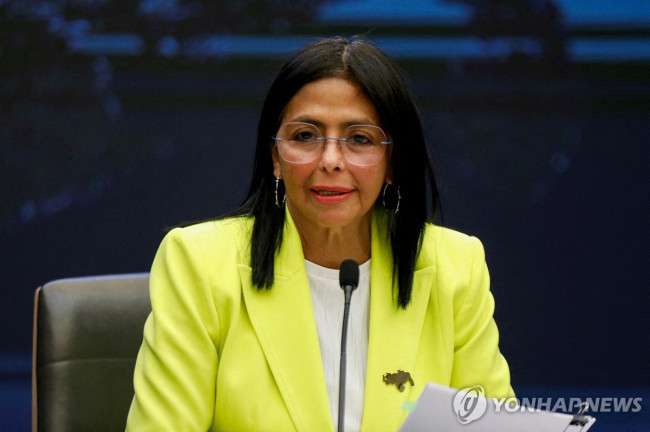 Venezuelan Vice President Rodríguez [Reuters Yonhap News]
In an interview with ABC, when asked if he considered Vice President Rodríguez the legitimate president, Secretary Rubio replied, "This is not about the legitimacy of the president," and that to achieve what the US wants, they must deal with those who currently control Venezuela and can bring about change.
He characterized Vice President Rodríguez's strong remarks as "rhetoric" and stated that the US would respond based on actual actions, not statements made at press conferences or interviews.
In an NBC interview, when asked about when elections would be held in Venezuela, Secretary Rubio said, "It is too early at this point," and that while the Trump administration is concerned about elections and democracy, its top priority is "the safety, security, well-being, and prosperity of the United States."
According to a report by The Washington Post (WP), Secretary Rubio, who is of Cuban-American descent, has long advocated for regime change in Venezuela and plays a very important role in the expulsion of President Maduro and the establishment of interim policies.
In an NBC interview, Secretary Rubio stated that he is heavily involved in Venezuela policy as both Secretary of State and National Security Advisor.
While Secretary Rubio appeared on several networks on this day to respond to the repercussions of President Trump's remarks about "running Venezuela's state affairs," President Trump continued his pressure campaign.
In an interview with The Atlantic magazine on the same day, President Trump stated about Vice President Rodríguez, "If she doesn't do the right thing, she will pay a very big price, perhaps bigger than Maduro," revealing a tougher stance than the previous day.
Although President Trump stated the previous day that he "is not afraid" of deploying ground troops to Venezuela, Secretary Rubio indicated that there are currently no US troops on the ground in Venezuela and no immediate plans.
Secretary Rubio explained President Trump's remarks from the previous day as a matter of not ruling out any options publicly, stating that the President is keeping "all options" open.
According to The New York Times (NYT), a White House official stated that what Secretary Rubio revealed in his interviews today elaborated on what President Trump meant by "running" Venezuela, and that Secretary Rubio's and President Trump's statements are not contradictory.
The official added that President Trump's senior staff will "continue to engage diplomatically" with Venezuela's current leadership.
The NYT described the remarks by Secretary Rubio and President Trump on this day as a "clear declaration of gunboat diplomacy," which is a foreign policy where a great power exerts pressure on another country through military force, with historical roots in imperial powers subduing weaker nations through naval displays of power.
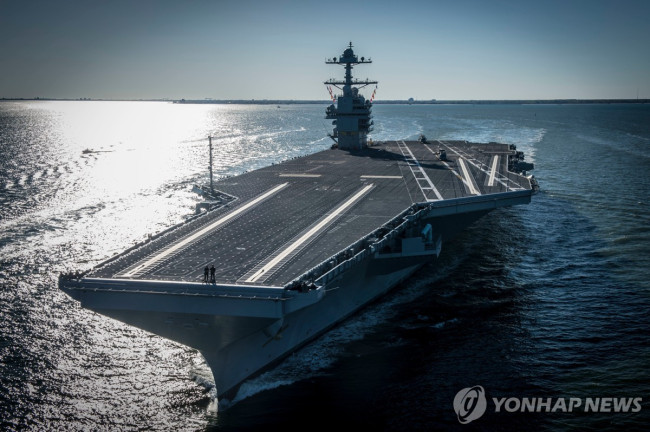 US Navy aircraft carrier USS Gerald R. Ford [AP Yonhap News file photo. Redistribution and database prohibited]

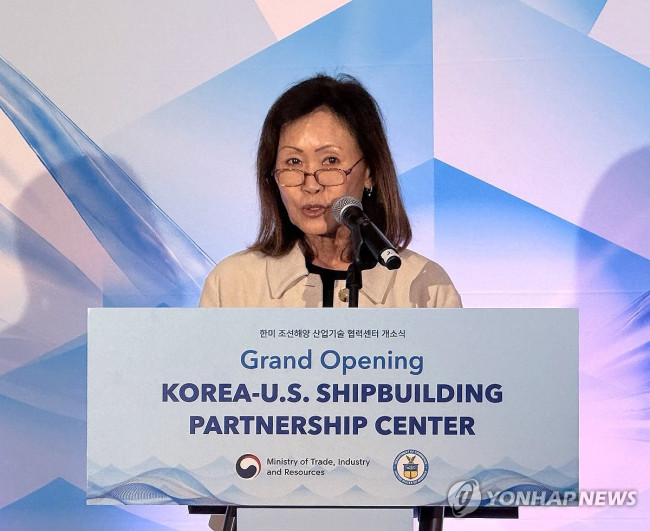 First U.S. Ambassador of Trump's Second Term to Arrive This Week… Will It Provide Momentum to Resolve Pending Issues?
U.S. Ambassador to South Korea Michelle Steel speaks at the opening ceremony of the Korea-U.S. Shipbuilding Cooperation Center held at the Mayflower Hotel in Washington, D.C., on the 23rd (local time)
First U.S. Ambassador of Trump's Second Term to Arrive This Week… Will It Provide Momentum to Resolve Pending Issues?
U.S. Ambassador to South Korea Michelle Steel speaks at the opening ceremony of the Korea-U.S. Shipbuilding Cooperation Center held at the Mayflower Hotel in Washington, D.C., on the 23rd (local time)
 President Yoon, regarding the first-instance ruling on the Public Official Election Act: “An excessive political verdict that distorts the facts… We will appeal immediately.”
The first-instance sentencing hearing for President Yoon Suk Yeol regarding violations of the Public Official Election Act is being broadcast live at Seoul Station on the 27th. [Photo=Yonhap News]Pres
President Yoon, regarding the first-instance ruling on the Public Official Election Act: “An excessive political verdict that distorts the facts… We will appeal immediately.”
The first-instance sentencing hearing for President Yoon Suk Yeol regarding violations of the Public Official Election Act is being broadcast live at Seoul Station on the 27th. [Photo=Yonhap News]Pres
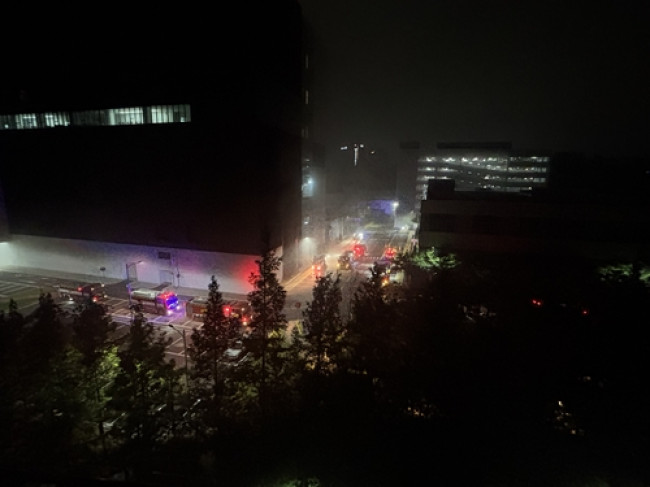 Fire at Hyundai Motor Group Battery Research Facility in Uiwang… Ignited in Waste Storage Room
A fire broke out at the Hyundai Motor Group battery research building at its Uiwang Research Center in Sam-dong, Uiwang-si, Gyeonggi-do, at 12:48 a.m. on the 28th and was extinguished after approximat
Fire at Hyundai Motor Group Battery Research Facility in Uiwang… Ignited in Waste Storage Room
A fire broke out at the Hyundai Motor Group battery research building at its Uiwang Research Center in Sam-dong, Uiwang-si, Gyeonggi-do, at 12:48 a.m. on the 28th and was extinguished after approximat
 'Godfather of Japanese Mystery Novels' Keigo Higashino Passes Away After Battle with Cancer at 68
Famous Japanese mystery novelist Keigo Higashino [AFP=Yonhap News]It has been belatedly reported that Keigo Higashino, the "godfather of Japanese mystery novels" and author of bestsellers such as "The
'Godfather of Japanese Mystery Novels' Keigo Higashino Passes Away After Battle with Cancer at 68
Famous Japanese mystery novelist Keigo Higashino [AFP=Yonhap News]It has been belatedly reported that Keigo Higashino, the "godfather of Japanese mystery novels" and author of bestsellers such as "The
 [Park Pil-kyu Security Column] To the Ignorant Trying to Clothe a Beast in Sheep's Clothing
Rep. Kim Byung-joo of the Democratic Party of Korea [Photo=Yonhap News]“The Air Force Academy doesn't teach you how to fly a plane!” “The Army, Navy, and Air Force academies are exactly the
[Park Pil-kyu Security Column] To the Ignorant Trying to Clothe a Beast in Sheep's Clothing
Rep. Kim Byung-joo of the Democratic Party of Korea [Photo=Yonhap News]“The Air Force Academy doesn't teach you how to fly a plane!” “The Army, Navy, and Air Force academies are exactly the
 [Issue Diagnosis] Two Effects of the Election Petition Review
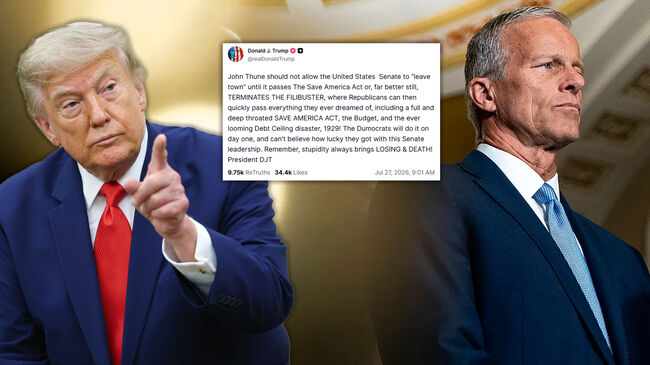 Trump Demands Passage of ‘SAVE Act’ Before Senate Recess
 [Photo] Evidence of Election Fraud Flooding U.S. Media… Trump Had 2.7 Million Votes Stolen
 [Video] U.S. Semiquincentennial Air Show... 'Art in the Sky' streaks across New York
 [Editorial Cartoon] A Draconian Law That Undermines Freedom of Expression

 List
List









