 North Korean Chairman of the State Affairs Commission Kim Jong Un and U.S. President Donald Trump at their 2018 summit in Singapore. [AP=Yonhap News]
As the new year of 2026 begins, significant events that could mark a milestone in world history are unfolding, and their repercussions are being assessed on a global scale.
Dictators around the world are finding themselves in a situation where they must gravely worry about their regimes' and their own personal safety due to these proactive and bold military operations by the United States. The unfolding of these situations is a consequence of the Trump administration's global strategy and is having a profound impact on our nation's security and economy.
Collapse of the Maduro Regime in Venezuela
Through Trump's-led attack on Venezuela, he demonstrated his qualities as a "man of action." With a fleet of 11 warships maintained in the Caribbean, 150 aircraft (including F-22s, F-35s, F-18s, B1s, and drones) carried out airstrikes on key locations.
Leveraging its formidable intelligence capabilities, including human intelligence, the CIA had advance knowledge of Maduro's movements and even the names of his pets. Shortly after a special envoy from the Chinese government met with Maduro, Delta Force, an arm of the U.S. Army, arrested the illegitimate leader Maduro and extradited him to New York, where he had already been indicted on charges of drug trafficking and terrorism.
President Trump has stated that the United States will manage Venezuela until it transitions to stability and that U.S. oil companies will rebuild the collapsed oil infrastructure. Opposition leader Machado, a Nobel Peace Prize laureate, is considered a strong candidate to lead the new government.
The regimes of Chavez and Maduro in Venezuela conducted fraudulent elections to extend their terms and exported their illicit election system to 72 countries worldwide. The attack on Venezuela was motivated by the export of fraudulent elections, alongside drug trafficking.
The collapse of the pro-China, pro-Russia Maduro regime in Venezuela signifies an unwillingness to tolerate anti-American regimes in America's backyard.
The United States has designated Mexico, Cuba, and Colombia as the next targets. Citing the influx of fentanyl, a primary cause of drug-related deaths in the U.S., through the Mexican border, the U.S. is strongly hinting at direct military intervention by U.S. forces to dismantle cartels.
Cuba, which has been a key ally supporting the Maduro regime by providing military and intelligence personnel in exchange for affordable oil from Venezuela, is likely to face the collapse of its regime or popular uprisings if its energy supply is cut off with Maduro's arrest, given its already severe economic difficulties.
Recently, the political landscape in Latin America has been shifting, with right-wing governments coming to power in Argentina, Chile, and Honduras, and countries like El Salvador and Ecuador forming right-wing alliances. The United States is supporting these nations in various ways.
Causes and Repercussions of the Iran Situation
Amid nationwide protests, the Iranian president has admitted to the country's fiscal collapse, and even its allies, China and Russia, are powerless to intervene.
Since late 2025, the value of the Iranian rial has plummeted to an all-time low, leading to skyrocketing prices. In particular, the prices of essential goods like bread have surged by over 15% in a single month, devastating the livelihoods of ordinary citizens.
Youth unemployment exceeds 25%, with highly educated unemployed youth forming the core of the protests. The depletion of water resources in major cities, including Tehran, has been elevated to a national security crisis, and public anger over water shortages is escalating into a movement to oust the government.
In June 2025, the U.S. conducted precision strikes on Iranian nuclear facilities, and Israel's airstrikes severely damaged ballistic missile bases. During these attacks, numerous high-ranking officials, including the Iranian Army Chief of Staff and senior commanders of the Islamic Revolutionary Guard Corps (IRGC), were killed, creating cracks in the regime's control.
The Iranian regime is currently facing a dual crisis of internal popular uprisings and external military pressure. The first half of 2026 is expected to be a historic turning point determining whether the Islamic Republic will be maintained or transition to a new democratic government.
Reza Pahlavi, the last crown prince of Iran's Pahlavi dynasty, has become increasingly active politically amid the escalating anti-government protests within Iran, effectively serving as the focal point of the opposition.
As the fall of pro-China and pro-Russia Iran approaches, China's oil imports from Iran will be disrupted, potentially leading to an energy crisis for China.
Weakening or End of Global Totalitarianism Through Trump's Strategy
China, Russia, Iran, Venezuela, and North Korea are considered totalitarian states, and their expansion of alliances worldwide has intensified the confrontation with the free world.
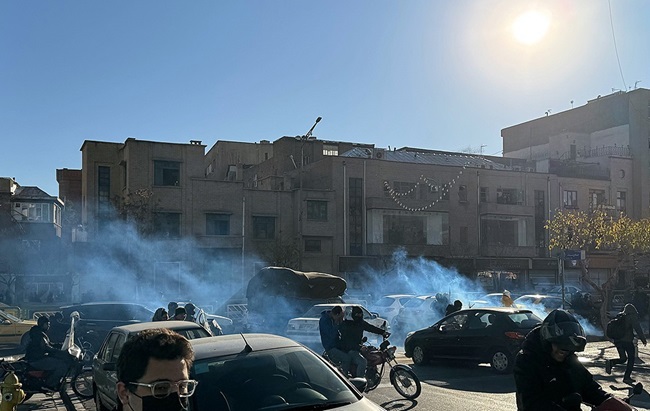 On December 29, 2025 (local time), riot police fire tear gas at merchants participating in anti-government protests in Tehran, Iran. [EPA=Yonhap News]
U.S. President Trump has pledged to eliminate these threats and establish American hegemony, ushering in what he calls America's "golden age."
If these countries collapse, China will be unable to secure cheap oil, and without energy, its hegemonic challenge to the U.S. will become impossible. Meanwhile, Russia is in a precarious state of national survival due to the depletion of its military power from the prolonged war with Ukraine and Western economic sanctions.
Following his defeat in the 2020 election, Trump has recently revealed through various investigations that a global fraudulent election cartel was involved (interconnected entities include Smartmatic in Venezuela, Dominion in the U.S., and Miru Systems in South Korea) and has declared war on so-called Digital Totalitarianism.
China's Invasion of Taiwan Faces Obstacles
Recently, Japanese Prime Minister Takaiichi suggested Japan's intervention in the event of a Taiwan contingency, recognizing it as a threat to Japan's existence, prompting China to adopt a series of stern measures.
The U.S. passed the National Defense Authorization Act for Fiscal Year 2026 (NDAA 2026) and the Taiwan Assurance Implementation Act in Congress, exporting a large quantity of weapons to Taiwan. In response, China has escalated tensions by conducting military exercises encircling Taiwan.
In preparation for a Chinese invasion of Taiwan, the U.S. is reinforcing its defense of the First Island Chain, which aims to prevent China's southward advance, under the principle of opposing "unification or independence." It is strengthening its technological and intelligence-sharing frameworks by actively utilizing the cooperation of South Korea, the U.S., and Japan, AUKUS (Australia, the United Kingdom, the United States), and Five Eyes.
To block China's expanding influence on the Korean Peninsula, the U.S. is strengthening the ROK-U.S. alliance while also demanding an increased contribution to defense cost-sharing from South Korea and a greater role in the anti-China front.
Although China is increasing its rhetoric regarding an invasion of Taiwan, obstacles are expected in its actual execution due to domestic economic crises and political instability (unoccupied real estate, sluggish domestic demand, high unemployment, and instability within the Communist Party leadership).
Trump's MAGA and Securing Global Energy Hegemony
The United States is maximizing its oil and gas production to record levels, thereby stabilizing international oil prices and reducing household costs to restore Energy Dominance.
Having withdrawn from the Paris Climate Agreement and largely abolished environmental regulations, including the repeal of mandatory electric vehicle adoption, the U.S. is reviving the competitiveness of its manufacturing sector.
The U.S. has officially put forward the purchase or incorporation of Greenland as a territorial issue on the agenda, citing its strategic importance and resource potential in the Arctic region, and is in negotiations with Denmark.
To neutralize China's rare earth element hegemony, the U.S. is promoting domestic development and diversifying import sources (including Australia, Ukraine, and Japan). Furthermore, in response to China's manufacturing rise, it is controlling the export of semiconductor equipment and technology.
The Trump administration has implemented an executive order to eradicate "anti-Christian bias" and established a Religious Freedom Commission to implement policies protecting conservative Christian values. Recently, it conducted airstrikes in Nigeria to retaliate against the persecution of Christians.
Large-scale deportation operations for undocumented immigrants and policies to encourage voluntary departure are being implemented, and a war against drug cartels, including those dealing in fentanyl, is underway. Securing election integrity has been designated a national priority, with efforts to amend and strengthen election laws and surveillance.
U.S. Closely Monitoring South Korea's Pro-China Actions
Amidst rapidly changing international political circumstances, President Lee Jae-myung's visit to China has led to various interpretations of its significance.
The fact sheet detailing the agreements from the ROK-U.S. tariff negotiations primarily reflects U.S. interests, and issues of non-compliance have recently emerged.
South Korea's Online Platform Act, amendments to the Information and Communications Network Act, and the recent regulation of U.S. big tech companies demonstrated in the Coupang incident are cited as risks in ROK-U.S. relations. The current sharp rise in the exchange rate carries the risk of escalating into a potential foreign exchange crisis.
Other risks include restrictions on access to U.S. Forces Korea facilities, arrests and searches of churches or religious figures, China's installation of illegal structures in the West Sea, South Korean military intervention in the event of a Taiwan contingency, issues concerning ROK-U.S.-Japan cooperation, illegal remittances to North Korea, and fraudulent election matters.
The U.S. is closely monitoring the current administration's pro-China policies (such as visa-free entry) and pro-North Korea policies (such as prohibiting the distribution of leaflets and operating loudspeakers, banning broadcasts to North Korea, and allowing subscriptions to the Rodong Sinmun). It is also reportedly conducting an in-depth analysis of China's "Operation Seoul Unification" within South Korea.
The U.S. response to the undermining of the ROK-U.S. alliance and the violation of agreements is multifaceted, and corresponding measures are expected depending on the degree of violation.
Through measures like the Reciprocal Trade Act, it is expected that the U.S. will impose high tariffs under Section 301 on South Korea's major exports (such as semiconductors and automobiles) or strengthen subsidy conditions.
Secondary boycotts, a powerful sanction, involve the exclusion of South Korean companies or financial institutions trading with China from the U.S. market.
Restricting information sharing could lead to South Korea's exclusion from the Five Eyes cooperation framework or the suspension of strategic asset deployments (such as nuclear submarines and strategic bombers), narrowing South Korea's security options. Precision financial sanctions against specific individuals or entities are also possible measures.
Regarding North Korea, there is a possibility that the U.S. may bypass the current administration and attempt direct North Korea-U.S. negotiations (Korea Passing) with Chairman Kim Jong Un.
Representative of the National Alliance for Free Unification, Ph.D. in Public Administration

◆ Dr. Shin Dong-chun
Ph.D. in Public Administration, Representative of the National Alliance for Free Unification. After passing the 21st Higher Civil Service Examination, he served in public office and has since been active as a corporate CEO, university professor, media contributor, author, and Chairman of the Global Aviation and Aerospace Industry Association.

 Iranian Foreign Ministry: "Continuing Message Exchanges with the U.S. and Activities of Mediating Countries"
Esmaeil Baghaei, Spokesperson for the Iranian Ministry of Foreign Affairs [Xinhua, Yonhap News file photo]Esmaeil Baghaei, spokesperson for the Iranian Ministry of Foreign Affairs, stated on the 26th
Iranian Foreign Ministry: "Continuing Message Exchanges with the U.S. and Activities of Mediating Countries"
Esmaeil Baghaei, Spokesperson for the Iranian Ministry of Foreign Affairs [Xinhua, Yonhap News file photo]Esmaeil Baghaei, spokesperson for the Iranian Ministry of Foreign Affairs, stated on the 26th
 President Yoon: "Do You Think You Are Safe from the Special Counsel?"... Final Statement Video Released
President Yoon Suk Yeol rebuking the special prosecutor on the 24th. [Court video / @birds_justice X account subtitle GIF] A video of President Yoon Suk Yeol's closing statement at his trial rega
President Yoon: "Do You Think You Are Safe from the Special Counsel?"... Final Statement Video Released
President Yoon Suk Yeol rebuking the special prosecutor on the 24th. [Court video / @birds_justice X account subtitle GIF] A video of President Yoon Suk Yeol's closing statement at his trial rega
 President Yoon, regarding the first-instance ruling on the Public Official Election Act: “An excessive political verdict that distorts the facts… We will appeal immediately.”
The first-instance sentencing hearing for President Yoon Suk Yeol regarding violations of the Public Official Election Act is being broadcast live at Seoul Station on the 27th. [Photo=Yonhap News]Pres
President Yoon, regarding the first-instance ruling on the Public Official Election Act: “An excessive political verdict that distorts the facts… We will appeal immediately.”
The first-instance sentencing hearing for President Yoon Suk Yeol regarding violations of the Public Official Election Act is being broadcast live at Seoul Station on the 27th. [Photo=Yonhap News]Pres
 WSJ: "SK Hynix ADR Premium Is a Sign of AI Trading Overheat"
Advertisement for SK Hynix ADR listing in New York's Times Square [Reuters=Yonhap News file photo]The Wall Street Journal (WSJ) has pointed out that the price of SK Hynix’s American Depositary Recei
WSJ: "SK Hynix ADR Premium Is a Sign of AI Trading Overheat"
Advertisement for SK Hynix ADR listing in New York's Times Square [Reuters=Yonhap News file photo]The Wall Street Journal (WSJ) has pointed out that the price of SK Hynix’s American Depositary Recei
 'Godfather of Japanese Mystery Novels' Keigo Higashino Passes Away After Battle with Cancer at 68
Famous Japanese mystery novelist Keigo Higashino [AFP=Yonhap News]It has been belatedly reported that Keigo Higashino, the "godfather of Japanese mystery novels" and author of bestsellers such as "The
'Godfather of Japanese Mystery Novels' Keigo Higashino Passes Away After Battle with Cancer at 68
Famous Japanese mystery novelist Keigo Higashino [AFP=Yonhap News]It has been belatedly reported that Keigo Higashino, the "godfather of Japanese mystery novels" and author of bestsellers such as "The
 [Park Pil-kyu Security Column] To the Ignorant Trying to Clothe a Beast in Sheep's Clothing
Rep. Kim Byung-joo of the Democratic Party of Korea [Photo=Yonhap News]“The Air Force Academy doesn't teach you how to fly a plane!” “The Army, Navy, and Air Force academies are exactly the
[Park Pil-kyu Security Column] To the Ignorant Trying to Clothe a Beast in Sheep's Clothing
Rep. Kim Byung-joo of the Democratic Party of Korea [Photo=Yonhap News]“The Air Force Academy doesn't teach you how to fly a plane!” “The Army, Navy, and Air Force academies are exactly the
 [Issue Diagnosis] Two Effects of the Election Petition Review
 [Photo] Evidence of Election Fraud Flooding U.S. Media… Trump Had 2.7 Million Votes Stolen
 [Video] U.S. Semiquincentennial Air Show... 'Art in the Sky' streaks across New York
 [Editorial Cartoon] A Draconian Law That Undermines Freedom of Expression

 List
List









