국제 질서가 급변하는 엄중한 시기에 국민 다수의 기대와 달리, 이재명은 실패한 ‘안미경중(安美經中)’을 넘어, 국가 안보와 경제의 축을 동시에 중국에 기울이는 ‘안중경중(安中經中)’ 노선으로 서둘러 방향을 틀고 있다. 서해는 협상의 대상이기 이전에 대한민국의 바다다. 그 사실을 분명히 하지 않고 ‘서해는 평화·공영의 바다’라고 말하는 것은 고구려 연남생(淵男生)처럼 길을 내주고 요동도독(遼東都督) 관직이라도 받겠다는 것인가?
 China's structures in the Yellow Sea within the Provisional Measures Zone between South Korea and China. ⒸHanmi Ilbo
On January 5th, the summit between South Korea and China held at the Great Hall of the People in Beijing was superficially filled with rhetoric about expanding cultural and content exchange and the notion of "the Yellow Sea as a sea of peace and prosperity." The South Korean government's stance on the various illegal structures and maritime buoys installed by China in the Yellow Sea's Provisional Measures Zone (PMZ) at this summit has undermined South Korea's maritime sovereignty and allied trust.
By establishing and maintaining structures in the gray zone of the Yellow Sea's Provisional Measures Zone, China has been accumulating a track record of having "continuously managed the sea." The precedent of building artificial islands in the South China Sea and converting them into military bases suggests that this strategy is not accidental but part of a deliberate long-term plan.
"The Yellow Sea as a Sea of Peace and Prosperity"... Implicitly Approving Illegal Occupation
The same provocation is being repeated in the Yellow Sea. In fact, China installed 'Xianlan'-class structures in 2018 and 2024, fixed a drillship-type steel structure to the seabed in 2022, and unilaterally declared the Provisional Measures Zone near 124 degrees East longitude a "navigation-prohibited zone for military purposes" in May 2025.
In this context, the agreement on January 5th between Lee Jae-myung and Xi Jinping to share the perception of "the Yellow Sea as a sea of peace and prosperity" and to resolve the structure issue through "constructive consultation" is not a matter to be taken lightly. If emphasis is placed solely on consultation without raising principled objections and demands for rectification regarding the structures suspected of illegal installation, it effectively amounts to condoning the current illegal occupation.
On February 26th last year, when the Korean maritime survey vessel Onnuri approached to inspect Chinese structures installed within the Provisional Measures Zone, two Chinese Coast Guard vessels and three inflatable boats were mobilized to systematically obstruct the inspection. The Korean Coast Guard deployed patrol vessels, but was unable to conduct a thorough investigation due to China's overwhelming response.
Of the 13 maritime buoys installed by China, many are densely concentrated in the southwestern waters. If the purpose were scientific observation, it would be logical to distribute them evenly across the entire area. The concentration in a specific area suggests control rather than observation is the objective.
Yellow Sea Structures: An Attempt to Secure the Southwest Sea and Shake the Indo-Pacific Front
This issue extends beyond a bilateral problem between South Korea and China, intertwining with the US's Indo-Pacific strategy and the "first island chain" concept. China's expansion of influence in the Yellow Sea is seen as an attempt to divert pressure from the South China Sea and the Taiwan Strait, and to destabilize the flanks and rear of the containment line.
It would be no surprise if the US is reaching the limits of its patience regarding these moves. In fact, the US has stated its official position of not recognizing China's Yellow Sea structures. This signals its difficulty in passively accepting the erosion of an ally's maritime sovereignty through gray zone strategies.
Furthermore, a key reason for China's obsession with "opening" the Yellow Sea lies in Qingdao on the Shandong Peninsula. This location has served as the core base for China's North Sea Fleet and virtually the homeport for its aircraft carrier strike group. The Yellow Sea is the gateway from Qingdao to the Pacific, and it is an area that the Chinese Navy must stabilize with strategic competition against the US Navy in mind. While they claim the structures and buoys are for "civilian" use, their function as tools for constant surveillance and control makes it difficult to deny their military significance for China.
Yellow Sea Structures: Beyond Environmental and Fishing Issues, a Matter of Maritime Sovereignty and Security
The progressives who reacted with "No Japan, boycott Japanese goods" whenever Japan raised the Dokdo issue are eerily silent on the issue of China's Yellow Sea structures.
The Yellow Sea structures are not merely an environmental or fishing issue, but a matter of maritime sovereignty and security. There is no need to revisit historical debates; we must confront the infringement of maritime sovereignty that is unfolding before our eyes.
Diplomacy is important. However, sovereignty precedes diplomacy. Lee Jae-myung is echoing China's "peace" and "prosperity" rhetoric, which infringes upon South Korea's maritime sovereignty. Emphasizing consultation without a principled response to China's installation of Yellow Sea structures and its physical obstruction of Korean Coast Guard investigations amounts to abandoning management of the Yellow Sea.
South Korea's options are clear.
First, it must codify the judgment of illegality based on the "South Korea-China Fisheries Agreement," which prohibits the installation of structures other than for fishing, and the "UN Convention on the Law of the Sea (UNCLOS)," which prohibits acts causing "permanent physical impact" on the marine environment without the consent of the other party in waters where the boundary has not been delimited, and set a deadline for their removal or relocation.
Second, if China fails to fulfill its promises, measures should be prepared in accordance with the principles of proportionality and reciprocity.
Third, on-site response capabilities should be strengthened, and immediate and visible actions should be taken against violations of scientific research rights.
Fourth, common standards for gray zone strategies should be established in cooperation with allies and friendly nations.
Lee Jae-myung Government Shifts Course from "Peace with US, Economy with China" to "Peace with China, Economy with China"
2026 will be a year of increasingly overt structural hegemonic competition between the US and China across various domains, including military, economic, diplomatic, technological, intelligence, and standards.
At this critical juncture of rapid shifts in the international order, contrary to the expectations of the majority of the public, Lee Jae-myung is hastily shifting course from the failed "Peace with US, Economy with China" (Anmi Gyeongjung) to a "Peace with China, Economy with China" (Anjung Gyeongjung) line, tilting the axes of national security and economy towards China.
The Yellow Sea is South Korea's sea, not a subject for negotiation. To say "The Yellow Sea is a sea of peace and prosperity" without clearly asserting that fact, is it akin to Yeon Gaesomun's son, Yeon Namseng, paving the way for the enemy and accepting a title from the Tang Dynasty, like Governor of Liaodong?
Editorial Department, Hanmi Ilbo

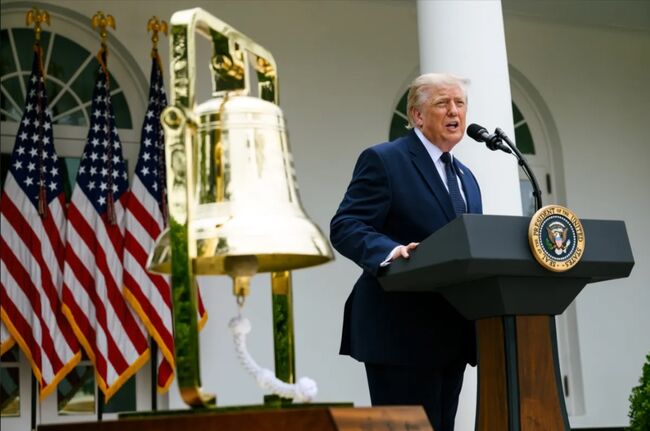 Trump pressures for rate cut again ahead of FOMC... "Should be the lowest in the world"
U.S. President Donald Trump. [Photo = The White House] U.S. President Donald Trump once again pressured the Federal Reserve, the U.S. central bank, to lower interest rates on the 27th (local time
Trump pressures for rate cut again ahead of FOMC... "Should be the lowest in the world"
U.S. President Donald Trump. [Photo = The White House] U.S. President Donald Trump once again pressured the Federal Reserve, the U.S. central bank, to lower interest rates on the 27th (local time
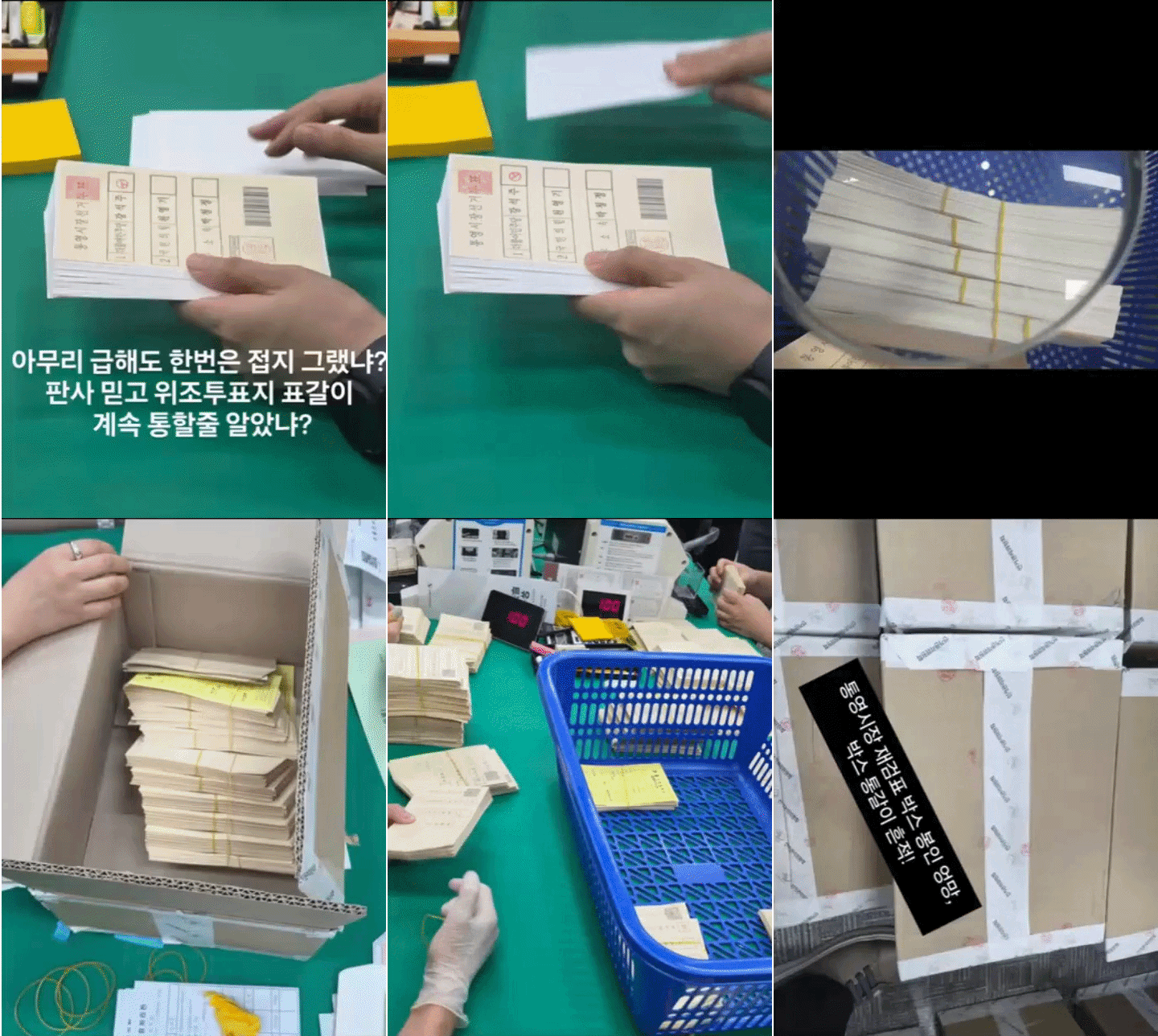 “Ignoring crisp ballots and damaged seals”… Tongyeong mayoral recount concludes with ‘no change in outcome,’ leaving suspicions and public outrage behind
Suspected counterfeit ballots discovered in Tongyeong [GIF from social media of Representative Hwang Kyo-ahn / Attorney Park Joo-hyun]During a recount of the Tongyeong mayoral election in South Gyeong
“Ignoring crisp ballots and damaged seals”… Tongyeong mayoral recount concludes with ‘no change in outcome,’ leaving suspicions and public outrage behind
Suspected counterfeit ballots discovered in Tongyeong [GIF from social media of Representative Hwang Kyo-ahn / Attorney Park Joo-hyun]During a recount of the Tongyeong mayoral election in South Gyeong
 President Yoon, regarding the first-instance ruling on the Public Official Election Act: “An excessive political verdict that distorts the facts… We will appeal immediately.”
The first-instance sentencing hearing for President Yoon Suk Yeol regarding violations of the Public Official Election Act is being broadcast live at Seoul Station on the 27th. [Photo=Yonhap News]Pres
President Yoon, regarding the first-instance ruling on the Public Official Election Act: “An excessive political verdict that distorts the facts… We will appeal immediately.”
The first-instance sentencing hearing for President Yoon Suk Yeol regarding violations of the Public Official Election Act is being broadcast live at Seoul Station on the 27th. [Photo=Yonhap News]Pres
 WSJ: "SK Hynix ADR Premium Is a Sign of AI Trading Overheat"
Advertisement for SK Hynix ADR listing in New York's Times Square [Reuters=Yonhap News file photo]The Wall Street Journal (WSJ) has pointed out that the price of SK Hynix’s American Depositary Recei
WSJ: "SK Hynix ADR Premium Is a Sign of AI Trading Overheat"
Advertisement for SK Hynix ADR listing in New York's Times Square [Reuters=Yonhap News file photo]The Wall Street Journal (WSJ) has pointed out that the price of SK Hynix’s American Depositary Recei
 'Godfather of Japanese Mystery Novels' Keigo Higashino Passes Away After Battle with Cancer at 68
Famous Japanese mystery novelist Keigo Higashino [AFP=Yonhap News]It has been belatedly reported that Keigo Higashino, the "godfather of Japanese mystery novels" and author of bestsellers such as "The
'Godfather of Japanese Mystery Novels' Keigo Higashino Passes Away After Battle with Cancer at 68
Famous Japanese mystery novelist Keigo Higashino [AFP=Yonhap News]It has been belatedly reported that Keigo Higashino, the "godfather of Japanese mystery novels" and author of bestsellers such as "The
 [Park Pil-kyu Security Column] To the Ignorant Trying to Clothe a Beast in Sheep's Clothing
Rep. Kim Byung-joo of the Democratic Party of Korea [Photo=Yonhap News]“The Air Force Academy doesn't teach you how to fly a plane!” “The Army, Navy, and Air Force academies are exactly the
[Park Pil-kyu Security Column] To the Ignorant Trying to Clothe a Beast in Sheep's Clothing
Rep. Kim Byung-joo of the Democratic Party of Korea [Photo=Yonhap News]“The Air Force Academy doesn't teach you how to fly a plane!” “The Army, Navy, and Air Force academies are exactly the
 [Issue Diagnosis] Two Effects of the Election Petition Review
 [Photo] Evidence of Election Fraud Flooding U.S. Media… Trump Had 2.7 Million Votes Stolen
 [Video] U.S. Semiquincentennial Air Show... 'Art in the Sky' streaks across New York
 [Editorial Cartoon] A Draconian Law That Undermines Freedom of Expression

 List
List









