
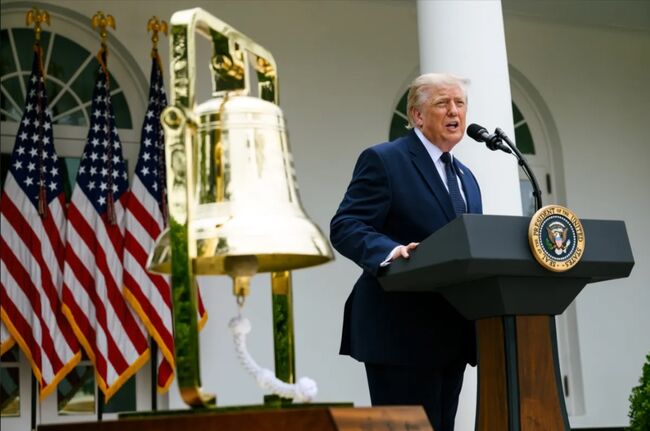
At a press conference on Saturday regarding the potential arrest of Venezuela's Nicolas Maduro, President Donald Trump expressed optimism about the future of Venezuelan oil production. He stated that "very big oil companies from the United States" would "rebuild the very badly damaged [oil] infrastructure," leading to revenues for Venezuela.
President Trump noted, "As everyone knows, Venezuela's oil business has been completely broken for a long time. They've been producing very little compared to what they were capable of producing and what they were able to achieve."
It remains unclear how quickly Venezuela, which possesses the world's largest proven oil reserves, can recover. Robert Rapier, a chemical engineer and editor of Shale Magazine, told Just The News that Venezuelan oil production is not easy. Much of the country's oil infrastructure has been neglected for decades due to mismanagement, with little to no maintenance.
"This is going to be a slow process," Rapier said.
In 1970, Venezuela was producing over 3.7 million barrels of oil per day, but current production is less than 1 million barrels per day. In comparison, the United States, the world's largest producer, produces 13.8 million barrels per day.
David Blackmon, an analyst with over 40 years in the oil and gas industry and author of the Substack "Energy Absurdities," explained to Just The News that Venezuelan crude oil is "about like tar that you see on the road."
U.S. companies like Exxon and Chevron, along with Britain's Shell, have developed technologies to extract and transport this heavy crude oil using steam and diluents.
Venezuela nationalized its oil industry in the 1970s but allowed foreign investors to re-enter in the late 1990s. After coming to power, the Chavez regime implemented policies requiring the state to hold a majority stake in oil assets, leading to the expropriation of assets from companies like Exxon and ConocoPhillips. While these companies later received compensation through international courts, the policy ultimately resulted in the country losing expertise needed for oil extraction.
Rapier stated, "Chavez brought in a lot of political appointees into technical roles. Then sanctions and corruption combined to cause everything to collapse."
He believes sanctions have somewhat suppressed Venezuela's oil production and that lifting them would lead to a surge in output. However, he estimates it could take up to a decade for the country to recover or exceed its 1970s production levels.
"The real variable here is how much of that infrastructure is so old that it's unusable," Rapier said.
He pointed out that low oil prices do not serve as a strong incentive for investors, and historical animosity towards foreign investors could also make many hesitant.
Blackmon estimates the timeline could be shortened to five to seven years. He stated that while most infrastructure is aging and needs modernization, existing facilities could shorten the timeline.
Blackmon suggested it's too early to predict how much influence the U.S. will wield over Venezuela's administration, but if permitting processes can be expedited, progress could accelerate. The U.S. federal government could also alleviate investor hesitation by offering low-interest loans or investment incentives.
Blackmon said, "Depending on how all of this plays out, you could have significant new production within just a few years. Venezuela used to produce 4 million barrels a day. Now it's less than a million barrels a day, but theoretically, you could get back to 1.5 million to 2 million barrels a day very rapidly. So, it could happen pretty quickly depending on how all the mechanisms work."
Blackmon noted on his Substack that increased Venezuelan production could have ripple effects for Canada and OPEC+ nations. While the U.S. produces a lot of oil domestically, most refineries were built in the 1970s before shale oil technology allowed for the massive production of crude.
The crude oil produced from U.S. shale is light and low-sulfur, unlike the heavy crude from Venezuela, Canada, and the Middle East. Since U.S. refineries are designed to process heavy crude, they must import a significant portion of the crude oil they use. About 60% of the oil imported by the U.S. comes from Canada.
Frustrated by Trump's tariffs, Canada's Prime Minister Mark Carney has worked with Alberta Premier Danielle Smith to advance the construction of pipelines to transport crude oil from Canada's oil sands to the West Coast. This is expected to open up avenues for Canada to enter Asian markets.
Blackmon wrote, "Now that Trump has control of Venezuela's heavy crude resources, he can exert leverage in return."
As the U.S. gains influence over key OPEC+ nations, it will now have a say in quota negotiations. This will weaken the negotiating power of Russia and Iran, who are struggling under sanctions, Blackmon analyzed.
U.S. NNP = Hong Seong-gu, Chief Reporter / Special Correspondent NNP info@newsandpost.com

 Trump pressures for rate cut again ahead of FOMC... "Should be the lowest in the world"
U.S. President Donald Trump. [Photo = The White House] U.S. President Donald Trump once again pressured the Federal Reserve, the U.S. central bank, to lower interest rates on the 27th (local time
Trump pressures for rate cut again ahead of FOMC... "Should be the lowest in the world"
U.S. President Donald Trump. [Photo = The White House] U.S. President Donald Trump once again pressured the Federal Reserve, the U.S. central bank, to lower interest rates on the 27th (local time
 “Ignoring crisp ballots and damaged seals”… Tongyeong mayoral recount concludes with ‘no change in outcome,’ leaving suspicions and public outrage behind
Suspected counterfeit ballots discovered in Tongyeong [GIF from social media of Representative Hwang Kyo-ahn / Attorney Park Joo-hyun]During a recount of the Tongyeong mayoral election in South Gyeong
“Ignoring crisp ballots and damaged seals”… Tongyeong mayoral recount concludes with ‘no change in outcome,’ leaving suspicions and public outrage behind
Suspected counterfeit ballots discovered in Tongyeong [GIF from social media of Representative Hwang Kyo-ahn / Attorney Park Joo-hyun]During a recount of the Tongyeong mayoral election in South Gyeong
 President Yoon, regarding the first-instance ruling on the Public Official Election Act: “An excessive political verdict that distorts the facts… We will appeal immediately.”
The first-instance sentencing hearing for President Yoon Suk Yeol regarding violations of the Public Official Election Act is being broadcast live at Seoul Station on the 27th. [Photo=Yonhap News]Pres
President Yoon, regarding the first-instance ruling on the Public Official Election Act: “An excessive political verdict that distorts the facts… We will appeal immediately.”
The first-instance sentencing hearing for President Yoon Suk Yeol regarding violations of the Public Official Election Act is being broadcast live at Seoul Station on the 27th. [Photo=Yonhap News]Pres
 WSJ: "SK Hynix ADR Premium Is a Sign of AI Trading Overheat"
Advertisement for SK Hynix ADR listing in New York's Times Square [Reuters=Yonhap News file photo]The Wall Street Journal (WSJ) has pointed out that the price of SK Hynix’s American Depositary Recei
WSJ: "SK Hynix ADR Premium Is a Sign of AI Trading Overheat"
Advertisement for SK Hynix ADR listing in New York's Times Square [Reuters=Yonhap News file photo]The Wall Street Journal (WSJ) has pointed out that the price of SK Hynix’s American Depositary Recei
 'Godfather of Japanese Mystery Novels' Keigo Higashino Passes Away After Battle with Cancer at 68
Famous Japanese mystery novelist Keigo Higashino [AFP=Yonhap News]It has been belatedly reported that Keigo Higashino, the "godfather of Japanese mystery novels" and author of bestsellers such as "The
'Godfather of Japanese Mystery Novels' Keigo Higashino Passes Away After Battle with Cancer at 68
Famous Japanese mystery novelist Keigo Higashino [AFP=Yonhap News]It has been belatedly reported that Keigo Higashino, the "godfather of Japanese mystery novels" and author of bestsellers such as "The
 [Park Pil-kyu Security Column] To the Ignorant Trying to Clothe a Beast in Sheep's Clothing
Rep. Kim Byung-joo of the Democratic Party of Korea [Photo=Yonhap News]“The Air Force Academy doesn't teach you how to fly a plane!” “The Army, Navy, and Air Force academies are exactly the
[Park Pil-kyu Security Column] To the Ignorant Trying to Clothe a Beast in Sheep's Clothing
Rep. Kim Byung-joo of the Democratic Party of Korea [Photo=Yonhap News]“The Air Force Academy doesn't teach you how to fly a plane!” “The Army, Navy, and Air Force academies are exactly the
 [Issue Diagnosis] Two Effects of the Election Petition Review
 [Photo] Evidence of Election Fraud Flooding U.S. Media… Trump Had 2.7 Million Votes Stolen
 [Video] U.S. Semiquincentennial Air Show... 'Art in the Sky' streaks across New York
 [Editorial Cartoon] A Draconian Law That Undermines Freedom of Expression

 List
List









