 Jo Bae-sook, Chairperson of the People Power Party's Special Committee for the Defense of Judicial Justice and Prevention of Dictatorship, and lawyer Park Kyung-ho, who represented the deceased Yangpyeong County official, are seen heading to the Seoul Central District Prosecutors' Office in Seocho-gu, Seoul, on October 22, 2025, to file a complaint against Special Prosecutor Min Joong-ki for the rebellion case, alleging violations of the Capital Markets Act and abuse of power. [Photo = Yonhap News]
In 2025, a period when an unprecedented three special prosecutors (rebellion, Kim Keon-hee, and Marine Corps) were simultaneously in operation, questions surrounding the use of special activity funds (SAFs) are growing as the budget execution details for each special prosecutor's office are revealed.
This is because, while the investigation and trial processes have been largely disclosed, explanations regarding how SAFs were actually used for specific activities are difficult to find.
According to the '2025 Special Prosecutor Budget and Dispatch Status (as of December 31)' obtained by Sisa Journal through the office of People Power Party lawmaker Ju Jin-woo on the 14th, the total SAFs executed by the three special prosecutors amounted to approximately 5.2 billion won.
By special prosecutor, the rebellion case special prosecutor executed the largest amount at 2.1 billion won, followed by the Kim Keon-hee special prosecutor at 1.4 billion won, and the Marine Corps special prosecutor at 690 million won. (The total amount may vary due to rounding and inclusion of items based on the calculation criteria.)
SAFs are not discretionary funds that are executed without any standards.
The State Finance Act stipulates the principle that budgets must be executed in accordance with their intended purpose, and specific execution standards for SAFs are determined by the Ministry of Economy and Finance's 'Guidelines for Budget and Fund Operation Plan Execution' and detailed guidelines related to special activity funds.
These guidelines define SAFs as expenses exceptionally permitted only for activities requiring confidentiality, such as investigations, intelligence, and security. They explicitly restrict their use for regular or continuous payments or as a substitute for personnel or operating expenses.
Furthermore, the execution of SAFs must meet the criteria of necessity, proportionality, and irreversibility, and is predicated on verification of whether it aligns with the purpose of the system, even retrospectively.
Due to their nature, SAFs have been a recurring subject of controversy.
In the case of the prosecution's SAFs, allegations of payments for "gift money and incentives" before and after holidays and controversies regarding their use unrelated to investigations have drawn criticism from the National Assembly and civic groups.
The National Assembly's Legislation and Judiciary Committee even discussed the complete elimination of SAFs, and recently, a court ruled that the Supreme Prosecutors' Office must disclose some of its SAF expenditure details, clearly stating that SAFs are also subject to ex-post verification.
In light of these standards, the execution of SAFs by the current special prosecutors naturally raises questions.
While it is theoretically possible that SAFs could have been used in the rebellion special prosecutor's case due to its handling of national security and military-related matters, questions arise about whether the confidential investigative activities presupposed by SAFs actually took place, given that a significant portion of the investigation was a continuation of existing prosecutorial investigations and the indictment and evidence structure were extensively disclosed in court.
The situation is no different for the Kim Keon-hee special prosecutor.
Looking at the indictment, there is no clear evidence of new secret intelligence networks, undercover investigations, or informal information gathering whose disclosure would inevitably compromise the investigation.
Nevertheless, the fact that 1.4 billion won in SAFs was executed makes it difficult to avoid the question, "Why was this amount of SAFs necessary?"
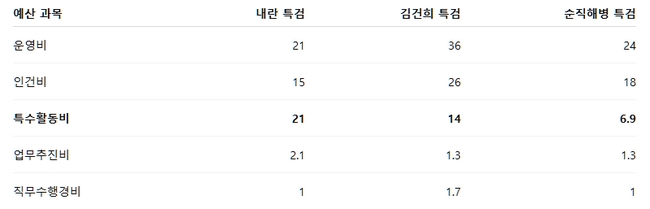 Budget execution status of the three special prosecutors. The rebellion special prosecutor had the largest amount of special activity funds (2.1 billion won), followed by the Kim Keon-hee special prosecutor (1.4 billion won). The rebellion special prosecutor's operating expenses and special activity funds are of the same magnitude (2.1 billion won each), revealing a structural characteristic.
The aspect that concretizes this question is the list of evidence revealed during the indictment and trial processes.
Most of the evidence presented in court consisted of publicly available materials such as documents and electronic records obtained through searches and seizures, testimonies collected during previous prosecutorial investigations, call records and account data, and media reports.
Traces of non-public and confidential investigative activities presupposed by SAFs, such as the operation of informal informants, undercover investigations, and clandestine contacts, were not clearly identified in the indictment or during the trial proceedings.
For this reason, it is pointed out that "an explanation is needed on how billions of won in SAFs were actually used for activities within this evidentiary structure."
Additionally, it is argued that since the disclosure of receipts is exempted for SAFs, internal controls and ex-post verification that fundamentally prevent the possibility of private use or improper influence must be in place.
Given the repeated controversies surrounding the private use of prosecution SAFs in the past, it is argued that the execution of SAFs for the current special prosecutors also needs to be examined by the same standards: the scope of the execution purpose, the timing of use, and whether control mechanisms were in operation.
This is explained as an issue of budget control, which requires confirmation that non-public funds were used in accordance with the purpose of the system, rather than a matter of determining specific actions.
A legal professional stated, "SAFs are exceptional funds that must meet strict requirements regardless of performance," and added, "If SAFs were used in cases where the investigation and trial were largely public, at least an ex-post explanation of the nature of the activities is necessary."
It is also assessed that as the investigation has concluded and the indictment and evidence have been disclosed, it is becoming increasingly difficult to evade SAF verification on the grounds of 'confidentiality protection'.
This is because special prosecutor budgets are all taxpayer money approved by the National Assembly, and thus, the use of SAFs should also be subject to inspection and requests for explanation at the National Assembly level.
Ultimately, the issue is not how much was spent, but why it was spent.
If the reason for investing non-public funds in investigations, which have been disclosed through trials, is not explained, SAFs will inevitably be at the center of the 'dark box budget' controversy once again.
By Reporter Kim Young

 Iranian Foreign Ministry: "Continuing Message Exchanges with the U.S. and Activities of Mediating Countries"
Esmaeil Baghaei, Spokesperson for the Iranian Ministry of Foreign Affairs [Xinhua, Yonhap News file photo]Esmaeil Baghaei, spokesperson for the Iranian Ministry of Foreign Affairs, stated on the 26th
Iranian Foreign Ministry: "Continuing Message Exchanges with the U.S. and Activities of Mediating Countries"
Esmaeil Baghaei, Spokesperson for the Iranian Ministry of Foreign Affairs [Xinhua, Yonhap News file photo]Esmaeil Baghaei, spokesperson for the Iranian Ministry of Foreign Affairs, stated on the 26th
 President Yoon: "Do You Think You Are Safe from the Special Counsel?"... Final Statement Video Released
President Yoon Suk Yeol rebuking the special prosecutor on the 24th. [Court video / @birds_justice X account subtitle GIF] A video of President Yoon Suk Yeol's closing statement at his trial rega
President Yoon: "Do You Think You Are Safe from the Special Counsel?"... Final Statement Video Released
President Yoon Suk Yeol rebuking the special prosecutor on the 24th. [Court video / @birds_justice X account subtitle GIF] A video of President Yoon Suk Yeol's closing statement at his trial rega
 President Yoon, regarding the first-instance ruling on the Public Official Election Act: “An excessive political verdict that distorts the facts… We will appeal immediately.”
The first-instance sentencing hearing for President Yoon Suk Yeol regarding violations of the Public Official Election Act is being broadcast live at Seoul Station on the 27th. [Photo=Yonhap News]Pres
President Yoon, regarding the first-instance ruling on the Public Official Election Act: “An excessive political verdict that distorts the facts… We will appeal immediately.”
The first-instance sentencing hearing for President Yoon Suk Yeol regarding violations of the Public Official Election Act is being broadcast live at Seoul Station on the 27th. [Photo=Yonhap News]Pres
 WSJ: "SK Hynix ADR Premium Is a Sign of AI Trading Overheat"
Advertisement for SK Hynix ADR listing in New York's Times Square [Reuters=Yonhap News file photo]The Wall Street Journal (WSJ) has pointed out that the price of SK Hynix’s American Depositary Recei
WSJ: "SK Hynix ADR Premium Is a Sign of AI Trading Overheat"
Advertisement for SK Hynix ADR listing in New York's Times Square [Reuters=Yonhap News file photo]The Wall Street Journal (WSJ) has pointed out that the price of SK Hynix’s American Depositary Recei
 'Godfather of Japanese Mystery Novels' Keigo Higashino Passes Away After Battle with Cancer at 68
Famous Japanese mystery novelist Keigo Higashino [AFP=Yonhap News]It has been belatedly reported that Keigo Higashino, the "godfather of Japanese mystery novels" and author of bestsellers such as "The
'Godfather of Japanese Mystery Novels' Keigo Higashino Passes Away After Battle with Cancer at 68
Famous Japanese mystery novelist Keigo Higashino [AFP=Yonhap News]It has been belatedly reported that Keigo Higashino, the "godfather of Japanese mystery novels" and author of bestsellers such as "The
 [Park Pil-kyu Security Column] To the Ignorant Trying to Clothe a Beast in Sheep's Clothing
Rep. Kim Byung-joo of the Democratic Party of Korea [Photo=Yonhap News]“The Air Force Academy doesn't teach you how to fly a plane!” “The Army, Navy, and Air Force academies are exactly the
[Park Pil-kyu Security Column] To the Ignorant Trying to Clothe a Beast in Sheep's Clothing
Rep. Kim Byung-joo of the Democratic Party of Korea [Photo=Yonhap News]“The Air Force Academy doesn't teach you how to fly a plane!” “The Army, Navy, and Air Force academies are exactly the
 [Issue Diagnosis] Two Effects of the Election Petition Review
 [Photo] Evidence of Election Fraud Flooding U.S. Media… Trump Had 2.7 Million Votes Stolen
 [Video] U.S. Semiquincentennial Air Show... 'Art in the Sky' streaks across New York
 [Editorial Cartoon] A Draconian Law That Undermines Freedom of Expression

 List
List









