 Lee Chan-jin, Governor of the Financial Supervisory Service [Photo: Yonhap News]
Raising Issues Under the Guise of "Governance Reform"
The government's policy to strengthen the reappointment process for financial holding company CEOs is being presented under the banner of "governance reform."
The criticism that the executive nomination committee, centered on outside directors, has effectively controlled the CEO's reappointment, and the issue raised about long-term tenures creating a closed structure in conjunction with the board of directors, are not new.
Indeed, the financial authorities, under the pretense of advancing governance, are including discussions on how to control the appointment and reappointment process for financial holding company CEOs within the scope of their task force (TF), alongside discussions on board independence.
However, the diagnosis of the problem and the proposed solutions do not align.
The current discussions are less about genuine governance reform and more about a design that shifts the financial holding company CEO position into an arena for political judgment.
Is a Special Resolution "Market Judgment" or an Aggregation of Political Signals?
The core of the government's consideration is to subject CEO reappointments to a special shareholder resolution. The plan is to raise the bar, requiring approval from at least two-thirds of the attending shareholders for reappointment.
This is presented with the rationale of strengthening shareholder control, moving away from a structure dominated by a few outside directors.
On the surface, it appears to be a democratic and market-friendly approach.
However, considering the reality of the governance structure of Korean financial holding companies, this process is highly likely to function not as "market judgment" but as an "aggregation of political signals."
Korean financial holding companies lack absolute controlling shareholders. Pension funds and institutional investors hold significant stakes, while foreign shareholders are sensitive to policy risks and short-term performance. Individual shareholder influence is limited.
In such a structure, achieving two-thirds approval at a shareholders' meeting based solely on the CEO's performance is difficult.
Policy direction, the gaze of supervisory authorities, and messages from the administration naturally permeate shareholder decisions.
Ultimately, the reappointment process could devolve into a political litmus test measuring "distance from the administration" rather than a governance evaluation.
The CEO Position: The Apex of Power, Not Management
At this juncture, the role of a financial holding company CEO fundamentally changes.
A financial holding company CEO is not an executive directly responsible for the operations of each subsidiary but the apex of the governance structure, overseeing group strategy, personnel, and overall governance.
Nevertheless, if reappointment hinges on a political hurdle like a special resolution, the CEO will prioritize calculating the shareholders' meeting dynamics over long-term strategy.
Interpreting policy signals before market assessments becomes the rational choice. This is where the politicalization of the financial holding company CEO position begins.
The Structure Remains, Only Responsibility is Dispersed
The more fundamental issue is that the outside director-centric structure, which the government has criticized, will essentially remain in place.
The executive nomination committee will still recommend a single candidate, and the board structure will not significantly change.
Only the final approval method will differ.
This is less about structural reform and more about dispersing responsibility. In the future, if problems arise, it will be possible to say, "The board approved it, and the shareholders agreed." The number of decision-makers increases, but the subject of responsibility becomes blurred.
Power Has Not Diminished, It Has Merely Broadened
The government calls this governance improvement.
However, this method is more of a design that broadens the influence of power rather than reduces it.
Judgment, once concentrated in the hands of a few outside directors, shifts to the shareholders' meeting, but that shareholders' meeting is dominated by institutional investors and pension funds, who are sensitive to political and policy signals.
It's a structure where everyone interprets the same signals first, even without direct instruction or intervention.
Power does not disappear. It merely permeates in more invisible ways and across a wider scope.
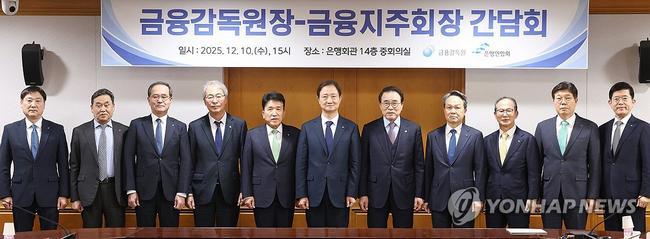 Lee Chan-jin, Governor of the Financial Supervisory Service (sixth from left), takes a commemorative photo with attendees at a meeting between the Governor of the Financial Supervisory Service and financial holding company CEOs, held at the Korea Federation of Banks in Jung-gu, Seoul, on the afternoon of December 10. 2025.12.10 [Photo: Yonhap News]
If This Isn't Collusion Between Politics and Business, What Is?
At this point, one cannot help but ask: Is this not collusion between politics and business?
Of course, blatant transactions where politics designates specific individuals and finance provides compensation, as seen in the past, are not evident.
However, the method has changed, but the structure has become more sophisticated. Instead of direct political intervention in personnel appointments, it involves designing a system with political hurdles that personnel must clear.
The irony is complete here.
The logic of "separation of industry and finance" (Geumsan Bunri), advocated to prevent industrial capital from controlling finance, was originally a safeguard to protect the autonomy of finance. Now, political influence is filling that void.
A structure is being created where only political judgment is superimposed on financial holding companies, which have no controlling shareholders and no responsible owner.
If this is not collusion between politics and business, what should we call it?
Not Reform, But Expansion of Power
Long-term reappointment itself was not the fundamental problem.
The problem was the absence of a verification structure.
There was no design for how performance would be evaluated, what responsibilities would be incurred in case of failure, or how external verification would operate.
Filling this void with approval ratios will not mature the system. A special resolution only strengthens the procedure; it does not guarantee the quality of judgment.
Finance gains trust when it maintains distance from politics.
While policy direction is important, the moment the apex of governance is managed by political signals, the financial system becomes short-term oriented.
A structure where financial holding company CEOs worry about reappointment based on political currents rather than market performance and results ultimately undermines the stability and conservatism of finance.
The cost of this will fall not on the financial sector itself but on the market and the public.
What is needed now is not a mechanism to make reappointment difficult.
It is transparent performance indicators, independent verification, and a clear accountability structure for failures.
Without these, simply raising the bar for reappointment will turn financial holding company CEOs into political survivors, not strategists.
It is now time to answer whether this is indeed reform, or an expansion of power with only the method of control changed.

 Iranian Foreign Ministry: "Continuing Message Exchanges with the U.S. and Activities of Mediating Countries"
Esmaeil Baghaei, Spokesperson for the Iranian Ministry of Foreign Affairs [Xinhua, Yonhap News file photo]Esmaeil Baghaei, spokesperson for the Iranian Ministry of Foreign Affairs, stated on the 26th
Iranian Foreign Ministry: "Continuing Message Exchanges with the U.S. and Activities of Mediating Countries"
Esmaeil Baghaei, Spokesperson for the Iranian Ministry of Foreign Affairs [Xinhua, Yonhap News file photo]Esmaeil Baghaei, spokesperson for the Iranian Ministry of Foreign Affairs, stated on the 26th
 President Yoon: "Do You Think You Are Safe from the Special Counsel?"... Final Statement Video Released
President Yoon Suk Yeol rebuking the special prosecutor on the 24th. [Court video / @birds_justice X account subtitle GIF] A video of President Yoon Suk Yeol's closing statement at his trial rega
President Yoon: "Do You Think You Are Safe from the Special Counsel?"... Final Statement Video Released
President Yoon Suk Yeol rebuking the special prosecutor on the 24th. [Court video / @birds_justice X account subtitle GIF] A video of President Yoon Suk Yeol's closing statement at his trial rega
 President Yoon, regarding the first-instance ruling on the Public Official Election Act: “An excessive political verdict that distorts the facts… We will appeal immediately.”
The first-instance sentencing hearing for President Yoon Suk Yeol regarding violations of the Public Official Election Act is being broadcast live at Seoul Station on the 27th. [Photo=Yonhap News]Pres
President Yoon, regarding the first-instance ruling on the Public Official Election Act: “An excessive political verdict that distorts the facts… We will appeal immediately.”
The first-instance sentencing hearing for President Yoon Suk Yeol regarding violations of the Public Official Election Act is being broadcast live at Seoul Station on the 27th. [Photo=Yonhap News]Pres
 WSJ: "SK Hynix ADR Premium Is a Sign of AI Trading Overheat"
Advertisement for SK Hynix ADR listing in New York's Times Square [Reuters=Yonhap News file photo]The Wall Street Journal (WSJ) has pointed out that the price of SK Hynix’s American Depositary Recei
WSJ: "SK Hynix ADR Premium Is a Sign of AI Trading Overheat"
Advertisement for SK Hynix ADR listing in New York's Times Square [Reuters=Yonhap News file photo]The Wall Street Journal (WSJ) has pointed out that the price of SK Hynix’s American Depositary Recei
 'Godfather of Japanese Mystery Novels' Keigo Higashino Passes Away After Battle with Cancer at 68
Famous Japanese mystery novelist Keigo Higashino [AFP=Yonhap News]It has been belatedly reported that Keigo Higashino, the "godfather of Japanese mystery novels" and author of bestsellers such as "The
'Godfather of Japanese Mystery Novels' Keigo Higashino Passes Away After Battle with Cancer at 68
Famous Japanese mystery novelist Keigo Higashino [AFP=Yonhap News]It has been belatedly reported that Keigo Higashino, the "godfather of Japanese mystery novels" and author of bestsellers such as "The
 [Park Pil-kyu Security Column] To the Ignorant Trying to Clothe a Beast in Sheep's Clothing
Rep. Kim Byung-joo of the Democratic Party of Korea [Photo=Yonhap News]“The Air Force Academy doesn't teach you how to fly a plane!” “The Army, Navy, and Air Force academies are exactly the
[Park Pil-kyu Security Column] To the Ignorant Trying to Clothe a Beast in Sheep's Clothing
Rep. Kim Byung-joo of the Democratic Party of Korea [Photo=Yonhap News]“The Air Force Academy doesn't teach you how to fly a plane!” “The Army, Navy, and Air Force academies are exactly the
 [Issue Diagnosis] Two Effects of the Election Petition Review
 [Photo] Evidence of Election Fraud Flooding U.S. Media… Trump Had 2.7 Million Votes Stolen
 [Video] U.S. Semiquincentennial Air Show... 'Art in the Sky' streaks across New York
 [Editorial Cartoon] A Draconian Law That Undermines Freedom of Expression

 List
List









