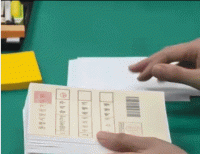
President Donald Trump attends the announcement of the charter for the 'Board of Peace,' aimed at resolving global conflicts, at the 56th World Economic Forum (WEF) in Davos, Switzerland, on January 22, 2026. [Reuters/Jonathan Ernst]
President Donald Trump officially launched the Board of Peace on Tuesday by signing the charter of a new international body during a high-level event that highlighted his administration's efforts to reshape global diplomacy, with Gaza as an initial focus.
Trump sat at a table at the front of the stage and watched as representatives from Bahrain and Morocco came forward to sign and ratify the founding charter of the board, followed by 19 other leaders, all against the backdrop of the board's newly unveiled logo, CBS News reported.
TASS news agency reported that the United States and 19 countries signed the charter: Armenia, Argentina, Azerbaijan, Bahrain, Bulgaria, Hungary, Indonesia, Jordan, Kazakhstan, Mongolia, Morocco, Pakistan, Paraguay, Qatar, Saudi Arabia, Türkiye, United Arab Emirates (UAE), and Uzbekistan, along with Kosovo.
According to President Trump, a total of 59 countries have expressed their intent to participate. Russia has also reportedly expressed interest but did not attend the signing ceremony. Russian President Vladimir Putin proposed using $1 billion of frozen Russian state assets in the U.S. to pay membership fees after the war in Ukraine.
President Trump limited the term for member states to three years but offered permanent membership status to those who contribute over $1 billion in the first year of its establishment.
White House spokesperson Karoline Leavitt, calling out leaders from the podium to guide them to sign, declared, "The charter is now fully ratified and the Board of Peace is officially launched as an international organization."
The Trump administration has defined the board as an implementing and oversight body for its U.S.-brokered plan to end the Gaza war and rebuild the region, while simultaneously positioning it as an agency for resolving conflicts in regions beyond the Middle East.
Ali Shaath, chairman of the U.S.-backed Palestinian technocratic committee, told attendees at the launch that the border between Gaza and Egypt would open next week, The Times of Israel reported.
Shaath described the Rafah crossing as a "lifeline" for Gaza residents, stating that its prolonged closure had trapped many inside Gaza and prevented numerous Palestinians displaced by fighting from returning.
Under the terms of a ceasefire agreement, Israel is obligated to reopen the crossing. However, Israeli authorities have publicly opposed its reopening until Hamas returns the remains of the last hostages believed to be held in Gaza, which Hamas has not yet fulfilled.
Prior to the event, Secretary of State Marco Rubio stated that Gaza would be the board's immediate focus, with a presentation led by Trump's special envoy Steve Witkoff and his son-in-law Jared Kushner.
Kushner presented a vision for reconstruction that calls for the disarmament of Hamas and the transfer of authority to a single civilian governing body, displaying a slide labeled 'New Gaza' and outlining what he termed "demilitarization principles."
The signing ceremony proceeded amidst ongoing tensions regarding Israel's role within the new body. Israel did not participate in the event, though officials have expressed interest in joining.
A spokesperson for Israeli President Isaac Herzog in Davos confirmed Herzog's absence from the event but declined to provide further details.
The structure of the Board of Peace is drawing attention from diplomats and international law experts.
Draft charters distributed to capitals in recent weeks grant the chairman broad powers, including veto power, control over the agenda and invitations, and the authority to dissolve the body and appoint a successor.
The document specifies that former President Trump will serve as the inaugural chairman.
Hungarian Prime Minister Viktor Orbán, one of Trump's closest allies in Europe, publicly endorsed the plan after receiving an invitation to participate.
"If Trump, then peace," Orbán wrote on Facebook. "Of course, I accepted this glorious invitation."
Saudi Arabia, Egypt, Belarus, and Pakistan have also expressed their intention to participate. Other U.S. allies, including France, Norway, and Sweden, have declined to participate, raising concerns that the body could undermine the United Nations.
Marc Weller, a Cambridge University professor of international law who has worked on peace negotiations, described the plan as "an attempt to refashion the international system around a single leader" and "a direct attack on the UN," according to The New York Times.
The UN Security Council approved the establishment of the Peace Board in November, welcoming the U.S.-brokered plan to end the Gaza conflict and endorsing a transitional administration to oversee reconstruction until 2027.
However, the Trump administration has since described the Gaza issue solely as a component of a broader mission that overlaps with the UN's traditional role of maintaining international peace and security.
Earlier this week, President Trump stated, "I wish the UN would do more," and "I wish there was no need for the Peace Board." When asked if the new body could replace the UN, Trump responded, "It might," while adding that the UN still has significant potential.
At the signing ceremony on Tuesday, President Trump stated that he would work with the UN, adding, "If it's successful in Gaza, it could be expanded to other matters."
Sung Ku Hong, Editor-in-Chief of U.S. NNP / Special Correspondent for this paper NNP info@newsandpost.com

 Trump pressures for rate cut again ahead of FOMC... "Should be the lowest in the world"
U.S. President Donald Trump. [Photo = The White House] U.S. President Donald Trump once again pressured the Federal Reserve, the U.S. central bank, to lower interest rates on the 27th (local time
Trump pressures for rate cut again ahead of FOMC... "Should be the lowest in the world"
U.S. President Donald Trump. [Photo = The White House] U.S. President Donald Trump once again pressured the Federal Reserve, the U.S. central bank, to lower interest rates on the 27th (local time
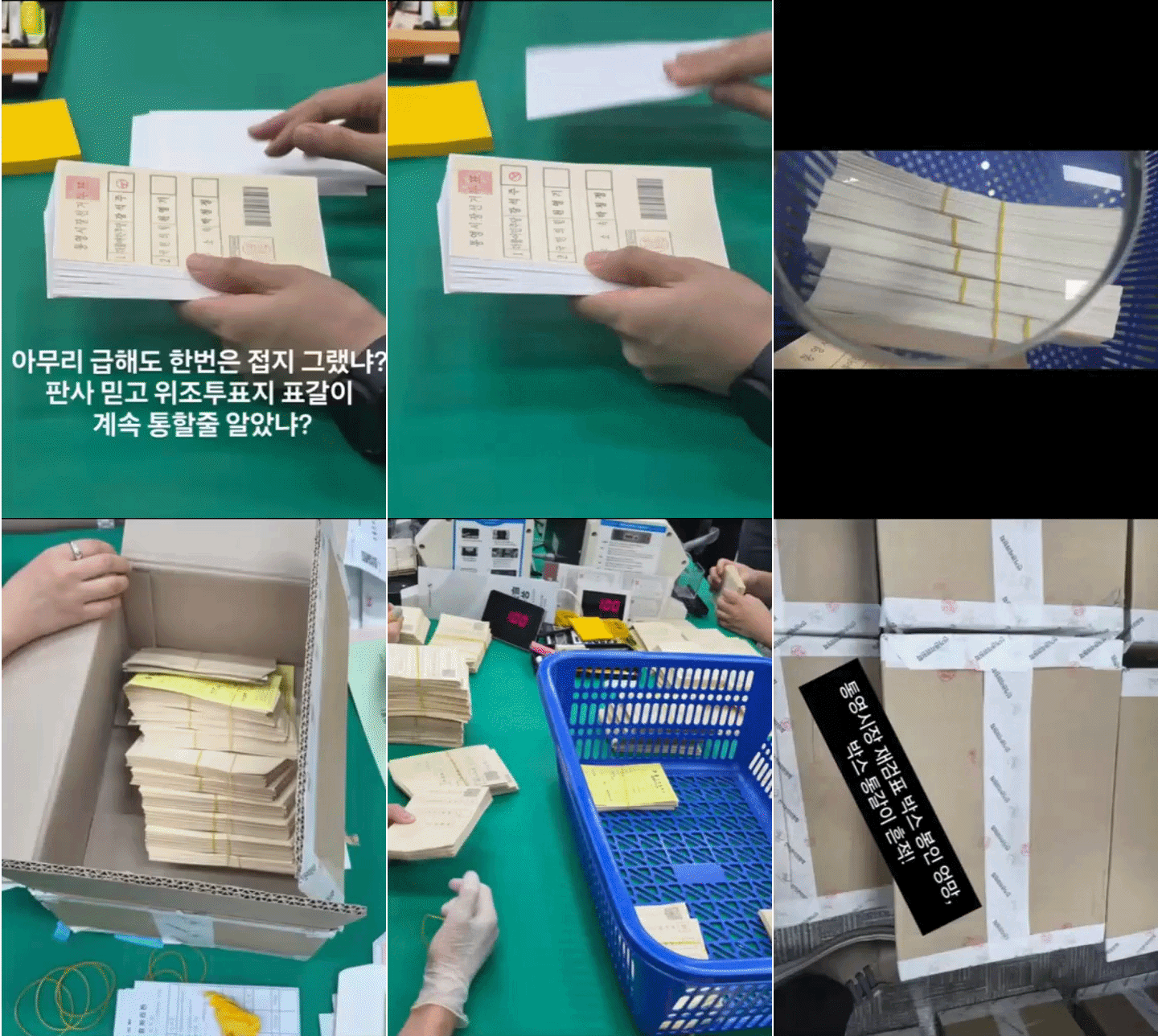 “Ignoring crisp ballots and damaged seals”… Tongyeong mayoral recount concludes with ‘no change in outcome,’ leaving suspicions and public outrage behind
Suspected counterfeit ballots discovered in Tongyeong [GIF from social media of Representative Hwang Kyo-ahn / Attorney Park Joo-hyun]During a recount of the Tongyeong mayoral election in South Gyeong
“Ignoring crisp ballots and damaged seals”… Tongyeong mayoral recount concludes with ‘no change in outcome,’ leaving suspicions and public outrage behind
Suspected counterfeit ballots discovered in Tongyeong [GIF from social media of Representative Hwang Kyo-ahn / Attorney Park Joo-hyun]During a recount of the Tongyeong mayoral election in South Gyeong
 President Yoon, regarding the first-instance ruling on the Public Official Election Act: “An excessive political verdict that distorts the facts… We will appeal immediately.”
The first-instance sentencing hearing for President Yoon Suk Yeol regarding violations of the Public Official Election Act is being broadcast live at Seoul Station on the 27th. [Photo=Yonhap News]Pres
President Yoon, regarding the first-instance ruling on the Public Official Election Act: “An excessive political verdict that distorts the facts… We will appeal immediately.”
The first-instance sentencing hearing for President Yoon Suk Yeol regarding violations of the Public Official Election Act is being broadcast live at Seoul Station on the 27th. [Photo=Yonhap News]Pres
 WSJ: "SK Hynix ADR Premium Is a Sign of AI Trading Overheat"
Advertisement for SK Hynix ADR listing in New York's Times Square [Reuters=Yonhap News file photo]The Wall Street Journal (WSJ) has pointed out that the price of SK Hynix’s American Depositary Recei
WSJ: "SK Hynix ADR Premium Is a Sign of AI Trading Overheat"
Advertisement for SK Hynix ADR listing in New York's Times Square [Reuters=Yonhap News file photo]The Wall Street Journal (WSJ) has pointed out that the price of SK Hynix’s American Depositary Recei
 'Godfather of Japanese Mystery Novels' Keigo Higashino Passes Away After Battle with Cancer at 68
Famous Japanese mystery novelist Keigo Higashino [AFP=Yonhap News]It has been belatedly reported that Keigo Higashino, the "godfather of Japanese mystery novels" and author of bestsellers such as "The
'Godfather of Japanese Mystery Novels' Keigo Higashino Passes Away After Battle with Cancer at 68
Famous Japanese mystery novelist Keigo Higashino [AFP=Yonhap News]It has been belatedly reported that Keigo Higashino, the "godfather of Japanese mystery novels" and author of bestsellers such as "The
 [Park Pil-kyu Security Column] To the Ignorant Trying to Clothe a Beast in Sheep's Clothing
Rep. Kim Byung-joo of the Democratic Party of Korea [Photo=Yonhap News]“The Air Force Academy doesn't teach you how to fly a plane!” “The Army, Navy, and Air Force academies are exactly the
[Park Pil-kyu Security Column] To the Ignorant Trying to Clothe a Beast in Sheep's Clothing
Rep. Kim Byung-joo of the Democratic Party of Korea [Photo=Yonhap News]“The Air Force Academy doesn't teach you how to fly a plane!” “The Army, Navy, and Air Force academies are exactly the
 [Issue Diagnosis] Two Effects of the Election Petition Review
 [Photo] Evidence of Election Fraud Flooding U.S. Media… Trump Had 2.7 Million Votes Stolen
 [Video] U.S. Semiquincentennial Air Show... 'Art in the Sky' streaks across New York
 [Editorial Cartoon] A Draconian Law That Undermines Freedom of Expression

 List
List