 President Lee Jae-myung holds a briefing document while speaking at a Cabinet meeting held at the Blue House on the 20th. [Photo=Yonhap News]
Housing prices have always moved under the same conditions
Every time real estate prices rise, the political sphere always brings up the same words. “It’s because of speculation.” The explanation is simple, and the direction of responsibility is clear.
However, looking back at periods of rapid housing price surges, there are common conditions across different political administrations.
Interest rates were low, liquidity was abundant, and supply could not increase in the short term. Prices always moved when these three factors overlapped.
Ignoring this structure and defining real estate as speculation means that policy no longer asks why prices rose. Analysis disappears, leaving only moral judgment.
There is no more convenient explanation than the word "speculation" to bypass issues of interest rates and liquidity, which are difficult for the government to control, and supply problems that require time.
When the word 'speculation' replaces explanation
Recently, President Lee Jae-myung's remarks, alluding to the long-term holding special deduction, suggesting that "long-term holding for speculative/investment purposes" could hinder supply and stimulate prices, fall within this context.
The point that long-term holding incentives can delay transactions is not inherently incorrect.
However, presenting this as the core cause of soaring housing prices is an explanation that selectively omits part of the truth. It leaves out the more fundamental factors of interest rates, liquidity, and supply rigidity.
In particular, the practice of the Presidential Office, the government, and the ruling party consistently shifting responsibility to the market and individuals using the same language during sensitive housing price periods has obscured the causes of policy failures.
In place of explanations, only stigma remains, and policies increasingly lose their persuasiveness.
Money looks for a place to stay
Major developed countries have designed regulations and taxation while acknowledging real estate as an investment asset.
The United States and the United Kingdom manage both residential and commercial real estate within capital markets and absorb liquidity through REITs. This is a method of managing real estate demand by shifting it to capital markets rather than suppressing it.
In contrast, China, under the slogan of excluding real estate from speculation, did not recognize private residential and commercial real estate as investment assets, and as a result, a normal REIT market did not form.
Capital, unable to be absorbed, flowed into developer debt and shadow banking, which ultimately led to real estate collapse and capital controls.
This is a contrasting case that shows how the definition of real estate determines the path of capital.
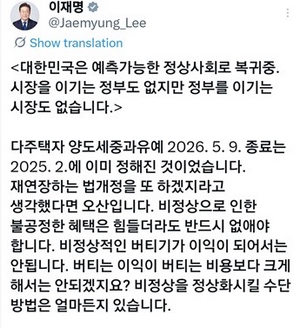 Lee Jae-myung X capture.Now, the reality is Korea's problem.
Both real estate and the stock market have become expensive. As asset prices rise, expected returns decrease, and investors calculate the risk of a decline before anticipating further increases.
When major domestic assets are simultaneously perceived as reaching their peak, liquidity can no longer find a place to stay within the country. At this point, the options naturally narrow.
It is moving from domestic assets to overseas assets.
What appears in this process is the exchange rate.
The exchange rate, rather than being a result of the trade balance, is an indicator of where capital wants to stay.
If asset prices rise but the currency weakens, it is less a sign of high growth expectations and more a signal that incentives to remain domestically are diminishing.
Will real estate be recognized as an investment?
Shifting the perspective at this point reveals the outline of a solution.
The moment real estate is categorized as an investment asset rather than speculation, much of the confusion disappears.
If it is an investment asset, prices respond to interest rates, liquidity, and supply. There are reasons for it to rise, and reasons for it to fall. The standard for explanation becomes structure, not morality.
Here, REITs are not just simple real estate products.
REITs are capital market mechanisms that distribute rental income from real estate as dividends, rather than a system for directly buying and selling real estate.
It is a system that allows individuals to participate in the profits of commercial real estate or rental assets without directly buying a home. It is a channel that absorbs real estate demand into the capital market instead of suppressing it.
However, this is possible only when REITs have normal tax systems, disclosures, and a private-sector-led operational structure.
As long as they remain as public-led development products, REITs can degenerate into another policy tool rather than a channel for capital.
The argument for recognizing real estate as an investment is not an endorsement of rising housing prices.
It is a demand to return prices to being a result that policy should explain and manage, rather than a moral issue.
As real estate is pushed towards speculation, liquidity silently seeks an exit.
While politics may be temporarily advantageous, the market eventually turns its back.

 Iranian Foreign Ministry: "Continuing Message Exchanges with the U.S. and Activities of Mediating Countries"
Esmaeil Baghaei, Spokesperson for the Iranian Ministry of Foreign Affairs [Xinhua, Yonhap News file photo]Esmaeil Baghaei, spokesperson for the Iranian Ministry of Foreign Affairs, stated on the 26th
Iranian Foreign Ministry: "Continuing Message Exchanges with the U.S. and Activities of Mediating Countries"
Esmaeil Baghaei, Spokesperson for the Iranian Ministry of Foreign Affairs [Xinhua, Yonhap News file photo]Esmaeil Baghaei, spokesperson for the Iranian Ministry of Foreign Affairs, stated on the 26th
 President Yoon: "Do You Think You Are Safe from the Special Counsel?"... Final Statement Video Released
President Yoon Suk Yeol rebuking the special prosecutor on the 24th. [Court video / @birds_justice X account subtitle GIF] A video of President Yoon Suk Yeol's closing statement at his trial rega
President Yoon: "Do You Think You Are Safe from the Special Counsel?"... Final Statement Video Released
President Yoon Suk Yeol rebuking the special prosecutor on the 24th. [Court video / @birds_justice X account subtitle GIF] A video of President Yoon Suk Yeol's closing statement at his trial rega
 President Yoon, regarding the first-instance ruling on the Public Official Election Act: “An excessive political verdict that distorts the facts… We will appeal immediately.”
The first-instance sentencing hearing for President Yoon Suk Yeol regarding violations of the Public Official Election Act is being broadcast live at Seoul Station on the 27th. [Photo=Yonhap News]Pres
President Yoon, regarding the first-instance ruling on the Public Official Election Act: “An excessive political verdict that distorts the facts… We will appeal immediately.”
The first-instance sentencing hearing for President Yoon Suk Yeol regarding violations of the Public Official Election Act is being broadcast live at Seoul Station on the 27th. [Photo=Yonhap News]Pres
 WSJ: "SK Hynix ADR Premium Is a Sign of AI Trading Overheat"
Advertisement for SK Hynix ADR listing in New York's Times Square [Reuters=Yonhap News file photo]The Wall Street Journal (WSJ) has pointed out that the price of SK Hynix’s American Depositary Recei
WSJ: "SK Hynix ADR Premium Is a Sign of AI Trading Overheat"
Advertisement for SK Hynix ADR listing in New York's Times Square [Reuters=Yonhap News file photo]The Wall Street Journal (WSJ) has pointed out that the price of SK Hynix’s American Depositary Recei
 'Godfather of Japanese Mystery Novels' Keigo Higashino Passes Away After Battle with Cancer at 68
Famous Japanese mystery novelist Keigo Higashino [AFP=Yonhap News]It has been belatedly reported that Keigo Higashino, the "godfather of Japanese mystery novels" and author of bestsellers such as "The
'Godfather of Japanese Mystery Novels' Keigo Higashino Passes Away After Battle with Cancer at 68
Famous Japanese mystery novelist Keigo Higashino [AFP=Yonhap News]It has been belatedly reported that Keigo Higashino, the "godfather of Japanese mystery novels" and author of bestsellers such as "The
 [Park Pil-kyu Security Column] To the Ignorant Trying to Clothe a Beast in Sheep's Clothing
Rep. Kim Byung-joo of the Democratic Party of Korea [Photo=Yonhap News]“The Air Force Academy doesn't teach you how to fly a plane!” “The Army, Navy, and Air Force academies are exactly the
[Park Pil-kyu Security Column] To the Ignorant Trying to Clothe a Beast in Sheep's Clothing
Rep. Kim Byung-joo of the Democratic Party of Korea [Photo=Yonhap News]“The Air Force Academy doesn't teach you how to fly a plane!” “The Army, Navy, and Air Force academies are exactly the
 [Issue Diagnosis] Two Effects of the Election Petition Review
 [Photo] Evidence of Election Fraud Flooding U.S. Media… Trump Had 2.7 Million Votes Stolen
 [Video] U.S. Semiquincentennial Air Show... 'Art in the Sky' streaks across New York
 [Editorial Cartoon] A Draconian Law That Undermines Freedom of Expression

 List
List









