 A scene from the live broadcast of the first-instance sentencing hearing for former President Yoon Suk-yeol regarding charges of rebellion. [Photo=KBS screen capture]
The first-instance verdict for former President Yoon Suk-yeol on charges of rebellion is scheduled for February 19th, immediately after the Lunar New Year holiday.
Given the extreme range of legal penalties, from acquittal to life imprisonment/imprisonment without parole, and even the death penalty, opinions in the legal and political circles are sharply divided.
Hanmi Ilbo conducted direct meetings and telephone interviews with about 10 individuals, including former Supreme Court justices, former court presidents, former chief prosecutors, former senior officials from the Supreme Prosecutors' Office, law school professors, renowned lawyers, and National Assembly members with legal backgrounds.
Among them were individuals with personal connections to the presiding court. All interviews were conducted on the condition of anonymity.
Synthesizing the findings, the outlook can be summarized in one sentence:
"Based on existing legal interpretations, it would be an acquittal; if an expansive interpretation considering the political situation is applied, it would be a conviction."
Here, 'existing legal interpretation' refers to the method of judgment that centers on the strict establishment requirements for rebellion, as established by Supreme Court precedents, namely the intent to subvert the constitution and the substantive existence of an uprising.
On the other hand, 'expansive interpretation' refers to an approach that broadly connects the political situation before and after the declaration of martial law and its ripple effects to the concepts of subverting the constitution and uprising.
A former Supreme Court justice, classified as progressive, stated, "Looking at the prosecution's closing argument logic, it attempts to link martial law to rebellion, but when viewed in isolation as a rebellion charge, it is quite difficult to find guilt."
A former chief prosecutor also commented, "While considering the political environment, the possibility of a conviction cannot be entirely ruled out, but strictly from a legal perspective, there is definitely room for an acquittal in a rebellion case."
A lawyer with a connection to a member of the rebellion case trial panel cautiously speculated, "I understand that the court has proceeded with extreme caution and diligence up to the final hearing. Wouldn't it be more likely that the conclusion will be based on legal principles rather than political considerations?"
Ultimately, this statement highlights that the core of this trial hinges not on the facts, but on 'which interpretative framework is applied.' It suggests a concern that opting for a narrow interpretation based on precedents increases the likelihood of acquittal, while choosing an expansive interpretation that reflects the political situation could lead to a conviction.
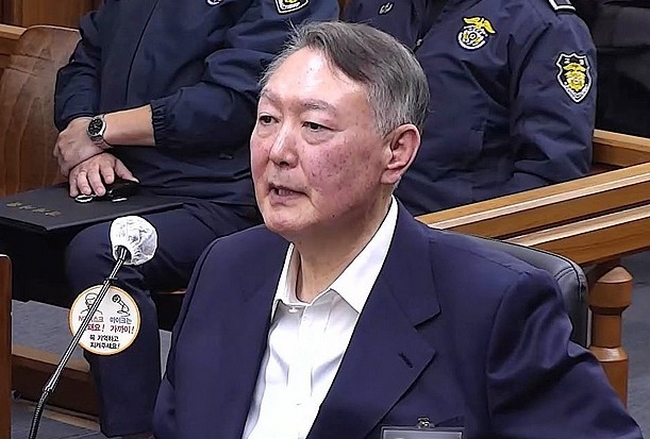 Former President Yoon Suk-yeol making a statement. [Photo=Yonhap News]
Opinions were divided among former court presidents who are now lawyers.
A conservative former court president, A, strongly criticized, "I sighed after reading the verdict in former President Yoon's abuse of power case. I got the impression that it was less well-crafted than a ruling by a novice judge. If this is the trend, then there's nothing more to consider in the rebellion case."
Conversely, a progressive former court president, B, said, "Ultimately, the key is what stance is taken towards existing Supreme Court precedents. If an interpretation that overturns them is chosen, the possibility of a conviction increases." However, he added, "Even if the verdict were free of political influence, who among the public would believe that?"
While the conclusions of the two former court presidents differ, both implicitly show that this trial extends beyond a legal issue to a matter of judicial trust. The conservative former court president questioned the quality of the verdict itself, while the progressive former court president pointed out the reality that the choice of precedent interpretation inevitably leads to political misinterpretations.
A law school professor, C (specializing in criminal law), stated, "Based solely on the indictment and the evidence adopted by the court, the possibility of acquittal is high. The crucial point is how the court views the evidence presented by the prosecution and the courtroom testimonies." This statement is interpreted to mean that it is difficult to conclude that rebellion has occurred based solely on the facts stated in the indictment and the evidence adopted by the court. It also suggests that the trial outcome will be determined by the court's assessment of the credibility of the evidence and the consistency of the testimonies, rather than by further political interpretations or the context of the case.
The 10 legal professionals interviewed by Hanmi Ilbo generally anticipated an acquittal, but all qualified their predictions with the condition of 'a state free from political pressure.'
Meanwhile, the views of National Assembly members with legal backgrounds leaned more towards the political impact of the trial outcome rather than the verdict itself. They showed greater interest in the changes in the political landscape after the ruling than in the actual conviction or acquittal.
Regarding an acquittal, they predicted, "It is inevitable that the Lee Jae-myung administration will fall into a political crisis," adding, "However, the trend could change depending on the response strategy adopted by the opposition party." Many also foresaw, "If the opposition wins the June local elections, the Lee Jae-myung administration will effectively enter an immediate lame-duck phase."
Conversely, if a conviction is handed down, there were also observations that "the People Power Party could rapidly falter amidst the ruling party's offensive and internal conflicts," and "the local elections could result in a landslide victory for the ruling party."
Watching legal professionals worry more about the 'situation' than the law itself, and lawyers-turned-politicians focusing more on the post-verdict political ramifications than the fairness of the trial, a remark made by one individual during the reporting process came to mind.
"This person is still naive. Where is fairness in a trial?"
The upcoming first-instance verdict is expected to be a test case, asking not just for a simple judgment of guilt or innocence, but also where the boundary lies between Korean judiciary and politics.

 Iranian Foreign Ministry: "Continuing Message Exchanges with the U.S. and Activities of Mediating Countries"
Esmaeil Baghaei, Spokesperson for the Iranian Ministry of Foreign Affairs [Xinhua, Yonhap News file photo]Esmaeil Baghaei, spokesperson for the Iranian Ministry of Foreign Affairs, stated on the 26th
Iranian Foreign Ministry: "Continuing Message Exchanges with the U.S. and Activities of Mediating Countries"
Esmaeil Baghaei, Spokesperson for the Iranian Ministry of Foreign Affairs [Xinhua, Yonhap News file photo]Esmaeil Baghaei, spokesperson for the Iranian Ministry of Foreign Affairs, stated on the 26th
 President Yoon: "Do You Think You Are Safe from the Special Counsel?"... Final Statement Video Released
President Yoon Suk Yeol rebuking the special prosecutor on the 24th. [Court video / @birds_justice X account subtitle GIF] A video of President Yoon Suk Yeol's closing statement at his trial rega
President Yoon: "Do You Think You Are Safe from the Special Counsel?"... Final Statement Video Released
President Yoon Suk Yeol rebuking the special prosecutor on the 24th. [Court video / @birds_justice X account subtitle GIF] A video of President Yoon Suk Yeol's closing statement at his trial rega
 President Yoon, regarding the first-instance ruling on the Public Official Election Act: “An excessive political verdict that distorts the facts… We will appeal immediately.”
The first-instance sentencing hearing for President Yoon Suk Yeol regarding violations of the Public Official Election Act is being broadcast live at Seoul Station on the 27th. [Photo=Yonhap News]Pres
President Yoon, regarding the first-instance ruling on the Public Official Election Act: “An excessive political verdict that distorts the facts… We will appeal immediately.”
The first-instance sentencing hearing for President Yoon Suk Yeol regarding violations of the Public Official Election Act is being broadcast live at Seoul Station on the 27th. [Photo=Yonhap News]Pres
 WSJ: "SK Hynix ADR Premium Is a Sign of AI Trading Overheat"
Advertisement for SK Hynix ADR listing in New York's Times Square [Reuters=Yonhap News file photo]The Wall Street Journal (WSJ) has pointed out that the price of SK Hynix’s American Depositary Recei
WSJ: "SK Hynix ADR Premium Is a Sign of AI Trading Overheat"
Advertisement for SK Hynix ADR listing in New York's Times Square [Reuters=Yonhap News file photo]The Wall Street Journal (WSJ) has pointed out that the price of SK Hynix’s American Depositary Recei
 'Godfather of Japanese Mystery Novels' Keigo Higashino Passes Away After Battle with Cancer at 68
Famous Japanese mystery novelist Keigo Higashino [AFP=Yonhap News]It has been belatedly reported that Keigo Higashino, the "godfather of Japanese mystery novels" and author of bestsellers such as "The
'Godfather of Japanese Mystery Novels' Keigo Higashino Passes Away After Battle with Cancer at 68
Famous Japanese mystery novelist Keigo Higashino [AFP=Yonhap News]It has been belatedly reported that Keigo Higashino, the "godfather of Japanese mystery novels" and author of bestsellers such as "The
 [Park Pil-kyu Security Column] To the Ignorant Trying to Clothe a Beast in Sheep's Clothing
Rep. Kim Byung-joo of the Democratic Party of Korea [Photo=Yonhap News]“The Air Force Academy doesn't teach you how to fly a plane!” “The Army, Navy, and Air Force academies are exactly the
[Park Pil-kyu Security Column] To the Ignorant Trying to Clothe a Beast in Sheep's Clothing
Rep. Kim Byung-joo of the Democratic Party of Korea [Photo=Yonhap News]“The Air Force Academy doesn't teach you how to fly a plane!” “The Army, Navy, and Air Force academies are exactly the
 [Issue Diagnosis] Two Effects of the Election Petition Review
 [Photo] Evidence of Election Fraud Flooding U.S. Media… Trump Had 2.7 Million Votes Stolen
 [Video] U.S. Semiquincentennial Air Show... 'Art in the Sky' streaks across New York
 [Editorial Cartoon] A Draconian Law That Undermines Freedom of Expression

 List
List









