 Can we trust opinion polls that change from time to time?
The results of a local election poll conducted by the polling firm Gongjeong at the request of 'Pen & Microphone' today raise fundamental questions about the 'common sense of public opinion polls' that has been taken for granted by the Korean political sphere and the old media.
This is because the poll showed a virtual tie within the margin of error, with the People Power Party at 39.7% and the Democratic Party of Korea at 39.6% when asked which party they would vote for in the local elections.
This is a completely different picture from the results of interviews conducted by Gallup or the National Barometer Survey (NBS) around the same time, which showed double-digit gaps.
The Power of Specific Questions to Neutralize Abstract Questions
This difference is not due to simple sampling error or coincidence. The key is the question design. Traditional opinion polls have asked about abstract attitudes such as, "Which party do you support?"
In contrast, this survey asked a specific and contextualized question: "Which party will you vote for in the local elections?"
It was based on the action of actually voting, not the emotion of support. The answers can differ even for the same voter depending on the question. And this gap is precisely what the old media has repeatedly missed.
Looking at the detailed figures makes the reason even clearer.
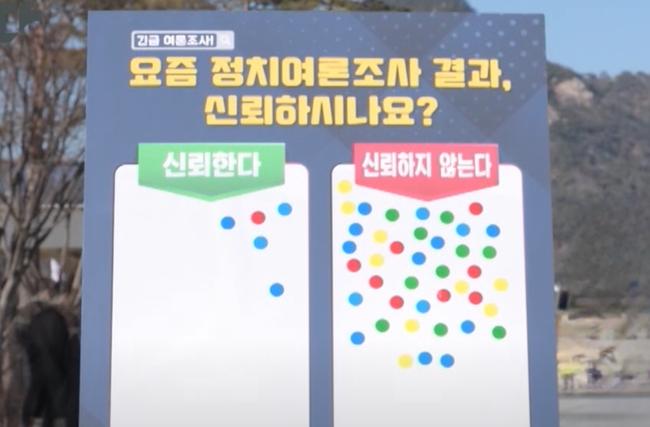 A survey in February last year also showed that people did not trust political opinion polls. [KBS News Capture]
By region, Seoul was a close race with the Democratic Party at 37.9% and the People Power Party at 38.3%. In Gyeonggi and Incheon, the People Power Party was ahead with 42.0% versus 40.2%.
In Daejeon, Sejong, and North Chungcheong Province, the gap was limited to 39.6% versus 37.6%.
In Busan, Ulsan, and Gyeongnam, the People Power Party led the Democratic Party by a significant margin of 46.7% to 30.8%. In Daegu and Gyeongbuk, they also maintained a stable lead with 42.6% versus 32.0%.
The situation was similar in Gangwon and Jeju, with 42.9% versus 33.7%. The narrative of a "disadvantage in the 수도권 (Seoul Metropolitan Area) and collapse in the provinces" loses its footing in the face of these numbers.
By age group, among those under 20, the People Power Party led the Democratic Party significantly with 50.5% to 29.5%. In their 30s, it was a complete tie at 36.4% versus 36.6%.
The structure for those in their 40s, 50s, and 60s is also such that neither party can be said to have an overwhelming advantage. This shows that simple diagnoses of the People Power Party lacking extensibility or moderates defecting are exaggerating reality.
The Significant Potential for the Ruling Party's Supporters to Rally
This means that even if the election landscape is simplified into a "judgment of the current government" frame, there is already sufficient potential for the ruling party's supporters to rally.
The issue is not the size of the supporter base, but how effectively they can be mobilized into action.
At this point, the misjudgment of the old media, which treats Gallup and NBS figures almost like scripture, becomes apparent. By directly converting poll results asking about attitudes into election outcomes, they are missing the essence of politics.
What is actually happening is not a defection of moderates, but a weakening of the intensity of action among existing supporters. Those who are disappointed but see no alternative are in a state of observation, and those who intend to vote but are not active have been misread as having withdrawn their support.
Therefore, what is needed now is not to cite poll numbers more, but to change the philosophy of opinion polling.
We need a system that moves beyond static opinion surveys to action-oriented surveys that ask about the intensity of voting intention and conditional choices, and that track voters who have actually voted for our party or candidates in the past over time.
This will enable precise prescriptions, such as "who, when, and why they stopped acting," rather than a vague diagnosis of "support rates have fallen."
The conclusion is clear. The message conveyed by this poll is not "The People Power Party will lose." It signals that the race is close, and the outcome will be determined by the candidates.
When we move to surveys that ask about action, the conditions for victory are already in place. If the old media cannot escape the illusion of numbers, they will once again repeat the belated reflection of "Why were the opinion polls wrong?" after the election is over.
The problem is not public opinion, but the way public opinion is interpreted.

◆ Professor Shim Gyu-jin
Professor of Digital Media, IE University, Spain. He is a former policy advisor to the Ministry of National Defense and a former head of the Data Lab at the Yoido Research Institute. He previously served as a full-time professor at the University of Melbourne, Australia, and an assistant professor at Singapore Management University. His books include 'K-Drama Yoon Suk-yeol' and 'Hyper Gender.'

 Trump pressures for rate cut again ahead of FOMC... "Should be the lowest in the world"
U.S. President Donald Trump. [Photo = The White House] U.S. President Donald Trump once again pressured the Federal Reserve, the U.S. central bank, to lower interest rates on the 27th (local time
Trump pressures for rate cut again ahead of FOMC... "Should be the lowest in the world"
U.S. President Donald Trump. [Photo = The White House] U.S. President Donald Trump once again pressured the Federal Reserve, the U.S. central bank, to lower interest rates on the 27th (local time
 “Ignoring crisp ballots and damaged seals”… Tongyeong mayoral recount concludes with ‘no change in outcome,’ leaving suspicions and public outrage behind
Suspected counterfeit ballots discovered in Tongyeong [GIF from social media of Representative Hwang Kyo-ahn / Attorney Park Joo-hyun]During a recount of the Tongyeong mayoral election in South Gyeong
“Ignoring crisp ballots and damaged seals”… Tongyeong mayoral recount concludes with ‘no change in outcome,’ leaving suspicions and public outrage behind
Suspected counterfeit ballots discovered in Tongyeong [GIF from social media of Representative Hwang Kyo-ahn / Attorney Park Joo-hyun]During a recount of the Tongyeong mayoral election in South Gyeong
 President Yoon, regarding the first-instance ruling on the Public Official Election Act: “An excessive political verdict that distorts the facts… We will appeal immediately.”
The first-instance sentencing hearing for President Yoon Suk Yeol regarding violations of the Public Official Election Act is being broadcast live at Seoul Station on the 27th. [Photo=Yonhap News]Pres
President Yoon, regarding the first-instance ruling on the Public Official Election Act: “An excessive political verdict that distorts the facts… We will appeal immediately.”
The first-instance sentencing hearing for President Yoon Suk Yeol regarding violations of the Public Official Election Act is being broadcast live at Seoul Station on the 27th. [Photo=Yonhap News]Pres
 WSJ: "SK Hynix ADR Premium Is a Sign of AI Trading Overheat"
Advertisement for SK Hynix ADR listing in New York's Times Square [Reuters=Yonhap News file photo]The Wall Street Journal (WSJ) has pointed out that the price of SK Hynix’s American Depositary Recei
WSJ: "SK Hynix ADR Premium Is a Sign of AI Trading Overheat"
Advertisement for SK Hynix ADR listing in New York's Times Square [Reuters=Yonhap News file photo]The Wall Street Journal (WSJ) has pointed out that the price of SK Hynix’s American Depositary Recei
 'Godfather of Japanese Mystery Novels' Keigo Higashino Passes Away After Battle with Cancer at 68
Famous Japanese mystery novelist Keigo Higashino [AFP=Yonhap News]It has been belatedly reported that Keigo Higashino, the "godfather of Japanese mystery novels" and author of bestsellers such as "The
'Godfather of Japanese Mystery Novels' Keigo Higashino Passes Away After Battle with Cancer at 68
Famous Japanese mystery novelist Keigo Higashino [AFP=Yonhap News]It has been belatedly reported that Keigo Higashino, the "godfather of Japanese mystery novels" and author of bestsellers such as "The
 [Park Pil-kyu Security Column] To the Ignorant Trying to Clothe a Beast in Sheep's Clothing
Rep. Kim Byung-joo of the Democratic Party of Korea [Photo=Yonhap News]“The Air Force Academy doesn't teach you how to fly a plane!” “The Army, Navy, and Air Force academies are exactly the
[Park Pil-kyu Security Column] To the Ignorant Trying to Clothe a Beast in Sheep's Clothing
Rep. Kim Byung-joo of the Democratic Party of Korea [Photo=Yonhap News]“The Air Force Academy doesn't teach you how to fly a plane!” “The Army, Navy, and Air Force academies are exactly the
 [Issue Diagnosis] Two Effects of the Election Petition Review
 [Photo] Evidence of Election Fraud Flooding U.S. Media… Trump Had 2.7 Million Votes Stolen
 [Video] U.S. Semiquincentennial Air Show... 'Art in the Sky' streaks across New York
 [Editorial Cartoon] A Draconian Law That Undermines Freedom of Expression

 List
List










