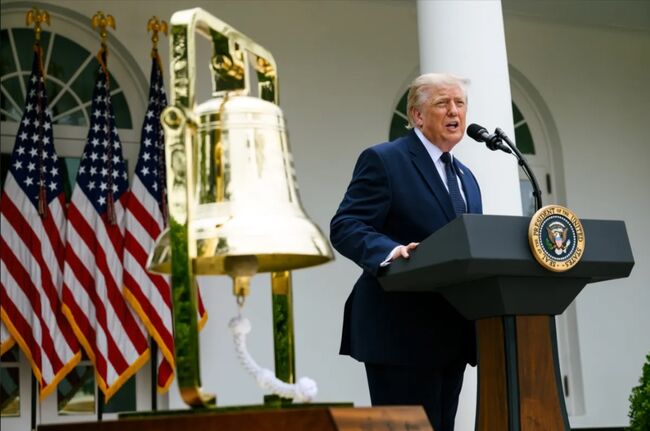
There is no need to downplay the significance of the Texas special election. However, to conclude that "public sentiment in the U.S. has drastically changed" or "the erosion of grassroots support has become visible just one year into Trump's presidency" is premature, distorting, and akin to incitement. [Photo=White House]
Taylor LeMaster, a Democrat, secured a victory by a significant margin over Republican candidate Lee Williams in the runoff election for the Texas State Senate in Tarrant County on the 31st of last month (local time).
Following this special election result, both Korean and American legacy media outlets simultaneously reported interpretations such as "a crushing defeat in a Republican stronghold" and "the erosion of grassroots support for President Trump has become visible."
Furthermore, based solely on the fact that a Democratic candidate won the special election for the Texas State Senate, they hastily concluded that "public sentiment in the U.S. is changing significantly, and the reason is that Latinos and Hispanics have turned away from the Republican Party due to Trump's immigration crackdowns through ICE."
Low Interest in Special Elections Leads to Low Voter Turnout
Special elections typically have low interest and voter turnout. Interpreting their results immediately as a barometer of national public sentiment deviates from the fundamentals of political analysis.
Despite this, major domestic media outlets, including JoongAng Ilbo, Yonhap News, and Kyunghyang Shinmun, as well as major American broadcasters, repeatedly used expressions such as "the erosion of public sentiment against President Trump has been revealed even in the heart of the Republican Party."
The district in question was won by President Trump by a margin of about 17 percentage points in the 2024 presidential election. Seen in isolation, the statement "votes have been completely reversed in just 1 year and 3 months" might seem plausible.
However, this election went to a runoff because no candidate secured a majority in the first round of voting.
In the first round, the Democratic candidate received 47.57% of the vote, while two Republican candidates received 35.94% and 16.49% respectively. The combined vote share of the two Republican candidates exceeded 52%. If it had been a single-candidate race, it is highly probable that the Republican would have won.
The core of the change seen in the runoff election is not "vote shifting" but "voter abstention."
In the first round of voting in November 2024, approximately 118,000 voters participated, but this decreased to about 94,000 in the runoff. This means about 24,000 fewer people went to the polls.
The Democratic candidate's vote share decreased slightly from about 56,000 votes in the first round to about 54,000 in the runoff, a decrease of only about 2,000 votes.
Conversely, a significant portion of the votes that went to the two Republican candidates in the first round did not translate into votes in the runoff. Consequently, approximately 20,000 Republican-leaning voters abstained from voting, resulting in a victory margin of 14-15 percentage points that appeared to be a "landslide."
Can we truly say that "public sentiment has shifted to the Democratic Party" based on this phenomenon?
Looking at the numbers alone, the conclusion is no. This is a result created by a decline in voter turnout, specifically an abstention from voting within a particular bloc, rather than a shift in votes.
The analysis that a combination of factors, such as the cold snap and adverse weather in the Texas region on election day, the Republican candidate's weak local ties, and the Democratic candidate's background as a former military member who presented relatively centrist policies and advocated for improved worker conditions, which could be accepted by Republican voters without objection, is more persuasive.
Despite this, legacy media outlets barely covered these contextual factors. Instead, they appended explanations such as "backlash against Trump's ICE policy" and "defection of Hispanic voters due to immigration crackdowns" to the results.
However, there is no clear evidence that Hispanic voters collectively shifted to the Democratic Party in this election. Rather, a considerable number of Republican-leaning voters abstained from voting in the runoff.
Democratic Seat Retained by Democrats
The 18th Congressional District of Texas, which held elections at the same time, is a traditional Democratic stronghold centered around Houston. This special election was held because the incumbent, Sylvester Turner (Democrat), passed away in 2024, leaving the seat vacant.
In other words, this was not an election where the Democrats took a seat from the Republicans, but an election where the Democrats retained their own seat.
The reporting on the special election for the 18th Congressional District of Texas also shows similar distortions.
When a Democratic candidate was elected, the media reported, "Democrats win again in Texas" and "Republican seats have decreased." However, this district was originally held by a Democratic congressman, and the special election was held due to his death.
In essence, it was simply a case of a Democrat returning to a Democratic seat. Both candidates who faced each other in the runoff were Democrats.
This reporting practice is not aimed at objectively conveying the results of the Texas special election but rather at constructing a narrative of "Republican crisis" and "Trump crisis."
However, looking at the political fundraising status released at the same time, the Republican National Committee raised approximately $95 million, while the Democratic National Committee's fundraising was around $14 million, and it is known to be burdened with considerable debt.
There are significant evaluations that the Democratic Party is experiencing structural difficulties in both its finances and leadership.
There is no need to downplay the significance of the Texas special election. However, to conclude that "public sentiment in the U.S. has drastically changed" or "the erosion of grassroots support has become visible just one year into Trump's presidency" is premature, distorting, and akin to incitement.
The two special elections in Texas do not prove a Republican defeat. One was a result manufactured by voter abstention, and the other was a simple succession in a district that was originally Democratic.
Despite this, legacy media outlets packaged them as a "shocking defeat" and a "major shift in public sentiment." The problem, more serious than the election results themselves, is the very practice of reporting that distorts public opinion by magnifying and reproducing isolated incidents.
Editorial Department, Hankookilbo

 Trump pressures for rate cut again ahead of FOMC... "Should be the lowest in the world"
U.S. President Donald Trump. [Photo = The White House] U.S. President Donald Trump once again pressured the Federal Reserve, the U.S. central bank, to lower interest rates on the 27th (local time
Trump pressures for rate cut again ahead of FOMC... "Should be the lowest in the world"
U.S. President Donald Trump. [Photo = The White House] U.S. President Donald Trump once again pressured the Federal Reserve, the U.S. central bank, to lower interest rates on the 27th (local time
 “Ignoring crisp ballots and damaged seals”… Tongyeong mayoral recount concludes with ‘no change in outcome,’ leaving suspicions and public outrage behind
Suspected counterfeit ballots discovered in Tongyeong [GIF from social media of Representative Hwang Kyo-ahn / Attorney Park Joo-hyun]During a recount of the Tongyeong mayoral election in South Gyeong
“Ignoring crisp ballots and damaged seals”… Tongyeong mayoral recount concludes with ‘no change in outcome,’ leaving suspicions and public outrage behind
Suspected counterfeit ballots discovered in Tongyeong [GIF from social media of Representative Hwang Kyo-ahn / Attorney Park Joo-hyun]During a recount of the Tongyeong mayoral election in South Gyeong
 President Yoon, regarding the first-instance ruling on the Public Official Election Act: “An excessive political verdict that distorts the facts… We will appeal immediately.”
The first-instance sentencing hearing for President Yoon Suk Yeol regarding violations of the Public Official Election Act is being broadcast live at Seoul Station on the 27th. [Photo=Yonhap News]Pres
President Yoon, regarding the first-instance ruling on the Public Official Election Act: “An excessive political verdict that distorts the facts… We will appeal immediately.”
The first-instance sentencing hearing for President Yoon Suk Yeol regarding violations of the Public Official Election Act is being broadcast live at Seoul Station on the 27th. [Photo=Yonhap News]Pres
 WSJ: "SK Hynix ADR Premium Is a Sign of AI Trading Overheat"
Advertisement for SK Hynix ADR listing in New York's Times Square [Reuters=Yonhap News file photo]The Wall Street Journal (WSJ) has pointed out that the price of SK Hynix’s American Depositary Recei
WSJ: "SK Hynix ADR Premium Is a Sign of AI Trading Overheat"
Advertisement for SK Hynix ADR listing in New York's Times Square [Reuters=Yonhap News file photo]The Wall Street Journal (WSJ) has pointed out that the price of SK Hynix’s American Depositary Recei
 'Godfather of Japanese Mystery Novels' Keigo Higashino Passes Away After Battle with Cancer at 68
Famous Japanese mystery novelist Keigo Higashino [AFP=Yonhap News]It has been belatedly reported that Keigo Higashino, the "godfather of Japanese mystery novels" and author of bestsellers such as "The
'Godfather of Japanese Mystery Novels' Keigo Higashino Passes Away After Battle with Cancer at 68
Famous Japanese mystery novelist Keigo Higashino [AFP=Yonhap News]It has been belatedly reported that Keigo Higashino, the "godfather of Japanese mystery novels" and author of bestsellers such as "The
 [Park Pil-kyu Security Column] To the Ignorant Trying to Clothe a Beast in Sheep's Clothing
Rep. Kim Byung-joo of the Democratic Party of Korea [Photo=Yonhap News]“The Air Force Academy doesn't teach you how to fly a plane!” “The Army, Navy, and Air Force academies are exactly the
[Park Pil-kyu Security Column] To the Ignorant Trying to Clothe a Beast in Sheep's Clothing
Rep. Kim Byung-joo of the Democratic Party of Korea [Photo=Yonhap News]“The Air Force Academy doesn't teach you how to fly a plane!” “The Army, Navy, and Air Force academies are exactly the
 [Issue Diagnosis] Two Effects of the Election Petition Review
 [Photo] Evidence of Election Fraud Flooding U.S. Media… Trump Had 2.7 Million Votes Stolen
 [Video] U.S. Semiquincentennial Air Show... 'Art in the Sky' streaks across New York
 [Editorial Cartoon] A Draconian Law That Undermines Freedom of Expression

 List
List