이 기획은 중국을 전제로 한 성장 공식이 흔들리는 가운데, 한국 기업들이 선택한 새로운 좌표가 왜 인도였는지를 추적한다. 산업별 사례를 통해 ‘중국 이후’가 어떻게 인도를 중심으로 설계되고 있는지를 살펴본다. <편집자 주>
 On September 10, 2023, President Yoon Suk-yeol attended the G20 Summit in New Delhi, India, where he held a bilateral meeting with Indian Prime Minister Narendra Modi at the summit venue. {Photo by Yonhap News]
<목차>
① Why India?
② Why Did Cars Go to India First?
③ Batteries Are Already Finding Answers in India
④ The Next Question for Semiconductors
⑤ Why Did Shipbuilding Move Away from China?
⑥ Businesses Moved, the Government Did Not
Where Market, Geopolitics, and Industry Intersect
The growth formula for Korean industries, premised on China, is faltering. China, which served as both a low-cost production base and a massive domestic market, is no longer a stable premise.
The question is not whether to leave China, but on what coordinates to redesign the post-China era.
Following this question, the movements of Korean companies converge at a single point: India.
There are still many misconceptions about India. Due to its low average income and significant wealth gap, there's a perception that India is "a market that's still too early."
However, India is not a market to be viewed by averages. Looking at its population distribution and consumption structure, an independent market is already functioning.
India's population is approximately 1.4 billion. Of this, the top 10% is about 140 million, and the top 15% is about 200 million. This is a consumer base comparable in size to a single country.
While the annual income of the top 10% is estimated to be around 5 million rupees (₹5 lakh) or more, actual purchasing power is much greater when considering informal income and household consumption.
This explains why global luxury brands are concentrated in major cities like New Delhi, Mumbai, and Bengaluru.
India's consumption operates on a dual structure where a "poor majority" and a "vast upper class" coexist.
At this point, India is often compared to China 20 years ago.
Indeed, in terms of income levels and the penetration of cars and motorcycles, India today is in a similar position to China in the mid-2000s.
However, their growth paths are different. While China boosted domestic demand through exports and foreign investment, India's structure is one of growth centered on domestic demand from the outset.
A more significant difference lies in industrial relations.
China has repeatedly absorbed foreign companies' technology and then replaced them with its own. In contrast, India has chosen a path where foreign companies establish roots locally, with employment, education, and language following suit.
The recent establishment of Korean academies in India and the rapid spread of Korean language education are symbolic scenes that show Korean industries are settling in beyond simple market entry, moving into the realm of lifestyle.
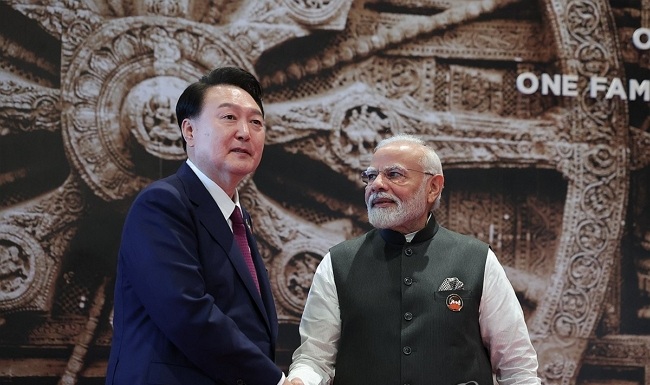 President Yoon Suk-yeol shakes hands with Indian Prime Minister Narendra Modi at the G20 Summit welcome reception at Bharat Mandapam International Convention Center in New Delhi, India, on September 9 (local time). 2023.9.9 [Photo by Yonhap News]
In the context of international relations, India also holds a unique position.
For India, China is a competitor leveraging price competitiveness but also an object of vigilance due to border disputes and security conflicts. Korea, on the other hand, is a competitor in technology and manufacturing, but lacks the historical, ethnic, or security-related conflict assets.
From India's perspective, Korea is closer to a partner with whom it can compete without needing to be vigilant. Coupled with the US strategy of cultivating India as a key pillar to counter China, Korea's position has become even more advantageous.
Within the reshaping of supply chains connecting the US, India, and Korea, Korea functions as the manufacturing and technology partner with the least burden.
These market and geopolitical conditions manifest in different ways across industries.
The automotive industry reacted first. India is not just a market for finished vehicles but a "simultaneous transition market" where electrification, automotive electronics, software, and AI are introduced concurrently.
Semiconductors hold great potential, but there are clear limitations for companies operating alone.
For batteries, realistic solutions are emerging in the context of electric two-wheelers and home charging structures, rather than large electric vehicles.
Shipbuilding is already creating new opportunities within the global security and energy order, having moved beyond China.
Crucially, India is not a market that replaces China. Rather, India is a coordinate that Korean industries have naturally arrived at in the process of designing the post-China era.
Businesses are already on the move. This series will follow those movements by industry and calmly explore the choices Korea must make on the coordinate of India.
The next installment will examine why the automotive industry was the first to head to India and how a testing ground for transformation, encompassing automotive electronics and AI, is being created.

 Iranian Foreign Ministry: "Continuing Message Exchanges with the U.S. and Activities of Mediating Countries"
Esmaeil Baghaei, Spokesperson for the Iranian Ministry of Foreign Affairs [Xinhua, Yonhap News file photo]Esmaeil Baghaei, spokesperson for the Iranian Ministry of Foreign Affairs, stated on the 26th
Iranian Foreign Ministry: "Continuing Message Exchanges with the U.S. and Activities of Mediating Countries"
Esmaeil Baghaei, Spokesperson for the Iranian Ministry of Foreign Affairs [Xinhua, Yonhap News file photo]Esmaeil Baghaei, spokesperson for the Iranian Ministry of Foreign Affairs, stated on the 26th
 President Yoon: "Do You Think You Are Safe from the Special Counsel?"... Final Statement Video Released
President Yoon Suk Yeol rebuking the special prosecutor on the 24th. [Court video / @birds_justice X account subtitle GIF] A video of President Yoon Suk Yeol's closing statement at his trial rega
President Yoon: "Do You Think You Are Safe from the Special Counsel?"... Final Statement Video Released
President Yoon Suk Yeol rebuking the special prosecutor on the 24th. [Court video / @birds_justice X account subtitle GIF] A video of President Yoon Suk Yeol's closing statement at his trial rega
 President Yoon, regarding the first-instance ruling on the Public Official Election Act: “An excessive political verdict that distorts the facts… We will appeal immediately.”
The first-instance sentencing hearing for President Yoon Suk Yeol regarding violations of the Public Official Election Act is being broadcast live at Seoul Station on the 27th. [Photo=Yonhap News]Pres
President Yoon, regarding the first-instance ruling on the Public Official Election Act: “An excessive political verdict that distorts the facts… We will appeal immediately.”
The first-instance sentencing hearing for President Yoon Suk Yeol regarding violations of the Public Official Election Act is being broadcast live at Seoul Station on the 27th. [Photo=Yonhap News]Pres
 WSJ: "SK Hynix ADR Premium Is a Sign of AI Trading Overheat"
Advertisement for SK Hynix ADR listing in New York's Times Square [Reuters=Yonhap News file photo]The Wall Street Journal (WSJ) has pointed out that the price of SK Hynix’s American Depositary Recei
WSJ: "SK Hynix ADR Premium Is a Sign of AI Trading Overheat"
Advertisement for SK Hynix ADR listing in New York's Times Square [Reuters=Yonhap News file photo]The Wall Street Journal (WSJ) has pointed out that the price of SK Hynix’s American Depositary Recei
 'Godfather of Japanese Mystery Novels' Keigo Higashino Passes Away After Battle with Cancer at 68
Famous Japanese mystery novelist Keigo Higashino [AFP=Yonhap News]It has been belatedly reported that Keigo Higashino, the "godfather of Japanese mystery novels" and author of bestsellers such as "The
'Godfather of Japanese Mystery Novels' Keigo Higashino Passes Away After Battle with Cancer at 68
Famous Japanese mystery novelist Keigo Higashino [AFP=Yonhap News]It has been belatedly reported that Keigo Higashino, the "godfather of Japanese mystery novels" and author of bestsellers such as "The
 [Park Pil-kyu Security Column] To the Ignorant Trying to Clothe a Beast in Sheep's Clothing
Rep. Kim Byung-joo of the Democratic Party of Korea [Photo=Yonhap News]“The Air Force Academy doesn't teach you how to fly a plane!” “The Army, Navy, and Air Force academies are exactly the
[Park Pil-kyu Security Column] To the Ignorant Trying to Clothe a Beast in Sheep's Clothing
Rep. Kim Byung-joo of the Democratic Party of Korea [Photo=Yonhap News]“The Air Force Academy doesn't teach you how to fly a plane!” “The Army, Navy, and Air Force academies are exactly the
 [Issue Diagnosis] Two Effects of the Election Petition Review
 [Photo] Evidence of Election Fraud Flooding U.S. Media… Trump Had 2.7 Million Votes Stolen
 [Video] U.S. Semiquincentennial Air Show... 'Art in the Sky' streaks across New York
 [Editorial Cartoon] A Draconian Law That Undermines Freedom of Expression

 List
List










