 Steven Fu, Canada's Special Representative for Defence Procurement. [Photo=Yonhap News]
Canada's next-generation submarine acquisition project (CPSP · Canadian Patrol Submarine Project) is entering its final stages.
This project, with an estimated total cost of approximately 60 trillion won, has been narrowed down to a two-way competition between a consortium of South Korea's Hanwha Ocean and HD Hyundai Heavy Industries, and Germany's ThyssenKrupp Marine Systems (TKMS). However, recent assessments suggest the nature of the competition is shifting from technology or price to 'time' and 'operational capability gaps'.
With the added strategic attention from the United States, the bidding process is transforming from a simple defense contract into a choice that weighs alliance commitments, security, and operational risks.
Technological and Industrial Hurdles Already Cleared
The CPSP is a large-scale project to replace Canada's aging Victoria-class submarines by acquiring up to 12 submarines of the 3,000-ton class and establishing an operations, maintenance, and repair (MRO) system for over 30 years.
The Canadian government has already officially selected South Korea and Germany as qualified suppliers, narrowing down the candidates that meet the technical requirements and basic industrial participation conditions.
According to an aggregation of evaluations from Canadian local media and defense industry specialized outlets, the consensus is that the gap in technology and performance between the two sides is not significant.
NATO interoperability (STANAG·standardization agreement), which is set to enable joint operations, is also not a decisive barrier. Germany already possesses designs proven within the NATO framework, and South Korea is technically capable of meeting the standards, making the 'feasibility' itself a non-issue.
The actual competition is shifting to the timeline and operational risks during the integration process.
Germany: The 'Safe Choice,' South Korea: The 'Choice Requiring Explanation'
Germany's TKMS is regarded as a politically low-cost option due to its symbolic status as a core NATO nation and its advantages in long-term operation and upgrades.
It carries less burden in persuading parliament and allies, and if issues arise, the defense argument of "a decision made in accordance with alliance standards" is clear.
Conversely, South Korea possesses strengths in production speed, delivery timelines, and cost control. However, the Canadian government faces the responsibility of explaining "why the core NATO nation was bypassed."
For this reason, there are reports of differing sentiments within Canada, with diplomatic and political circles favoring Germany, while the military and operational teams place greater importance on a choice that can mitigate capability gaps.
The US Variable: 'Urging Speed Rather Than Picking a Side'
The United States is the decisive variable in this equation.
The U.S. does not overtly support any specific country in Canada's submarine program. Instead, its message is consistent.
"It doesn't matter who builds it. The issue is by when and how effectively it can be operated."
This statement is interpreted not as pressure on Germany or South Korea, but as a warning against delays themselves.
There is a prevalent sentiment within the U.S. security community that the absence of Canadian submarine capabilities in the North American security environment, particularly concerning Arctic routes and control of access to the Atlantic and Pacific oceans, can no longer be ignored.
From this perspective, the focus of the competition naturally shifts to delivery timelines and operational readiness.
Amidst reports of bottlenecks in the European defense industry, South Korea, with its relative strengths in production speed and schedule management, is gaining attention.
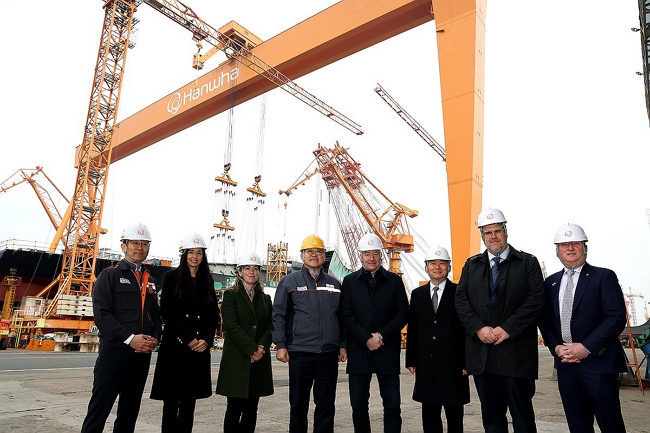 Steven Fu, Canada's Special Representative for Defence Procurement, poses for a commemorative photo with officials during his visit to Hanwha Ocean's Geoje shipyard on February 2, 2026. [Photo=Hanwha Ocean]
The Shadow of 'Redback' Emerging within Canada
In light of this structure, some within Canada's defense industry are mentioning Australia's armored vehicle project, the so-called 'Redback case,' as a point of comparison.
Australia selected South Korea's Redback armored vehicle over Germany, a core NATO nation, for its LAND 400 Phase 3 project. At that time, South Korea was at a disadvantage as a non-NATO member, but it overturned the decision by presenting tangible military and industrial benefits that outweighed the explanation costs.
Of course, there are clear differences. Unlike armored vehicles, submarines carry far greater alliance and strategic symbolism.
Among former Canadian naval personnel and policy analysts, there is a shared understanding that "as submarines are assets directly linked to North American defense and NATO maritime strategy, they require a higher level of explanation than armored vehicles."
The Redback case is pointed out as a precedent that only works when the conditions are right, not a formula that can be automatically repeated.
Explanation Costs, Real Benefits, and the Timeline
Ultimately, Canada's decision will be made at the intersection of 'explanation costs' and 'real benefits'.
Germany represents a choice that requires no additional explanation. It can persuade parliament and allies based on its symbolic status as a core NATO nation and the rationale of alliance standards.
Conversely, South Korea's offer is a choice that requires explanation. However, the conditions under which such an explanation becomes possible are clear: when it can reduce capability gaps, expedite delivery timelines, and substantively lower the resulting security and operational risks.
At this point, the criteria for judgment change.
As the capability gap lengthens, the value of the 'safe choice' diminishes, and the strategic value of the 'currently available choice' increases.
What is important for Canadian policymakers is not which option is more familiar, but which option can fulfill its responsibilities more quickly.
U.S. Pressure Also Operates at This Juncture.
The U.S. does not endorse any specific country. Instead, it makes the delay in decision-making itself a cost, applying pressure to accelerate the timeline for the choice.
Consequently, the weight of the bidding process is shifting from technology or price to the question of whether the decision can be further postponed.
Canada's submarine project has moved beyond a technological competition to a battle of time. The variable that most drastically shakes the timeline is the U.S., or more precisely, the 'warning that delays will not be tolerated'.
A single remark from Trump may not directly determine the fate of 60 trillion won. However, it can sufficiently influence which direction that 60 trillion won may tilt.

 Iranian Foreign Ministry: "Continuing Message Exchanges with the U.S. and Activities of Mediating Countries"
Esmaeil Baghaei, Spokesperson for the Iranian Ministry of Foreign Affairs [Xinhua, Yonhap News file photo]Esmaeil Baghaei, spokesperson for the Iranian Ministry of Foreign Affairs, stated on the 26th
Iranian Foreign Ministry: "Continuing Message Exchanges with the U.S. and Activities of Mediating Countries"
Esmaeil Baghaei, Spokesperson for the Iranian Ministry of Foreign Affairs [Xinhua, Yonhap News file photo]Esmaeil Baghaei, spokesperson for the Iranian Ministry of Foreign Affairs, stated on the 26th
 President Yoon: "Do You Think You Are Safe from the Special Counsel?"... Final Statement Video Released
President Yoon Suk Yeol rebuking the special prosecutor on the 24th. [Court video / @birds_justice X account subtitle GIF] A video of President Yoon Suk Yeol's closing statement at his trial rega
President Yoon: "Do You Think You Are Safe from the Special Counsel?"... Final Statement Video Released
President Yoon Suk Yeol rebuking the special prosecutor on the 24th. [Court video / @birds_justice X account subtitle GIF] A video of President Yoon Suk Yeol's closing statement at his trial rega
 President Yoon, regarding the first-instance ruling on the Public Official Election Act: “An excessive political verdict that distorts the facts… We will appeal immediately.”
The first-instance sentencing hearing for President Yoon Suk Yeol regarding violations of the Public Official Election Act is being broadcast live at Seoul Station on the 27th. [Photo=Yonhap News]Pres
President Yoon, regarding the first-instance ruling on the Public Official Election Act: “An excessive political verdict that distorts the facts… We will appeal immediately.”
The first-instance sentencing hearing for President Yoon Suk Yeol regarding violations of the Public Official Election Act is being broadcast live at Seoul Station on the 27th. [Photo=Yonhap News]Pres
 WSJ: "SK Hynix ADR Premium Is a Sign of AI Trading Overheat"
Advertisement for SK Hynix ADR listing in New York's Times Square [Reuters=Yonhap News file photo]The Wall Street Journal (WSJ) has pointed out that the price of SK Hynix’s American Depositary Recei
WSJ: "SK Hynix ADR Premium Is a Sign of AI Trading Overheat"
Advertisement for SK Hynix ADR listing in New York's Times Square [Reuters=Yonhap News file photo]The Wall Street Journal (WSJ) has pointed out that the price of SK Hynix’s American Depositary Recei
 'Godfather of Japanese Mystery Novels' Keigo Higashino Passes Away After Battle with Cancer at 68
Famous Japanese mystery novelist Keigo Higashino [AFP=Yonhap News]It has been belatedly reported that Keigo Higashino, the "godfather of Japanese mystery novels" and author of bestsellers such as "The
'Godfather of Japanese Mystery Novels' Keigo Higashino Passes Away After Battle with Cancer at 68
Famous Japanese mystery novelist Keigo Higashino [AFP=Yonhap News]It has been belatedly reported that Keigo Higashino, the "godfather of Japanese mystery novels" and author of bestsellers such as "The
 [Park Pil-kyu Security Column] To the Ignorant Trying to Clothe a Beast in Sheep's Clothing
Rep. Kim Byung-joo of the Democratic Party of Korea [Photo=Yonhap News]“The Air Force Academy doesn't teach you how to fly a plane!” “The Army, Navy, and Air Force academies are exactly the
[Park Pil-kyu Security Column] To the Ignorant Trying to Clothe a Beast in Sheep's Clothing
Rep. Kim Byung-joo of the Democratic Party of Korea [Photo=Yonhap News]“The Air Force Academy doesn't teach you how to fly a plane!” “The Army, Navy, and Air Force academies are exactly the
 [Issue Diagnosis] Two Effects of the Election Petition Review
 [Photo] Evidence of Election Fraud Flooding U.S. Media… Trump Had 2.7 Million Votes Stolen
 [Video] U.S. Semiquincentennial Air Show... 'Art in the Sky' streaks across New York
 [Editorial Cartoon] A Draconian Law That Undermines Freedom of Expression

 List
List









