 In relation to the Coupang incident, there are loud voices within the United States claiming that the South Korean government is discriminating against American companies. [Photo=Yonhap News]
In relation to Coupang's information leak incident, there are loud voices within the United States claiming that the South Korean government is discriminating against American companies.
In particular, cases of discrimination are being meticulously detailed on the website korearedflags.com. This post, being shared via social media platform X, carries the tagline: "Exposing the South Korean government's harassment campaign against American companies and their executives to benefit domestic vested interests and the Chinese Communist Party."
The title of this page is 'Is Korea going the way of China?'.
The operator of this site is identified only as Korea Red Flags (KRF). People can only speculate about the actual operator, guessing it to be a group of Coupang investors or right-wing forces in the United States who are wary of the Chinese Communist Party.
Regardless of who the site's operator is, if it is true that the South Korean government is indeed discriminating against American companies, including Coupang, it could lead to serious diplomatic issues.
Then, as they claim, are the various measures taken by the South Korean government against American companies, including Coupang, truly discriminatory?
A Gap of 3,000 vs. 34 Million, What Does It Mean?
"Despite what was a limited and controlled data incident where approximately 3,000 accounts were downloaded, the South Korean government falsely distorted it to appear as an incident involving tens of millions of victims."
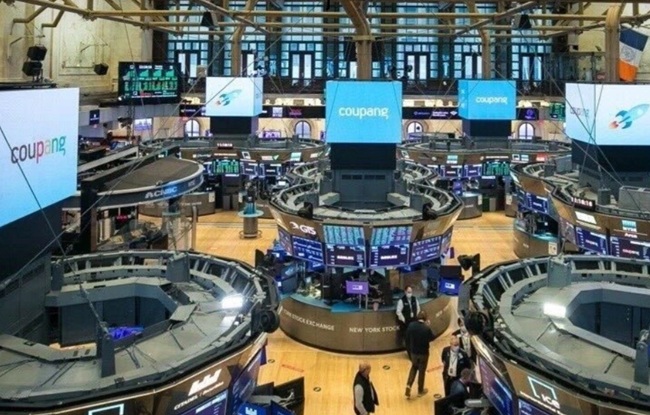 Due to the customer personal information leak incident that occurred in November 2025, Coupang's stock price on the New York Stock Exchange fell by about 27%, and Coupang's US investors are currently suing the South Korean government. [Photo=korearedflags.com]
It is difficult to refute KRF's claim.
However, the differing views between Coupang and the South Korean government stem from Coupang focusing on the number of 'downloads' and mentioning 3,000 victims, while the South Korean government calculated 34 million victims based on the number of 'views'.
Then what about media reports stating that cyber attackers viewed the delivery address list page over 148 million times? Is it possible for one person to view it that many times? If one had to manually check this, it would take hundreds of years. Moreover, Coupang has fewer than 100 million registered users.
The claim of over 148 million views should be interpreted as an automated program accessing the delivery address pages multiple times.
In conclusion, while both sides claim their assertions are distorted, the issue of whether to define the leak by 'storage' or 'viewing' needs to be resolved.
Unprecedented Crackdown on Coupang Due to Being an American Company
KRF claims that over the past two months, the South Korean government, solely because it is an American company, "mobilized over a dozen government agencies targeting a single company, deployed an unprecedented number of government investigators throughout Coupang's offices, and repeatedly engaged in 'administrative attacks' akin to unrelated search and seizure, on-site investigations, and inspections."
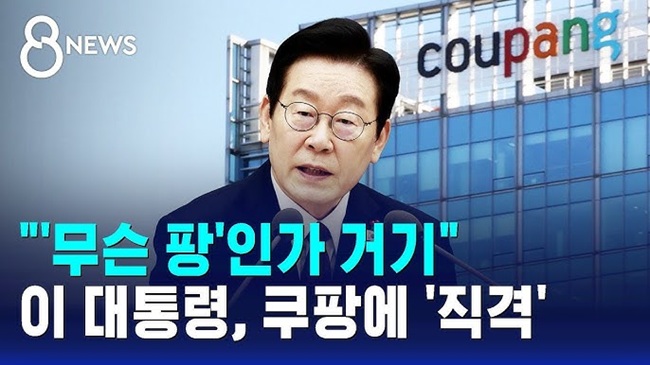 [Photo=SBS News Capture]
They further stated, "A task force of 150 tax investigators and a task force of 86 police officers were formed solely to target Coupang, emergency parliamentary hearings were convened, and public threats to halt Coupang's operations continued."
They also revealed, "There were attempts to pressure the National Pension Fund to withdraw its investment in Coupang and blacklist it, and to obstruct its usual fundraising and financial transactions. Threats were made to arrest or criminally prosecute Coupang's executives despite no illegal activities."
KRF is most outraged by the attitudes of the Prime Minister and the President.
Kim Min-seok urged regulatory authorities to pursue Coupang "with the same resolve as when eradicating the mafia," and stated that there would be "no way out" for Coupang.
Kim Min-seok refuted this as baseless, but in a work report on December 19, 2025, he stated the need to rectify unfair market order and emphasized, "Market order must be established with the same determination as when eradicating the mafia."
KRF stated, "President Lee suggested imposing 'harsh' punitive fines on Coupang, enough to force it out of business, and requested legislative amendments to allow for higher fines to be imposed on Coupang."
Upon reviewing this part, on December 11, 2025, the President specifically mentioned Coupang, saying, "Companies like 'Whoever-Pang' are also violating things now. They won't be afraid of any punishment."
The next day, December 12, regarding fines for companies engaging in unfair practices, he instructed, "Impose a fine of 3% based on the year with the highest revenue over the past three years." Applying this regulation to the 2024 revenue (41 trillion won) would allow for a fine of approximately 1.23 trillion won for Coupang.
The President did not stop there and instructed, "Consider measures to increase punitive fines by up to 10% to prevent companies from repeatedly violating laws." 10% of 41 trillion won exceeds 4 trillion won.
President Lee also stated, "Sanctions should be such that companies realize they could go bankrupt if they harm the public."
Of course, even if the remarks by Kim Min-seok and the President were not directly aimed at Coupang, their statements made in the context of dealing with Coupang-related matters are sufficiently open to misinterpretation.
What Level of Punishment Was Imposed on Asian Companies?
"In the case of Kakao Pay, between 2018 and 2024, over six years, sensitive financial information and 40 million records, totaling 54 billion data entries, were intentionally transferred to a Chinese company (Alipay). However, the response measures were limited to a negligible fine of approximately $15 million (about 21.7 billion won), and the CEO received only a warning."
Although there are differences between KRF's claim and the amounts reported by the media (the US side's calculation is actually higher), the Kakao Pay case was concluded with a fine equivalent to about 20 billion won.
 Kakao Pay, SK Telecom, Upbit, and AliExpress, among other Asian companies, were not subject to the same fines as American companies.
"SK Telecom, on April 2025, experienced exposure of highly sensitive information for 23 to 27 million people, yet the regulatory authorities imposed fines far below the legal maximum. There was no government-wide response, and no high-ranking government official mentioned suspending the company's operations."
KRF's claim that SK Telecom was fined significantly below the legal maximum is correct. This is because, as mentioned earlier, the American company Qualcomm was fined over 1 trillion won. At that time, SK Telecom was fined 134.8 billion won, which MBC reported as a 'record high'.
"Upbit, in November 2025, had over $30 million (approximately 43 billion won) of customer crypto assets stolen by hackers linked to North Korea, and there were also concerns about user data exposure, yet no wider crackdown or comprehensive response was taken."
Is KRF's statement accurate? According to domestic reports, in November 2024, the police confirmed that North Korean hacking groups were behind the theft of 340,000 Upbit Ethereum coins (worth about 58 billion won at the time, trillions of won at current market prices) that occurred in 2019. In other words, the scale of damage was larger.
At the time, there were reports that South Korean prosecutors and police, in cooperation with the US FBI, tracked the money laundering routes and recovered some of the funds. While the scope of the 'wider crackdown' mentioned by KRF is ambiguous, it was clearly not as stringent as the measures taken against Coupang.
"Aliexpress, in October 2025, experienced a hacking incident involving sensitive information from the Chinese e-commerce platform, resulting in millions of dollars in financial losses. Despite reports that AliExpress provided false statements to the authorities, the government's response was limited to requesting 'prevention of recurrence'."
This claim is correct. There were reports that in October 2025, an incident occurred where account information of merchants (sellers) on the Chinese e-commerce platform Aliexpress was hacked, leading to the embezzlement of 8.6 billion won in settlement funds.
In response, the government did not impose any special sanctions, but merely requested measures to prevent recurrence, which could indeed make American companies feel discriminated against. Additionally, in July 2024, the Personal Information Protection Commission imposed a fine of 1.978 billion won on Aliexpress.
What Other Discrimination Have American Companies Faced?
KRF stated, "Coupang is just the most recent example. For years, American companies, especially in the technology and digital services sector, have faced △selective enforcement of laws △excessive penalties △harassment through abuse of regulations in South Korea." Google and Qualcomm were cited as prime examples.
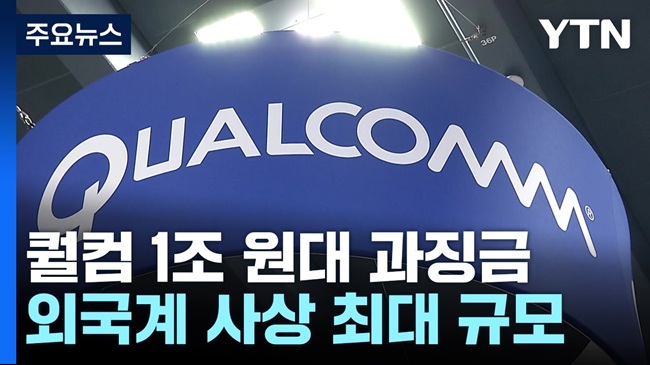 According to media reports, Qualcomm was fined approximately 1.311 trillion won in December 2016 for unfair practices against mobile phone manufacturers such as Samsung and LG. [Photo=YTN News Capture]
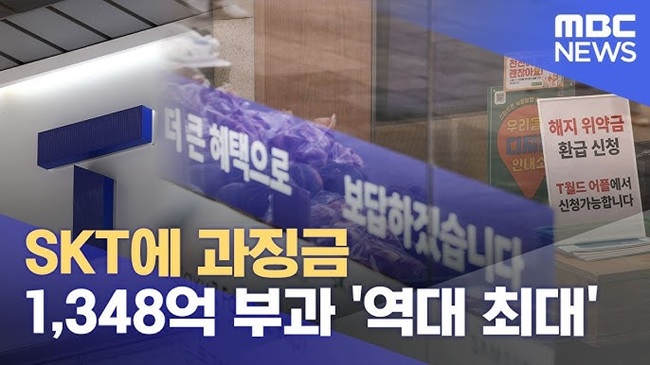 MBC reported the 134.8 billion won fine imposed on SK Telecom in 2025 as 'the highest ever'. However, Qualcomm had previously been fined over 1.3 trillion won. [Photo=MBC News Capture]According to media reports, in 2025, the Fair Trade Commission imposed a penalty on Google in the form of a 'win-win support measure' of approximately 30 billion won for bundling 'YouTube Music' with 'YouTube Premium'.
In January 2024, the Fair Trade Commission imposed a fine of 224.9 billion won on Google for allegedly forcing smartphone manufacturers to install Android. In 2022, Google was fined 69.2 billion won for collecting behavioral information without user consent and using it for targeted advertising, a case that is still ongoing.
In 2023, Google was also fined for blocking the launch of its app market competitor 'One Store,' and related fines are still under discussion.
In the case of Qualcomm, it was fined approximately 1.311 trillion won in December 2016 for unfair practices against mobile phone manufacturers such as Samsung and LG. Qualcomm appealed the decision, but in April 2023, the Supreme Court finalized the ruling that the Fair Trade Commission's disposition was legitimate.
This amount was the largest fine ever imposed by the Fair Trade Commission at the time and was overwhelmingly number one among the top 10 FTC fines as of 2023. Naturally, the 134.8 billion won fine for SK Telecom (2025) cannot be the highest fine ever, as MBC claims.
Additionally, Qualcomm was previously prosecuted by the Fair Trade Commission in 2009 for issues related to CDMA, resulting in a fine of approximately 224.5 billion won, finalized in late March 2019.
"Coupang's Contribution in Korea is by No Means Small"
"Over the past decade, US-based Coupang has become the second-largest employer in South Korea, employing nearly 100,000 people."
KRF's statement is true. Coupang employed 99,881 people by the end of 2024, surpassing 90,000 in October of the previous year, overtaking Hyundai Motor's 72,757 employees (as of June 2025) to become the second-largest employer. Samsung Electronics, with approximately 130,000 employees, is the largest employer.
KRF emphasizes the economic partnership built between South Korea and the United States over decades, stating, "Companies should compete on value. Success should be achieved through fair competition, not political retaliation. However, the digital bills proposed in South Korea in 2025 benefit Chinese technology companies."
By Reporter Lim Yo-hee

 Iranian Foreign Ministry: "Continuing Message Exchanges with the U.S. and Activities of Mediating Countries"
Esmaeil Baghaei, Spokesperson for the Iranian Ministry of Foreign Affairs [Xinhua, Yonhap News file photo]Esmaeil Baghaei, spokesperson for the Iranian Ministry of Foreign Affairs, stated on the 26th
Iranian Foreign Ministry: "Continuing Message Exchanges with the U.S. and Activities of Mediating Countries"
Esmaeil Baghaei, Spokesperson for the Iranian Ministry of Foreign Affairs [Xinhua, Yonhap News file photo]Esmaeil Baghaei, spokesperson for the Iranian Ministry of Foreign Affairs, stated on the 26th
 President Yoon: "Do You Think You Are Safe from the Special Counsel?"... Final Statement Video Released
President Yoon Suk Yeol rebuking the special prosecutor on the 24th. [Court video / @birds_justice X account subtitle GIF] A video of President Yoon Suk Yeol's closing statement at his trial rega
President Yoon: "Do You Think You Are Safe from the Special Counsel?"... Final Statement Video Released
President Yoon Suk Yeol rebuking the special prosecutor on the 24th. [Court video / @birds_justice X account subtitle GIF] A video of President Yoon Suk Yeol's closing statement at his trial rega
 President Yoon, regarding the first-instance ruling on the Public Official Election Act: “An excessive political verdict that distorts the facts… We will appeal immediately.”
The first-instance sentencing hearing for President Yoon Suk Yeol regarding violations of the Public Official Election Act is being broadcast live at Seoul Station on the 27th. [Photo=Yonhap News]Pres
President Yoon, regarding the first-instance ruling on the Public Official Election Act: “An excessive political verdict that distorts the facts… We will appeal immediately.”
The first-instance sentencing hearing for President Yoon Suk Yeol regarding violations of the Public Official Election Act is being broadcast live at Seoul Station on the 27th. [Photo=Yonhap News]Pres
 WSJ: "SK Hynix ADR Premium Is a Sign of AI Trading Overheat"
Advertisement for SK Hynix ADR listing in New York's Times Square [Reuters=Yonhap News file photo]The Wall Street Journal (WSJ) has pointed out that the price of SK Hynix’s American Depositary Recei
WSJ: "SK Hynix ADR Premium Is a Sign of AI Trading Overheat"
Advertisement for SK Hynix ADR listing in New York's Times Square [Reuters=Yonhap News file photo]The Wall Street Journal (WSJ) has pointed out that the price of SK Hynix’s American Depositary Recei
 'Godfather of Japanese Mystery Novels' Keigo Higashino Passes Away After Battle with Cancer at 68
Famous Japanese mystery novelist Keigo Higashino [AFP=Yonhap News]It has been belatedly reported that Keigo Higashino, the "godfather of Japanese mystery novels" and author of bestsellers such as "The
'Godfather of Japanese Mystery Novels' Keigo Higashino Passes Away After Battle with Cancer at 68
Famous Japanese mystery novelist Keigo Higashino [AFP=Yonhap News]It has been belatedly reported that Keigo Higashino, the "godfather of Japanese mystery novels" and author of bestsellers such as "The
 [Park Pil-kyu Security Column] To the Ignorant Trying to Clothe a Beast in Sheep's Clothing
Rep. Kim Byung-joo of the Democratic Party of Korea [Photo=Yonhap News]“The Air Force Academy doesn't teach you how to fly a plane!” “The Army, Navy, and Air Force academies are exactly the
[Park Pil-kyu Security Column] To the Ignorant Trying to Clothe a Beast in Sheep's Clothing
Rep. Kim Byung-joo of the Democratic Party of Korea [Photo=Yonhap News]“The Air Force Academy doesn't teach you how to fly a plane!” “The Army, Navy, and Air Force academies are exactly the
 [Issue Diagnosis] Two Effects of the Election Petition Review
 [Photo] Evidence of Election Fraud Flooding U.S. Media… Trump Had 2.7 Million Votes Stolen
 [Video] U.S. Semiquincentennial Air Show... 'Art in the Sky' streaks across New York
 [Editorial Cartoon] A Draconian Law That Undermines Freedom of Expression

 List
List









