 Oman's ambassador's residence in Geneva, Switzerland, where U.S.-Iran nuclear talks are underway [Reuters Yonhap News]
Amid escalating military tensions, the United States and Iran have established guiding principles on February 17 (local time) that will serve as the foundation for a final agreement in their nuclear negotiations.
According to Reuters, AFP, and other news agencies, the U.S. and Iran held negotiations for approximately three hours and thirty minutes at the Omani ambassador's residence to the United Nations in Geneva, Switzerland, concerning Iran's nuclear program.
This marks 11 days since the resumption of talks in Oman on February 6. Iranian representatives, including Foreign Minister Abbas Araghchi, and U.S. representatives, including President Donald Trump's envoy Steve Witkoff and son-in-law Jared Kushner, engaged in indirect negotiations by exchanging messages through Omani mediators.
Following the talks, Minister Araghchi stated to Iranian state television, "Various ideas were presented, and these ideas were seriously discussed, ultimately leading to an overall agreement on several guiding principles."
While he did not disclose the specific details of these principles, he explained that work would commence based on these principles and the drafting of a potential agreement would begin.
Araghchi assessed the day's discussions as more constructive compared to previous talks, but cautioned, "This does not necessarily mean that the negotiations can be concluded."
Regarding the next round of talks, he stated that "the schedule has not yet been set" and that the date for the third round of talks would be determined only after each side prepares draft proposals for a potential agreement and exchanges them. He added that the next meeting would be more difficult and detailed.
Iranian officials reported that the day's talks focused on sanctions relief and technical issues related to the nuclear program. The U.S. Wall Street Journal (WSJ), citing sources, reported that Iran proposed a halt to uranium enrichment for up to three years and the transfer of its enriched uranium stockpile to a third country.
Minister Araghchi also discussed the role the International Atomic Energy Agency (IAEA) could play in the relations between Iran and the U.S., stating that Iran would continue to engage in dialogue with the IAEA at an expert level.
Badr Albusaidi, the Omani Minister of Foreign Affairs, also commented on X (formerly Twitter), evaluating that Iran and the U.S. had "made good progress in identifying common goals and related technical issues" in Geneva and that the discussions were "constructive."
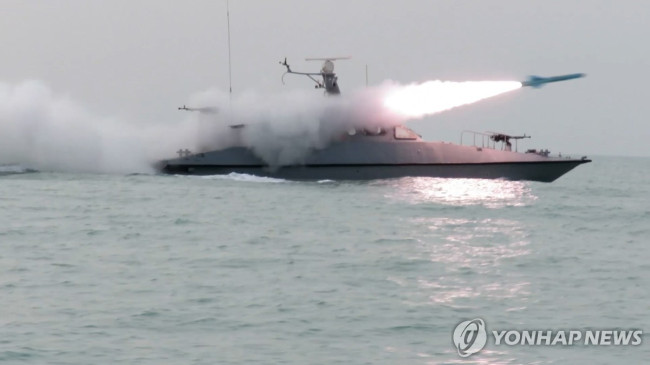 Military exercise by Iran's Islamic Revolutionary Guard Corps (February 16) [EPA/SEPAHNEWS Yonhap News]
The talks were held amidst heightened tensions, with the United States amassing military forces in the Middle East targeting Iran, and Iran commencing large-scale maritime exercises, including missile launches.
Shortly after the negotiations began, Iranian state television announced that the Strait of Hormuz, a crucial waterway for global oil transport, would be temporarily blockaded due to military exercises by Iran's Islamic Revolutionary Guard Corps (IRGC).
The Revolutionary Guard, which began military exercises in the Strait of Hormuz the previous day, conducted live-fire drills in the area on this day. Iran's semi-official Tasnim news agency reported that several missiles were launched from various locations within Iran, including its coast and islands, hitting targets in the Strait of Hormuz.
Iran's military exercises in the Strait of Hormuz are seen as a response to the military threats posed by the U.S. military.
President Trump told reporters on his plane the previous day that he would be indirectly involved in the negotiations and warned, "I don't think they (the Iranian side) will want the consequences of not reaching an agreement."
With U.S. aircraft carriers deployed in waters near Iran, Reuters reported, citing an unnamed U.S. official, that the U.S. military was preparing for the possibility of conducting operations against Iran for several weeks if President Trump gives the order.
Ayatollah Seyyed Ali Khamenei, Iran's Supreme Leader, warned President Trump in a speech on this day, stating, "You cannot destroy Iran."
He said, "The U.S. president said in one of his recent speeches that for 47 years, the U.S. has not succeeded in destroying Iran. You will not succeed either." President Trump had previously stated on February 13 that regime change in Iran would be "the most positive thing that could happen," pointing out the ongoing adversarial relationship between the U.S. and Iran since the Islamic Revolution in 1979.
Khamenei also countered the U.S. military threat by saying, "Sometimes the world's strongest armies get slapped and cannot get up. They (the U.S.) constantly say they are sending ships towards Iran. Of course, that navy is dangerous, but what is more frightening is the weapon that can send those ships to the bottom of the sea."

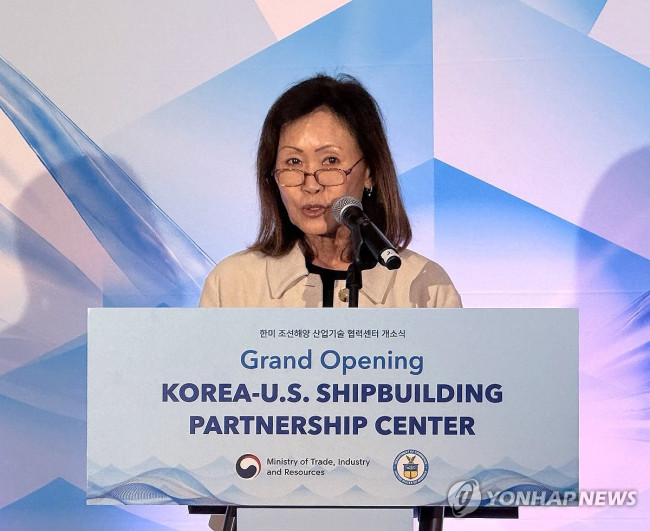 First U.S. Ambassador of Trump's Second Term to Arrive This Week… Will It Provide Momentum to Resolve Pending Issues?
U.S. Ambassador to South Korea Michelle Steel speaks at the opening ceremony of the Korea-U.S. Shipbuilding Cooperation Center held at the Mayflower Hotel in Washington, D.C., on the 23rd (local time)
First U.S. Ambassador of Trump's Second Term to Arrive This Week… Will It Provide Momentum to Resolve Pending Issues?
U.S. Ambassador to South Korea Michelle Steel speaks at the opening ceremony of the Korea-U.S. Shipbuilding Cooperation Center held at the Mayflower Hotel in Washington, D.C., on the 23rd (local time)
 President Yoon, regarding the first-instance ruling on the Public Official Election Act: “An excessive political verdict that distorts the facts… We will appeal immediately.”
The first-instance sentencing hearing for President Yoon Suk Yeol regarding violations of the Public Official Election Act is being broadcast live at Seoul Station on the 27th. [Photo=Yonhap News]Pres
President Yoon, regarding the first-instance ruling on the Public Official Election Act: “An excessive political verdict that distorts the facts… We will appeal immediately.”
The first-instance sentencing hearing for President Yoon Suk Yeol regarding violations of the Public Official Election Act is being broadcast live at Seoul Station on the 27th. [Photo=Yonhap News]Pres
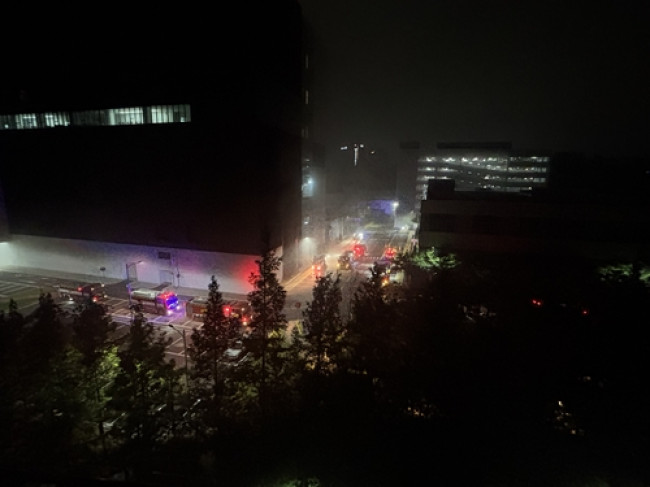 Fire at Hyundai Motor Group Battery Research Facility in Uiwang… Ignited in Waste Storage Room
A fire broke out at the Hyundai Motor Group battery research building at its Uiwang Research Center in Sam-dong, Uiwang-si, Gyeonggi-do, at 12:48 a.m. on the 28th and was extinguished after approximat
Fire at Hyundai Motor Group Battery Research Facility in Uiwang… Ignited in Waste Storage Room
A fire broke out at the Hyundai Motor Group battery research building at its Uiwang Research Center in Sam-dong, Uiwang-si, Gyeonggi-do, at 12:48 a.m. on the 28th and was extinguished after approximat
 'Godfather of Japanese Mystery Novels' Keigo Higashino Passes Away After Battle with Cancer at 68
Famous Japanese mystery novelist Keigo Higashino [AFP=Yonhap News]It has been belatedly reported that Keigo Higashino, the "godfather of Japanese mystery novels" and author of bestsellers such as "The
'Godfather of Japanese Mystery Novels' Keigo Higashino Passes Away After Battle with Cancer at 68
Famous Japanese mystery novelist Keigo Higashino [AFP=Yonhap News]It has been belatedly reported that Keigo Higashino, the "godfather of Japanese mystery novels" and author of bestsellers such as "The
 [Park Pil-kyu Security Column] To the Ignorant Trying to Clothe a Beast in Sheep's Clothing
Rep. Kim Byung-joo of the Democratic Party of Korea [Photo=Yonhap News]“The Air Force Academy doesn't teach you how to fly a plane!” “The Army, Navy, and Air Force academies are exactly the
[Park Pil-kyu Security Column] To the Ignorant Trying to Clothe a Beast in Sheep's Clothing
Rep. Kim Byung-joo of the Democratic Party of Korea [Photo=Yonhap News]“The Air Force Academy doesn't teach you how to fly a plane!” “The Army, Navy, and Air Force academies are exactly the
 [Issue Diagnosis] Two Effects of the Election Petition Review
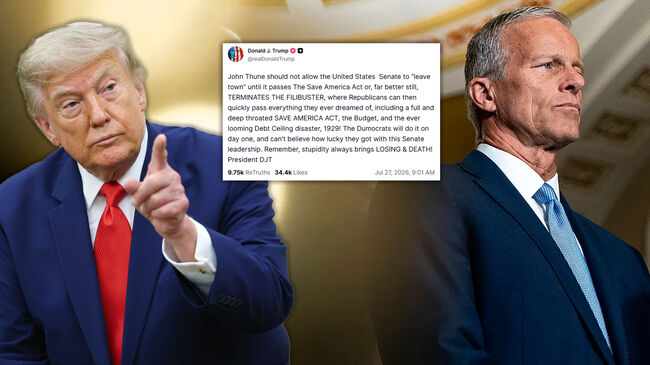 Trump Demands Passage of ‘SAVE Act’ Before Senate Recess
 [Photo] Evidence of Election Fraud Flooding U.S. Media… Trump Had 2.7 Million Votes Stolen
 [Video] U.S. Semiquincentennial Air Show... 'Art in the Sky' streaks across New York
 [Editorial Cartoon] A Draconian Law That Undermines Freedom of Expression

 List
List









