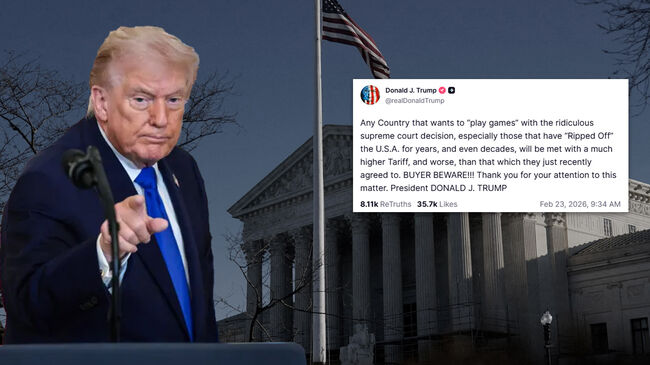
President Donald Trump warned on Monday that countries "messing around" with trade agreements signed with the United States would face stronger sanctions.
This comes after the Supreme Court ruled that the broad tariffs imposed by President Trump were unconstitutional.
"Countries that 'mess around' with this ridiculous Supreme Court ruling, especially those that have been 'ripping off' the United States for many years, even decades, will pay much higher tariffs, much harsher measures than recently agreed upon," Trump wrote on Truth Social. He emphasized, "Buyers beware!!!"
According to White House announcements and data from the Office of the United States Trade Representative (USTR), President Trump signed an Economic Prosperity Agreement with the United Kingdom in May 2025, which included reciprocal tariff conditions and broader trade commitments. The agreement was described as a bilateral arrangement negotiated under Trump's reciprocal tariff policy.
In October 2025, following negotiations driven by President Trump's threats to increase tariffs, the U.S. Trade Representative announced that the United States had entered into reciprocal trade agreements with Malaysia and Cambodia, and announced a common tariff system with Vietnam and Thailand.
This month, the U.S. Trade Representative announced that the United States had signed a reciprocal trade agreement with Indonesia. This is part of a series of country-specific tariff negotiations that the U.S. administration has been conducting during its term, which also include framework or agreement deals with Japan, South Korea, India, and several Latin American partner countries, the administration stated.
Trump stated his desire for a global tariff of 15%, an increase from the 10% baseline tariff he had announced immediately after the court ruling.
On Friday, the Supreme Court ruled that President Trump's imposition of broad tariffs on almost all major U.S. trading partners under the International Emergency Economic Powers Act (IEEPA) exceeded his authority.
The court concluded that the emergency law does not grant the president the authority to impose blanket import tariffs without explicit congressional approval.
The decision appeared to invalidate tariffs that had been applied to China, Mexico, Canada, European Union member states, and other countries.
However, Trump criticized the justices in his social media posts, calling the ruling a "ridiculous Supreme Court ruling" and expressing his dissatisfaction with the decision.
One of Trump's executive orders would allow for a 10% tariff on all global imports starting on Tuesday, the day of his State of the Union address, potentially sparking new conflicts over the president's trade powers.
Administration officials stated that even after the court limited the president's use of emergency powers, the president could utilize other legal bases, including provisions of the Trade Act of 1974 that allow for the imposition of temporary tariffs in certain circumstances.
Some legal experts interpret this Supreme Court ruling as a limitation on the administration's authority over taxation and trade, emphasizing that the power to impose taxes rests with Congress.
The stock market, which had been on an upward trend following the Supreme Court ruling, turned to a downward trend on Monday.
By Hong Seong-gu, Chief Reporter of NNP USA / Special Contribution to this publication NNP info@newsandpost.com
What do you think of this article?

 Trump pressures for rate cut again ahead of FOMC... "Should be the lowest in the world"
U.S. President Donald Trump. [Photo = The White House] U.S. President Donald Trump once again pressured the Federal Reserve, the U.S. central bank, to lower interest rates on the 27th (local time
Trump pressures for rate cut again ahead of FOMC... "Should be the lowest in the world"
U.S. President Donald Trump. [Photo = The White House] U.S. President Donald Trump once again pressured the Federal Reserve, the U.S. central bank, to lower interest rates on the 27th (local time
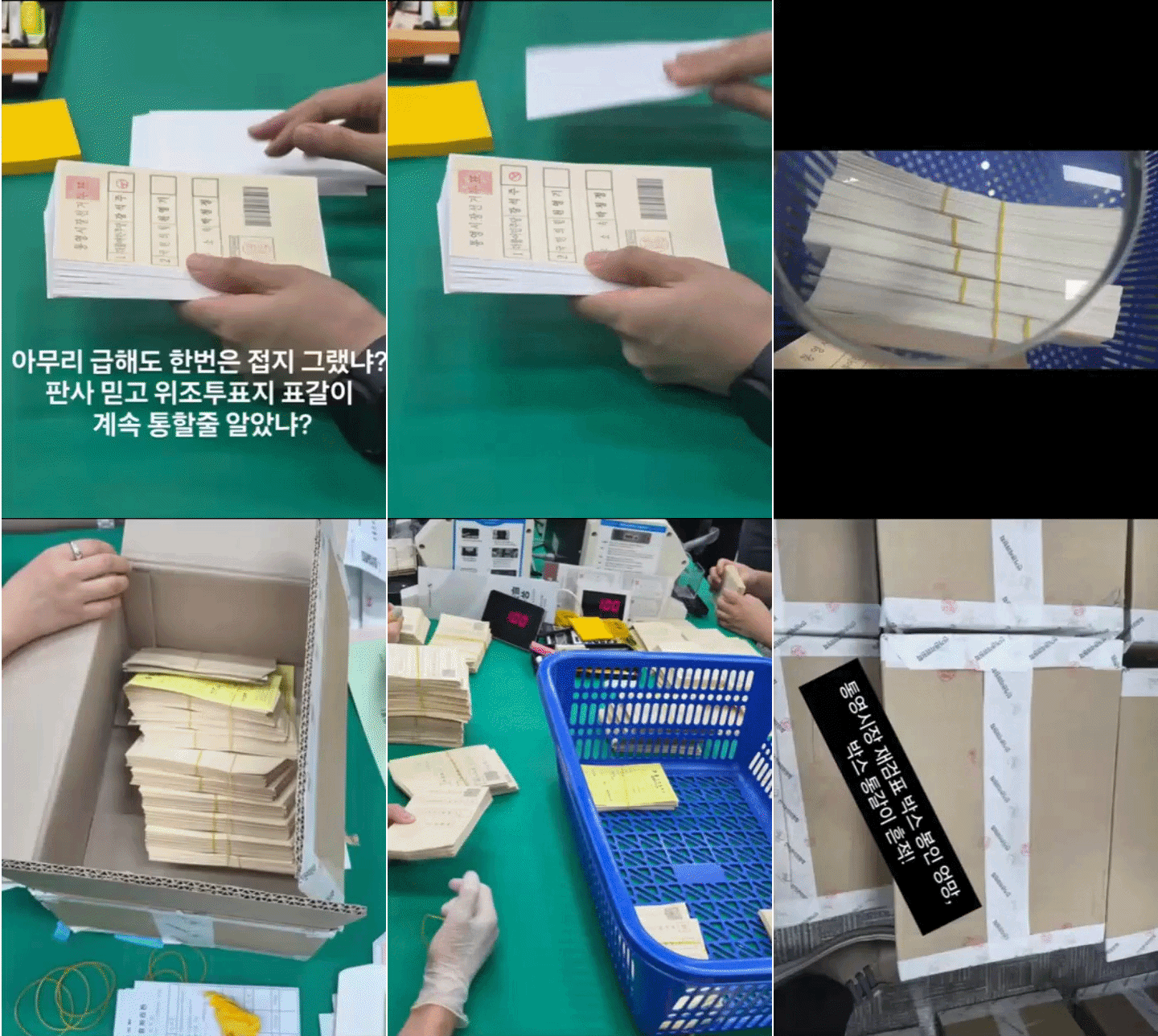 “Ignoring crisp ballots and damaged seals”… Tongyeong mayoral recount concludes with ‘no change in outcome,’ leaving suspicions and public outrage behind
Suspected counterfeit ballots discovered in Tongyeong [GIF from social media of Representative Hwang Kyo-ahn / Attorney Park Joo-hyun]During a recount of the Tongyeong mayoral election in South Gyeong
“Ignoring crisp ballots and damaged seals”… Tongyeong mayoral recount concludes with ‘no change in outcome,’ leaving suspicions and public outrage behind
Suspected counterfeit ballots discovered in Tongyeong [GIF from social media of Representative Hwang Kyo-ahn / Attorney Park Joo-hyun]During a recount of the Tongyeong mayoral election in South Gyeong
 President Yoon, regarding the first-instance ruling on the Public Official Election Act: “An excessive political verdict that distorts the facts… We will appeal immediately.”
The first-instance sentencing hearing for President Yoon Suk Yeol regarding violations of the Public Official Election Act is being broadcast live at Seoul Station on the 27th. [Photo=Yonhap News]Pres
President Yoon, regarding the first-instance ruling on the Public Official Election Act: “An excessive political verdict that distorts the facts… We will appeal immediately.”
The first-instance sentencing hearing for President Yoon Suk Yeol regarding violations of the Public Official Election Act is being broadcast live at Seoul Station on the 27th. [Photo=Yonhap News]Pres
 WSJ: "SK Hynix ADR Premium Is a Sign of AI Trading Overheat"
Advertisement for SK Hynix ADR listing in New York's Times Square [Reuters=Yonhap News file photo]The Wall Street Journal (WSJ) has pointed out that the price of SK Hynix’s American Depositary Recei
WSJ: "SK Hynix ADR Premium Is a Sign of AI Trading Overheat"
Advertisement for SK Hynix ADR listing in New York's Times Square [Reuters=Yonhap News file photo]The Wall Street Journal (WSJ) has pointed out that the price of SK Hynix’s American Depositary Recei
 'Godfather of Japanese Mystery Novels' Keigo Higashino Passes Away After Battle with Cancer at 68
Famous Japanese mystery novelist Keigo Higashino [AFP=Yonhap News]It has been belatedly reported that Keigo Higashino, the "godfather of Japanese mystery novels" and author of bestsellers such as "The
'Godfather of Japanese Mystery Novels' Keigo Higashino Passes Away After Battle with Cancer at 68
Famous Japanese mystery novelist Keigo Higashino [AFP=Yonhap News]It has been belatedly reported that Keigo Higashino, the "godfather of Japanese mystery novels" and author of bestsellers such as "The
 [Park Pil-kyu Security Column] To the Ignorant Trying to Clothe a Beast in Sheep's Clothing
Rep. Kim Byung-joo of the Democratic Party of Korea [Photo=Yonhap News]“The Air Force Academy doesn't teach you how to fly a plane!” “The Army, Navy, and Air Force academies are exactly the
[Park Pil-kyu Security Column] To the Ignorant Trying to Clothe a Beast in Sheep's Clothing
Rep. Kim Byung-joo of the Democratic Party of Korea [Photo=Yonhap News]“The Air Force Academy doesn't teach you how to fly a plane!” “The Army, Navy, and Air Force academies are exactly the
 [Issue Diagnosis] Two Effects of the Election Petition Review
 [Photo] Evidence of Election Fraud Flooding U.S. Media… Trump Had 2.7 Million Votes Stolen
 [Video] U.S. Semiquincentennial Air Show... 'Art in the Sky' streaks across New York
 [Editorial Cartoon] A Draconian Law That Undermines Freedom of Expression

 List
List









