Marcus Aurelius (left), the last of the Five Good Emperors, and Judge Ji Gui-yeon.
In this trial, Judge Ji Gui-yeon frequently invoked history and drew parallels.
To find evidence that "even the president can be punished," he had no choice but to delve into history, from the Roman era through the Middle Ages to 17th-century England. As a result, the examples from times when democracy was not yet established only served to weaken the persuasiveness of the presidential ruling.
The Emperor's Edicts Were Based on the Support of Roman Citizens
Judge Ji stated, "In the Roman era, acts that disrupted the basic order of the state were punished as treason, but by the imperial period, acts of rebellion against the emperor were also punished as treason."
Rome's political system underwent changes: monarchy (8th-6th centuries BC), republic (6th-1st centuries BC), and empire (1st century BC - 5th century AD). The imperial era that Judge Ji mentioned refers to the Roman Empire period.
During the Roman Empire, capable emperors, including the Five Good Emperors, ruled the country, ushering in the Pax Romana, achieving the greatest territorial expansion, and enjoying a golden age. They also enacted Roman law and applied it to the diverse peoples within the empire, which became the foundation of European jurisprudence.
During that time, the emperor exercised ultimate authority in legislation, administration, and justice. Imperial edicts (Edicta) meant that the emperor's command was law. Naturally, rebellion against the emperor was subject to punishment for treason as an act that undermined the constitution.
However, it is not the case that emperors during this period abused their power and issued edicts indiscriminately. In the era of the Five Good Emperors, emperors maintained political stability by adopting capable individuals as their successors. Although the emperor's edicts were law, their judgments were wise and trustworthy, allowing Roman citizens to enjoy peace. The key point is that behind the emperor's authority lay the acceptance of the Roman citizens.
Judge Ji explained that this tendency continued into the subsequent Middle Ages, and then, in England, a parliament was established. When parliament issued a resolution requesting the correction of 200 grievances, King Charles I, enraged, personally led his army to storm the parliament building and forcibly dissolved it on the spot.
He continued, "Through these civil wars, Charles I was eventually sentenced to death for treason and executed," adding, "Examining the verdict at that time, it is clear that the king's act of rebellion against the state was explicitly acknowledged."
Judge Ji stated, "From this point on, the concept that attacking parliament, which had been delegated sovereignty by the people, constituted treason, even for a king, seems to have become widespread."
Ultimately, to explain how the act of "attacking parliament" led to such severe punishment, he drew upon the history of Rome, the Middle Ages, and the early modern period. Did he truly believe this logic was persuasive?
Dictatorial Rule Was More Unbearable Than Dissolving Parliament
Then, did Oliver Cromwell, who led the parliamentary forces and defeated the royalists, lead parliament well?
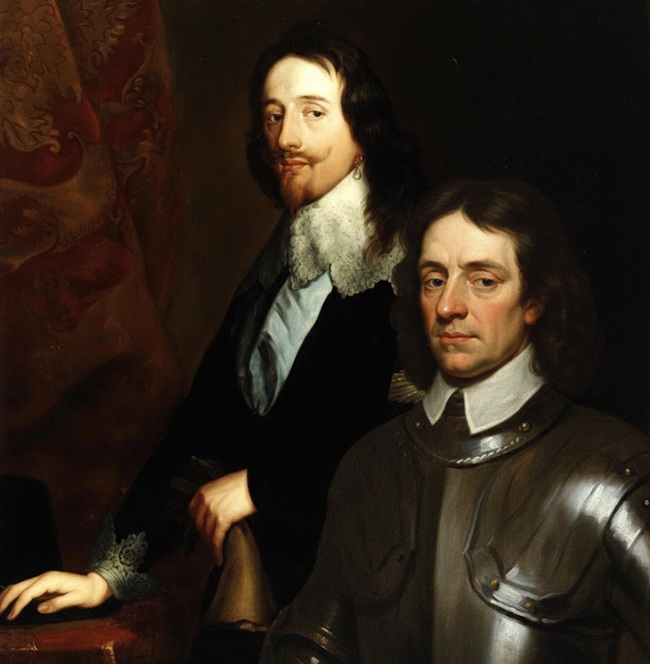 Cromwell, who executed Charles I, stormed the parliament building in London's Westminster four years later, on April 20, 1653, and forcibly dissolved the then-governing Rump Parliament.
On January 30, 1649, Cromwell, who executed Charles I, stormed the parliament building in London's Westminster four years later, on April 20, 1653, and forcibly dissolved the then-governing Rump Parliament.
This was a direct action taken when parliament ignored the demands of the military and attempted to pass a new parliamentary constitution in a manner favorable to them.
Cromwell stormed into the parliament building with armed soldiers and declared to the members, "You have sat too long for any good you have been doing! Depart, and let us have done with you! In the name of God, go!" ordering their dissolution.
Major Thomas Harrison dragged Speaker William Lenthall from his chair, and soldiers drove the members out.
After dissolving parliament, Cromwell was inaugurated as Lord Protector under the "Instrument of Government" in December 1653 and began a terrifying military dictatorship. He was criticized as "a dictator worse than a king."
Cromwell died of malaria at the end of 1658. Horrified by his brutal dictatorship, the English people invited Charles II (son of Charles I), who was in exile, to the throne, thereby realizing the Restoration (Stuart dynasty).
And King Charles II, upon his ascension, dug up Cromwell's body, beheaded him, and displayed his head on a pole for all to see.
Now, we can understand the real reason Charles I was executed. He was not executed for dissolving parliament but was brought to the scaffold due to power struggles.
From the perspective of the people, if Charles I had been such a horrifying figure, there would have been no reason to find the exiled prince and place him back on the throne.
Both Charles I and Cromwell dissolved parliament. Here, the dissolution of parliament was merely a means. What plunged the people into despair was not the dissolution of parliament itself, but the ruthless 'dictatorial rule.'
The purpose of President Yoon Suk-yeol's emergency martial law was never to seize control of parliament. He did not harm any members of the National Assembly, nor did he have any intention or reason to do so. He simply sought to prevent 'one-person dictatorship' and 'one-party dictatorship' through fraudulent elections. As a means to achieve this, he dispatched 270 unarmed troops to the National Assembly.
Does it make sense that martial law to prevent 'dictatorship' is more wrong than 'dictatorship'? The prosecution, police, and courts are attacking the finger pointing at the fraudulent elections, rather than addressing the issue itself.
By Reporter Im Yo-hee

 Trump pressures for rate cut again ahead of FOMC... "Should be the lowest in the world"
U.S. President Donald Trump. [Photo = The White House] U.S. President Donald Trump once again pressured the Federal Reserve, the U.S. central bank, to lower interest rates on the 27th (local time
Trump pressures for rate cut again ahead of FOMC... "Should be the lowest in the world"
U.S. President Donald Trump. [Photo = The White House] U.S. President Donald Trump once again pressured the Federal Reserve, the U.S. central bank, to lower interest rates on the 27th (local time
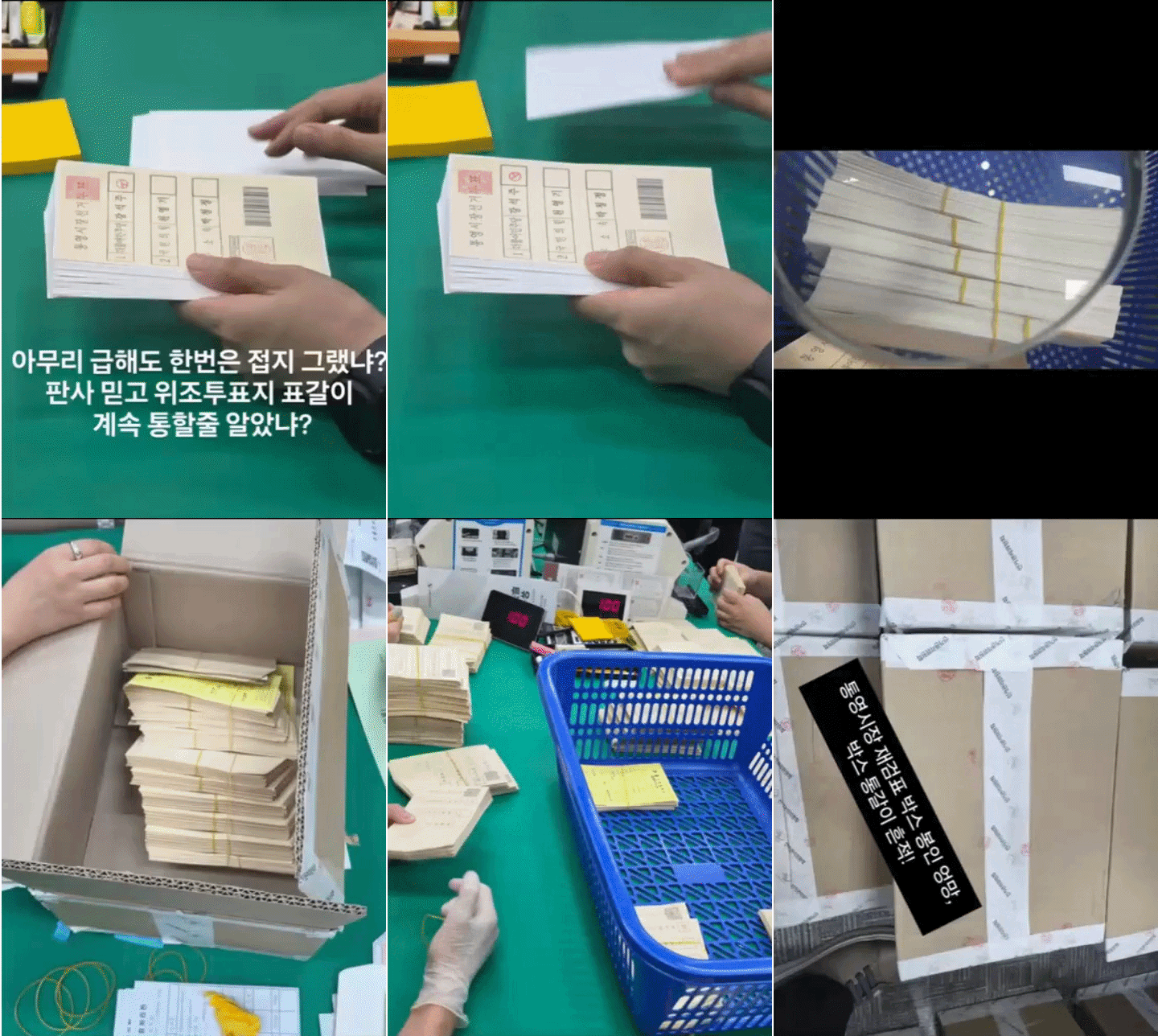 “Ignoring crisp ballots and damaged seals”… Tongyeong mayoral recount concludes with ‘no change in outcome,’ leaving suspicions and public outrage behind
Suspected counterfeit ballots discovered in Tongyeong [GIF from social media of Representative Hwang Kyo-ahn / Attorney Park Joo-hyun]During a recount of the Tongyeong mayoral election in South Gyeong
“Ignoring crisp ballots and damaged seals”… Tongyeong mayoral recount concludes with ‘no change in outcome,’ leaving suspicions and public outrage behind
Suspected counterfeit ballots discovered in Tongyeong [GIF from social media of Representative Hwang Kyo-ahn / Attorney Park Joo-hyun]During a recount of the Tongyeong mayoral election in South Gyeong
 President Yoon, regarding the first-instance ruling on the Public Official Election Act: “An excessive political verdict that distorts the facts… We will appeal immediately.”
The first-instance sentencing hearing for President Yoon Suk Yeol regarding violations of the Public Official Election Act is being broadcast live at Seoul Station on the 27th. [Photo=Yonhap News]Pres
President Yoon, regarding the first-instance ruling on the Public Official Election Act: “An excessive political verdict that distorts the facts… We will appeal immediately.”
The first-instance sentencing hearing for President Yoon Suk Yeol regarding violations of the Public Official Election Act is being broadcast live at Seoul Station on the 27th. [Photo=Yonhap News]Pres
 WSJ: "SK Hynix ADR Premium Is a Sign of AI Trading Overheat"
Advertisement for SK Hynix ADR listing in New York's Times Square [Reuters=Yonhap News file photo]The Wall Street Journal (WSJ) has pointed out that the price of SK Hynix’s American Depositary Recei
WSJ: "SK Hynix ADR Premium Is a Sign of AI Trading Overheat"
Advertisement for SK Hynix ADR listing in New York's Times Square [Reuters=Yonhap News file photo]The Wall Street Journal (WSJ) has pointed out that the price of SK Hynix’s American Depositary Recei
 'Godfather of Japanese Mystery Novels' Keigo Higashino Passes Away After Battle with Cancer at 68
Famous Japanese mystery novelist Keigo Higashino [AFP=Yonhap News]It has been belatedly reported that Keigo Higashino, the "godfather of Japanese mystery novels" and author of bestsellers such as "The
'Godfather of Japanese Mystery Novels' Keigo Higashino Passes Away After Battle with Cancer at 68
Famous Japanese mystery novelist Keigo Higashino [AFP=Yonhap News]It has been belatedly reported that Keigo Higashino, the "godfather of Japanese mystery novels" and author of bestsellers such as "The
 [Park Pil-kyu Security Column] To the Ignorant Trying to Clothe a Beast in Sheep's Clothing
Rep. Kim Byung-joo of the Democratic Party of Korea [Photo=Yonhap News]“The Air Force Academy doesn't teach you how to fly a plane!” “The Army, Navy, and Air Force academies are exactly the
[Park Pil-kyu Security Column] To the Ignorant Trying to Clothe a Beast in Sheep's Clothing
Rep. Kim Byung-joo of the Democratic Party of Korea [Photo=Yonhap News]“The Air Force Academy doesn't teach you how to fly a plane!” “The Army, Navy, and Air Force academies are exactly the
 [Issue Diagnosis] Two Effects of the Election Petition Review
 [Photo] Evidence of Election Fraud Flooding U.S. Media… Trump Had 2.7 Million Votes Stolen
 [Video] U.S. Semiquincentennial Air Show... 'Art in the Sky' streaks across New York
 [Editorial Cartoon] A Draconian Law That Undermines Freedom of Expression

 List
List