 Monument commemorating the Declaration of Independence in Tapgol Park, Jongno, Seoul. ⒸHanmi Ilbo
1. Preamble to the Constitution and the March 1st Declaration of Independence
The preamble to our Constitution states: "We, the people of Korea, endowed with a glorious history and tradition, inheriting the legitimacy of the Provisional Government of the Republic of Korea established by the March 1st Movement and the democratic ideals of the April 19th Revolution which resisted injustice..."
Therefore, the March 1st Declaration of Independence is the supreme charter of our nation, above the Constitution. Just as the world has the Universal Declaration of Human Rights, our people have the "March 1st Declaration of Independence," a golden rule and a monumental decree.
2. Establishment of the Provisional Government in Shanghai and the Separation of Powers in a Democratic Republic
In the wake of the March 1st Movement, the Provisional Government of the Republic of Korea was established in Shanghai, China, on April 11, 1919, to effectively and systematically pursue independence from Japanese rule.
In September of the same year, a provisional constitution was promulgated, and in November, President Syngman Rhee and Prime Minister Lee Dong-hwi were elected. The Provisional Government was the first democratic republican government in our history, with the separation of powers into the legislature (the National Assembly), the judiciary (the Courts), and the executive (the State Council). The "Dongnip Sinmun" (Independent Newspaper) was published to foster the spirit of independence.
3. The February 8th Declaration of Independence and the March 1st Declaration of Independence
As World War I drew to a close, U.S. President Wilson advocated for national self-determination, and in response to this trend, the nation's will to achieve independence grew stronger.
On February 8, 1919, Korean students in Tokyo, led by the Korean Youth Independence Corps, announced the February 8th Declaration of Independence, drafted by Lee Kwang-soo. The announcement of this declaration served as a catalyst, leading to the proclamation of the March 1st Declaration of Independence by 33 national representatives at Taehwagwan in Seoul on March 1, 1919.
As that year was the "Gim-i" year (己未年) in the sexagenary cycle, it is commonly referred to as the Gim-i Declaration of Independence, and it is also abbreviated as the Declaration or Proclamation.
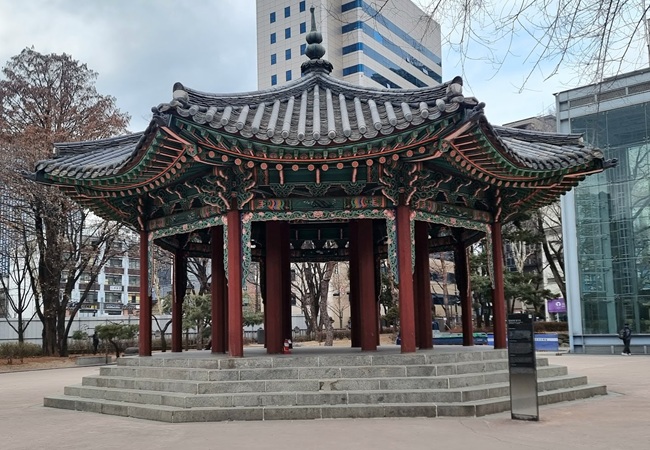 The Octagonal Pavilion in Tapgol Park, Jongno, Seoul. ⒸHanmi Ilbo
4. Proclamation of Independence at Taehwagwan on March 1st and Protests in Tapgol Park
On March 1, 1919, at noon, national representatives gathered at Taehwagwan, where Manhae Han Yong-un read the Declaration of Independence.
At 2 PM, at the Octagonal Pavilion in Tapgol Park, about 1,500 students and citizens gathered. The 만세 (manse) movement began with the reading of the declaration by Chi Se Jeong-yong, and the independence movement spread nationwide with street parades.
5. The March 1st Independence Movement and the Structure of the Declaration of Independence
The March 1st Independence Movement, commencing on March 1, 1919, was a grand undertaking by the 20 million Korean people to resist Japanese aggression and achieve independence.
The text of the proclamation, addressed to the entire Korean nation, was written in a solemn and eloquent manner, based on objective facts, and structured in four stages: introduction (기), development (승), turn (전), and conclusion (결).
6. Drafting of the March 1st Declaration of Independence and the Three Articles of Pledge
The Declaration was drafted by Yukdang Choi Nam-sun, and the Three Articles of Pledge, serving as a code of conduct, were added by Manhae Han Yong-un. The date of signing was left blank because the date of the action could not be revealed in advance.
The representatives by religion were: 15 from Cheondogyo, 16 from Christianity, and 2 from Buddhism, totaling 33 people. The representative of the nation was Master Eui-am Son Byong-hi.
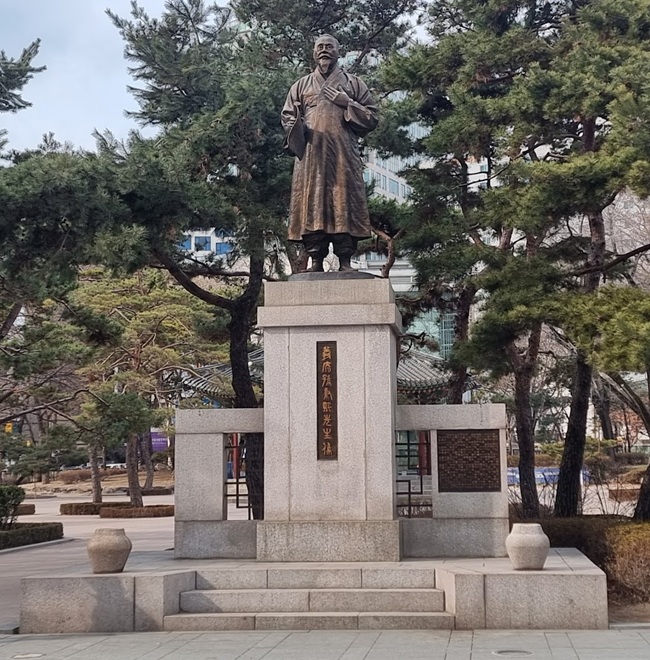 Statue of Eui-am Son Byong-hi in Tapgol Park, Jongno, Seoul. ⒸHanmi Ilbo
7. Essence of the Declaration and the Composition of the Proclamation's Sentences According to Rhetorical Devices
The essence of the Declaration is to inform the world that Joseon is an independent nation, and by clarifying the legitimacy and inevitability of this declaration, to urge the firm resolve and determination of our people.
The sentences are structured to be logical yet convey strong determination, aiming to mobilize the masses. Various rhetorical devices such as exclamation, parallelism, enumeration, climax, and comparison were utilized.
8. Style of the Declaration and Printing and Distribution of the Declaration
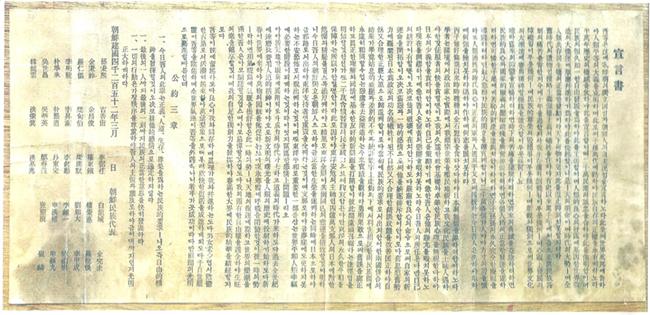
The style of the Declaration is a mixed script of Chinese characters and Korean, primarily centered around Chinese characters but also using Korean. The entire text is 1,760 characters long, with 62% being Hanja (Chinese characters), forming a robust writing style.
The Declaration was printed as 21,000 copies at Boseongsa on February 27, 1919, and distributed on February 28. On March 1, 1,500 copies were delivered to students participating in the Tapgol Park demonstration, and the remaining printed materials were sent nationwide.
9. Allegation of Errors on the Declaration Stele in Tapgol Park and the Erection of a Facsimile of the Declaration
In Tapgol Park, a sacred site for the nation, there are three steles to the east of the statue of Master Son Byong-hi. In the center is a large Declaration of Independence stele, to the left is a stele with the English translation of the declaration, and to the right is a stele with the Korean translation. The writer discovered six erroneous Chinese characters and approximately 250 characters inscribed in the Northern Wei style on the central large declaration stele and requested the erection of a new original declaration stele through a public proposal to the President, the Ministry of Patriots and Veterans Affairs, and the Jongno District Office. This proposal was not accepted.
Subsequently, on June 7, 2015, the responsible Jongno District Office erected a "Facsimile of the Original Declaration" (模寫板) four times the size of the original declaration, providing citizens visiting Tapgol Park with an opportunity to directly verify the original text of the declaration. This facsimile is currently managed by the Cultural Heritage Administration as Historic Site No. 354.
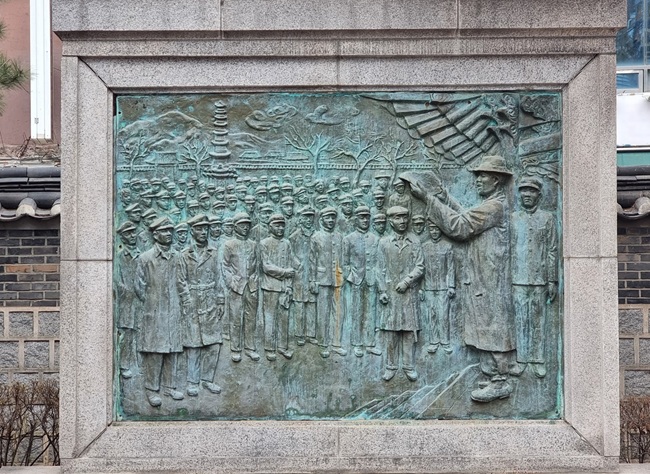 On March 1, 1919, at 2 PM, the 만세 (manse) movement began at the Octagonal Pavilion in Tapgol Park, where about 1,500 students and citizens gathered and Chi Se Jeong-yong read the declaration. ⒸHanmi Ilbo
10. Distinguishing Between the Boseongsa Edition and the Sinmun Publishing House Edition of the Declaration of Independence
The March 1st Declaration of Independence is divided into the Boseongsa (普成社) edition and the Sinmun Publishing House (新文館) edition. The Boseongsa edition corresponds to the original declaration published by Boseongsa during the March 1st Independence Movement.
On the other hand, the Sinmun Publishing House edition is believed to have been mass-produced after the liberation of August 15th and differs in some markings from the original. The distinction between the two editions can be confirmed through differences in Korean orthography and Chinese character notation.
The original Boseongsa edition of the Declaration of Independence is designated as Registered Cultural Heritage No. 664-1 and is currently housed at the Independence Hall of Korea in Cheonan and the Seoul Museum of History.
Actual declarations distributed during the March 1st Movement are extremely rare. One is preserved by the descendants of Woltan Park Jong-hwa, a fourth-year student at Hwimun Uisuk who participated in the Tapgol Park demonstration. Another is the "Pyongyang Edition," handed down by the grandson of a Japanese person who possessed a declaration in Pyongyang at the time.
Only a very small number of rare original copies remain today. Most declaration steles erected nationwide and the circulated declarations are based on the Sinmun Publishing House edition produced after liberation.
Analysis and Comparison of the Original Boseongsa Edition and the Erroneous Sinmun Publishing House Edition of the March 1st Declaration of Independence
No. | Area of Distinction | Boseongsa Edition | Sinmun Publishing House Edition |
1 | Sentence Narration | 1930s archaic style
No spacing | Based on Ju Si-gyeong's grammar
Partial spacing |
2 | Font Size | Large | Small |
3 | Number of Lines | 62 Lines | 47 Lines |
4 | Notation of 'Joseon' (朝鮮) | 鮮朝 | 朝鮮 |
5 | Printing Company President | LEE Jong-il | CHOI Nam-sun |
6 | Date of Signing | March Day | March 1st |
7 | Punctuation | Symbols (not used) | Symbols (period indicated) |
8 | Erroneous Chinese
Characters
| Declaration, Line 9: 剝喪 (Bak-sang) | 剝奪 (Bak-tal) |
Declaration, Line 12: 宣暢 (Seon-chang) | 宣揚 (Seon-yang) |
Declaration, Line 23: 懲辦 (Jeong-ban) | 懲辨 (Jeong-byeon) |
Declaration, Line 33: 共倒同兦 (Gongdo-dongmang) | 共倒同亡 (Gongdo-dongmang) |
Declaration, Line 40: 回穌 (Hoe-so) | 回蘇 (Hoe-so) |
Declaration, Line 42: 蹰躇 (Ju-cheo) | 躊躇 (Ju-cheo) |
11. 'Seoncho' in the opening of the March 1st Declaration of Independence is 'Joseon'
The inversion of "Joseon" to "Seoncho" in the opening line of the original declaration, "We are an independent nation of Seoncho...", is presumed to be an error during the typesetting and printing process in the urgent circumstances of the time.
12. The Classical Chinese and Korean Sentences of the March 1st Declaration of Independence and the Reading of the Korean Translated Declaration at Commemorative Ceremonies
Approximately 62% of the 1,762 characters in the Declaration are Chinese. It uses difficult Sino-Korean words and Korean orthography predating the 1933 Korean orthography standardization.
A notable feature is the use of four characters that have fallen out of use: ,ㆍㅿ ㆆ ㆁ. Due to the complex sentence structure, which mixes classical Chinese and Korean, some individuals reading the Declaration at celebratory or commemorative events may add pronunciations and annotations to the Chinese characters or read the entire text translated into modern Korean.
Often, the general public finds the prolonged reading of Chinese characters difficult and tedious, which can hinder the full transmission of the meaning of the Declaration. To address this challenge and enable all citizens to easily read and understand the Declaration, the author petitioned the Ministry of the Interior and Safety, the Ministry of Patriots and Veterans Affairs, and the Korean Liberation Association to officially use the Korean translated version of the Declaration by Lee Hee-seung at official events.
As a result, on March 1, 2012, the official reading of the Korean translated Declaration began at the 93rd March 1st anniversary celebrations and memorial services. The author attended the memorial service with his spouse, and the introduction of the Korean translated Declaration became a significant opportunity for the public to newly understand the meaning of the Declaration of Independence and further elevate the spirit of independence.
13. The March 1st Declaration of Independence is Written in Standard Script Based on Kangxi Dictionary
In school education, according to the Ministry of Education's Notification No. 1992-19 (October 30, 1992) on the "High School Chinese Character Curriculum Order," the standard for Chinese character notation used in middle and high schools is clearly defined as standard script (楷書體) based on the Kangxi Dictionary (康熙字典) and Ming Dynasty style (明朝體).
Considering this educational continuity, students who have completed Chinese character studies should be able to fully comprehend the Declaration of Independence. Therefore, using the Kangxi Dictionary standard script when transcribing or engraving the Declaration is the most natural and appropriate method.
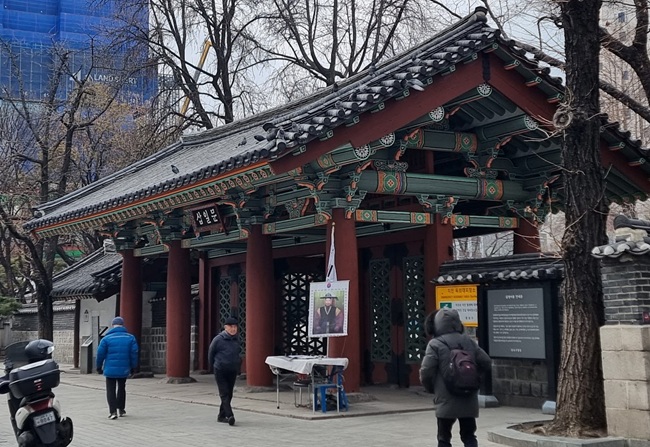 The Samilmun Gate at the main entrance of Tapgol Park, Jongno, Seoul. ⒸHanmi Ilbo
14. Inclusion of the Declaration of Independence in the 'Republic of Korea Official Gazette' and Other Publications for Public Promotion
The author proposed to the Ministry of the Interior and Safety and the Ministry of Patriots and Veterans Affairs, through Pocheon City, to widely publicize the original Boseongsa edition of the Declaration of Independence by including it in the 'Republic of Korea Official Gazette'.
As a result, on August 18, 2014, the original declaration was officially published in Official Gazette No. 18329, marking the first large-scale introduction of the original declaration to the public.
Subsequently, requests were made for its inclusion in eight institutional publications, including the 'National Assembly Newsletter' and 'Library Culture', contributing to the broader dissemination of the original declaration.
15. Correction of Errors in Chinese Characters in the Declaration within High School Korean Textbooks and Printing/Distribution of Revised Editions
While working as a high school teacher, the author taught the Declaration of Independence in Korean classes and has experience in co-reading the Declaration at March 1st anniversary ceremonies, which made it easy to identify errors in the Chinese characters of the Declaration.
Several errors in Chinese characters were found in the Declaration published on pages 116-123 of the first volume of the high school Korean textbook published by Chunjae Education. Although corrections were repeatedly requested from the editorial staff of the Ministry of Education and Science Technology for three years, the reflection was delayed.
On November 29, 2010, the author directly proposed the need for correction to Minister Lee Ju-ho of the Ministry of Education and Science Technology, who was a special invited speaker at the '2010 Pocheon City Lifelong Learning Vision Declaration Ceremony'. As a result, revised textbooks began to be published and distributed from 2013.
16. Inclusion of the Original Declaration in Various Literary Materials
Facsimiles of the original Declaration of Independence identified by the proposer can be found in the following literature: Page 31 of Choi Nam-sun's 'History of the Korean Independence Movement' published by Kyung-in Publishing House; pages 38-39 of 'Meeting Manhae Han Yong-un in Namhansanseong' published by Manhae Memorial Hall; and a facsimile of the Declaration in the appendix of 'Declaration of Independence' published by the Samil Spirit Promotion Association. Four types of literary materials contained facsimiles of the original Declaration of Independence.
17. Compilation and Distribution of a Teaching/Learning Edition of the March 1st Declaration of Independence and Production and Distribution of a Handwritten/Printed Edition of the Declaration
To enable students of all levels to easily comprehend the March 1st Declaration of Independence, elementary students and the general public were provided with the 'Easy and Correct Reading of the Declaration' established by the government for the 100th anniversary of the March 1st Movement. Middle school students were provided with Professor Lee Hee-seung's 'Korean Translation of the March 1st Declaration of Independence', and high school students were provided with the 'Original March 1st Declaration of Independence'.
To this end, the author compiled and produced 50 copies of a 'March 1st Declaration of Independence Teaching-Learning Edition', consisting of 25 pages, and distributed them to Korean language teachers at various schools in the jurisdiction for use in classes.
Additionally, the author personally transcribed, printed, and produced 280 copies of a handwritten/printed edition of the Declaration on imitation half-cut paper and sent them to former presidents, relevant ministers, the National Council of Senior Citizens, 44 branches under the Gyeonggi Provincial Federation, and various institutions within the jurisdiction for display.
The author is confident that this played a significant role in raising awareness and interest in promoting the spirit of independence.
18. Appointment and Activities as a Member of the March 1st Movement 100th Anniversary Commemoration Promotion Committee
In connection with the government's promotion of the 100th anniversary of the March 1st Movement, the author was appointed as a member of the 'March 1st Movement 100th Anniversary Commemoration Promotion Committee' and actively participated in various cultural events, academic presentations, research projects, and material contests. The author also participated in sponsorship programs three times.
Furthermore, the author contributed an article titled "First Verification in 100 Years: Mr. Park Dong-wan, Among the 33 National Representatives of the March 1st Movement, is from Pocheon" in the autumn issue of 'March 1st Spirit'. This article informed the entire nation and the citizens of Pocheon about a new fact that had been unknown until then, allowing citizens to feel a great sense of pride.
19. Publication of the First and Second Editions of 'Rereading the March 1st Movement' Published by the March 1st Culture Foundation
The author discovered three typographical errors in the first edition of 'Rereading the March 1st Movement' published by the March 1st Culture Foundation. On September 5, 2013, the author personally visited the foundation in Ok-in Dong, Jongno-gu, Seoul, and strongly requested the necessity of correction.
As a result, on March 31, 2015, a revised edition, correcting all errors, was perfectly revised and published. The foundation generously distributed it nationwide, greatly contributing to the elevation of the spirit of independence. This was recognized as the first case of correcting errors in Chinese characters of the Declaration.
Additionally, while the declaration stele erected in Seodaemun Prison Park is accurately constructed without defects, it is regrettable that most other declaration steles are based on the Sinmun Publishing House edition and contain numerous errors.
20. Distribution of 'Easy and Correct Reading of the March 1st Declaration of Independence' to the Entire Nation
For 70 years since Lee Hee-seung's Korean translation of the March 1st Declaration of Independence, his translated version has played a crucial role in promoting the spirit of independence by being included in high school Korean textbooks.
However, because it was difficult for the general public to comprehend the text, the government, as part of the 100th anniversary of the March 1st Movement in 2019, newly created and widely promoted and distributed 'Easy and Correct Reading of the March 1st Declaration of Independence'.
This enabled the entire nation to easily read and understand the Declaration, creating an opportunity to widely celebrate the historical significance of the March 1st Movement. Furthermore, it was translated and distributed in five foreign languages to overseas Koreans, marking a new turning point in globally promoting the spirit of independence.
Should not all citizens thoroughly read the Declaration to reaffirm the correct understanding of the March 1st Movement, the legitimacy of the independence movement, and the nation's resolve and determination, thereby further elevating the March 1st spirit?
21. Inclusion of the Declaration of Independence in Korean Textbooks for All Levels of Schools and Promotion of the Spirit of Independence
To enhance the nation's spirit of independence, the author has continuously submitted public proposals for the past five years to reform the Korean language curriculum so that the original March 1st Declaration of Independence is taught in high schools, the Korean translated version in middle schools, and the 'Easy and Correct Reading of the Declaration' in elementary schools.
Middle and high school textbooks are subject to a verified accreditation system, requiring a curriculum reform. In contrast, elementary school textbooks are government-issued. The author proposed to former presidents and the former president to include the 'Easy and Correct Reading of the Declaration' in elementary school Korean textbooks, but all attempts were in vain.
Subsequently, on January 6, 2026, a public proposal was submitted again to the current President, which was forwarded to the Ministry of Education.
The author cited the phrase from the preamble to the Constitution, "We, the people of Korea, endowed with a glorious history and tradition, inheriting the legitimacy of the Provisional Government of the Republic of Korea established by the March 1st Movement and the democratic ideals of the April 19th Revolution which resisted injustice," to explain the purpose of the proposal.
The Ministry of Education also agreed with this intention and expressed its willingness to proceed. As a result, the possibility of including the Declaration in elementary school Korean textbooks has opened up, which fills the author with immense emotion.
22. Inclusion of 'Easy and Correct Reading of the March 1st Declaration of Independence' in Elementary School Korean Textbooks
In its response to the public proposal on January 20, 2026, the Ministry of Education stated that when developing educational materials, the compilers and publishers must adhere to the spirit of the March 1st independence movement. The Ministry also responded, "We will strive to provide textbooks to schools that are suitable for the curriculum and allow students to learn correct ideologies and values by cooperating with compilers and publishers."
Although somewhat delayed, this response is very fortunate and holds great promise, as it can become a cornerstone of national education.
Declaration of Independence (宣言書)
Recalling the 107th anniversary of the March 1st Independence Movement
The spirit of an independent nation is the origin; the spirit of March 1st independence is the origin of the nation. The 107th anniversary of the March 1st Declaration.
It has been 107 years since the March 1st Declaration of Independence.
Oppression by the Japanese invaders reached everywhere, and protesting citizens took to the streets.
The cries of "Manse!" were loud in every corner of the nation, and the Three Articles of Pledge were read from the pavilion.
Recalling the history of regaining sovereignty, patriots are praised by all ages.
The praise of patriots is sung in all eras.
As the cold autumn wind began to blow in November 2009, Park Dong-gyu, former principal of Yeongbuk High School, couldn't move his feet from the center of Tapgol Park. The inscription of the Declaration of Independence, standing in the heart of the March 1st Movement's birthplace, caught his eye.
The characters were different, and the typeface was different. There were characters that did not match the original Chinese character notation of the Declaration, and instead of the handwriting left by the national representatives, modern typefaces were engraved. He could not leave the scene where the authenticity of the historical document was compromised. From that day on, his life was dedicated to correcting the Declaration.
During his teaching career, he poured his passion into imparting the spirit of independence to students while teaching the Declaration. Even after retirement, that passion did not wane; rather, it deepened.
He re-read, researched, compared, and verified the Declaration. From Kim So-jin's 'Korean Declaration of Independence' to Choi Nam-sun's history of the independence movement, he considered it his mission to correct every character and sentence.
He submitted proposals to the government and local authorities for five years to correct the errors on the inscription at Tapgol Park. Despite being rejected multiple times, he did not give up. Eventually, the Jongno District Office erected a facsimile restoring the original declaration to four times its size, and it was designated as a cultural heritage. It was a moment when one person's persistence corrected public records.
His efforts extended to textbooks. The Declaration in high school Korean textbooks contained incorrect Chinese characters that had been there for decades. He requested corrections from the Ministry of Education, and after three years of persuasion, corrected textbooks began to be distributed nationwide to high schools from 2013. Students finally learned the accurate Declaration.
Changes also occurred at the March 1st anniversary ceremonies. To change the practice of reading only the original text, which mixed Chinese characters and old spellings for 70 years, he proposed reading the Korean translated version, and since 2013, the Korean translation has been officially read at ceremonies.
He pursued the inclusion of the Declaration in the Official Gazette to inform more people about it, and it was promoted through the 'Library Culture' magazine and libraries nationwide. For the 100th anniversary of the March 1st Movement, he personally produced materials that were screened at schools and libraries, and held an exhibition at the ceremony venue, allowing citizens to see and feel the Declaration with their hearts.
He also worked to correct the history of local independence movements in Pocheon. He confirmed that the birthplace of national representative Park Dong-wan (朴東完, 1885-1941) had been incorrectly recorded for 100 years and verified through literature, inscriptions, and family registers that he was from Pocheon.
He proposed and supervised the erection of a Declaration of Independence stele at Cheongseong Park in Pocheon and participated in the publication of a revised edition of the local independence movement history. Reclaiming the region's historical pride was another of his missions.
In particular, the correction of the fact that Geungok Park Dong-wan was from Pocheon after 100 years left a significant resonance in local history. It was an event that reminded us that the spirit of independence is not just a record in a museum but a value that all citizens living today must carry forward together.
Principal Park Dong-gyu's 15 years are a record of human will, demonstrating how quietly and consistently one person can set history straight, rather than grand pronouncements.
It is also a manual of human victory achieved through unwavering diligence and persistence. Now in his 90s, he still says, "The spirit of independence is not the past but the strength that sustains today."
His journey is not yet over. The steles he erected, the textbooks he corrected, the reading texts at ceremonies he changed, and the forgotten history he revived will reawaken the spirit of March 1st in the nation and the citizens of Pocheon, and elevate respect for independence martyrs and pride in the region.
He lamented that approximately 6.7 million students had not learned about the Declaration in the 11 years since its education disappeared with the shift to a verified accreditation system. Principal Park Dong-gyu repeatedly submitted proposals to the government and educational institutions for its re-inclusion and made every effort to ensure the Declaration of Independence would be included in textbooks again.
As a result, in January 2026, the Ministry of Education sent a reply stating its intention to include the 'Easy and Correct Reading of the March 1st Declaration of Independence' in elementary school Korean textbooks. This was a promise to ensure that students learn the correct values and ideologies. Although late, this is a meaningful change and will be the starting point for the education of the spirit of independence to be re-established as a pillar of national education.
His spiritual beacon, seeking to integrate the Declaration of Independence with the present and to use it as the fundamental spirit for free unification, is no longer that of one person. Its light is spreading to more people, illuminating a new path to re-establish the spirit of independence.
And his 15 years of noble efforts will remain a silent torch, illuminating present and future generations. The achievements he preserved have now become the task of our era, which we must all carry forward.
Park Pil-gyu, Editorial Board Member
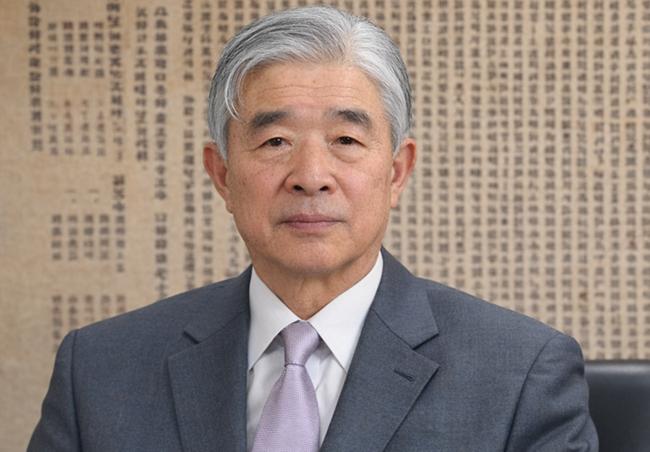
◆ Park Dong-gyu (朴東奎)
Former Principal of Yeongbuk High School, Dean of Yeongbuk Senior Citizens' College, Director of Gyeonggi Northern Senior Leaders' College, Member of the March 1st Movement 100th Anniversary Commemoration Promotion Committee (National Representatives), Instructor at Haklim Korean Language School, President of the Pocheon Chapter of the Korean Classical Poetry Association, Current Guidance Member of the National Hanja Education Promotion Federation, Member of the Pocheon City History Compilation Committee, Lifetime Member of the Pocheon Cultural Center, Member of the Pocheon Classical Poetry Society.

 Trump pressures for rate cut again ahead of FOMC... "Should be the lowest in the world"
U.S. President Donald Trump. [Photo = The White House] U.S. President Donald Trump once again pressured the Federal Reserve, the U.S. central bank, to lower interest rates on the 27th (local time
Trump pressures for rate cut again ahead of FOMC... "Should be the lowest in the world"
U.S. President Donald Trump. [Photo = The White House] U.S. President Donald Trump once again pressured the Federal Reserve, the U.S. central bank, to lower interest rates on the 27th (local time
 “Ignoring crisp ballots and damaged seals”… Tongyeong mayoral recount concludes with ‘no change in outcome,’ leaving suspicions and public outrage behind
Suspected counterfeit ballots discovered in Tongyeong [GIF from social media of Representative Hwang Kyo-ahn / Attorney Park Joo-hyun]During a recount of the Tongyeong mayoral election in South Gyeong
“Ignoring crisp ballots and damaged seals”… Tongyeong mayoral recount concludes with ‘no change in outcome,’ leaving suspicions and public outrage behind
Suspected counterfeit ballots discovered in Tongyeong [GIF from social media of Representative Hwang Kyo-ahn / Attorney Park Joo-hyun]During a recount of the Tongyeong mayoral election in South Gyeong
 President Yoon, regarding the first-instance ruling on the Public Official Election Act: “An excessive political verdict that distorts the facts… We will appeal immediately.”
The first-instance sentencing hearing for President Yoon Suk Yeol regarding violations of the Public Official Election Act is being broadcast live at Seoul Station on the 27th. [Photo=Yonhap News]Pres
President Yoon, regarding the first-instance ruling on the Public Official Election Act: “An excessive political verdict that distorts the facts… We will appeal immediately.”
The first-instance sentencing hearing for President Yoon Suk Yeol regarding violations of the Public Official Election Act is being broadcast live at Seoul Station on the 27th. [Photo=Yonhap News]Pres
 WSJ: "SK Hynix ADR Premium Is a Sign of AI Trading Overheat"
Advertisement for SK Hynix ADR listing in New York's Times Square [Reuters=Yonhap News file photo]The Wall Street Journal (WSJ) has pointed out that the price of SK Hynix’s American Depositary Recei
WSJ: "SK Hynix ADR Premium Is a Sign of AI Trading Overheat"
Advertisement for SK Hynix ADR listing in New York's Times Square [Reuters=Yonhap News file photo]The Wall Street Journal (WSJ) has pointed out that the price of SK Hynix’s American Depositary Recei
 'Godfather of Japanese Mystery Novels' Keigo Higashino Passes Away After Battle with Cancer at 68
Famous Japanese mystery novelist Keigo Higashino [AFP=Yonhap News]It has been belatedly reported that Keigo Higashino, the "godfather of Japanese mystery novels" and author of bestsellers such as "The
'Godfather of Japanese Mystery Novels' Keigo Higashino Passes Away After Battle with Cancer at 68
Famous Japanese mystery novelist Keigo Higashino [AFP=Yonhap News]It has been belatedly reported that Keigo Higashino, the "godfather of Japanese mystery novels" and author of bestsellers such as "The
 [Park Pil-kyu Security Column] To the Ignorant Trying to Clothe a Beast in Sheep's Clothing
Rep. Kim Byung-joo of the Democratic Party of Korea [Photo=Yonhap News]“The Air Force Academy doesn't teach you how to fly a plane!” “The Army, Navy, and Air Force academies are exactly the
[Park Pil-kyu Security Column] To the Ignorant Trying to Clothe a Beast in Sheep's Clothing
Rep. Kim Byung-joo of the Democratic Party of Korea [Photo=Yonhap News]“The Air Force Academy doesn't teach you how to fly a plane!” “The Army, Navy, and Air Force academies are exactly the
 [Issue Diagnosis] Two Effects of the Election Petition Review
 [Photo] Evidence of Election Fraud Flooding U.S. Media… Trump Had 2.7 Million Votes Stolen
 [Video] U.S. Semiquincentennial Air Show... 'Art in the Sky' streaks across New York
 [Editorial Cartoon] A Draconian Law That Undermines Freedom of Expression

 List
List










