
President Donald Trump predicted on Tuesday that energy costs would plummet once the conflict calms down, even as rising tensions in the Middle East have rattled oil and financial markets.
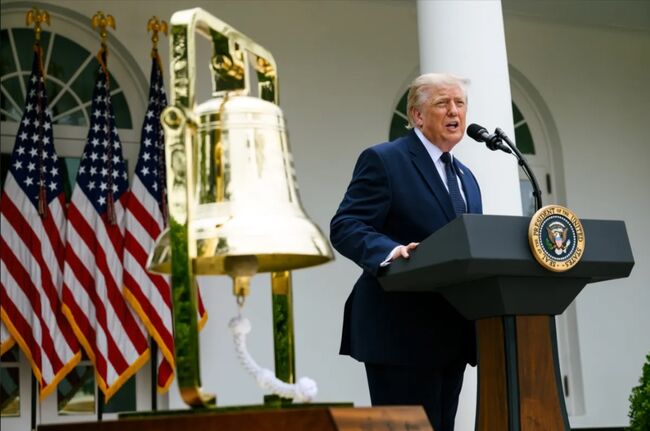
Speaking at the White House alongside German Chancellor Friedrich Merz, President Trump acknowledged the surge in crude oil prices due to heightened regional instability, citing concerns over potential supply disruptions.
"I think prices are going to be considerably lower than they were before this happened, when this is over," President Trump stated.
International oil prices have climbed amid growing investor concerns over the security of key shipping routes and energy infrastructure, fueled by the escalating conflict between Iran and Israel. These price fluctuations have triggered broader market volatility, with traders closely monitoring developments abroad.
President Trump expressed confidence that the United States and its allies are managing the situation well, attributing the oil price spike directly to the uncertainty surrounding the conflict.
"The key is stability," President Trump told reporters. "Once there is stability, you're going to see a big difference."
Chancellor Merz echoed concerns about the potential economic repercussions of prolonged regional instability, particularly for European economies sensitive to energy costs.
Both leaders underscored the importance of keeping trade routes open and preventing further escalation of tensions.
Oil prices continued their sharp ascent following the developments in Iran, with Brent crude rising 9% to over $85 a barrel on Tuesday, its highest level since July 2024, according to Reuters. European natural gas prices also surged an additional 45%.
West Texas Intermediate (WTI) crude oil rose by $4.68 (7%) to settle at $75.91 a barrel, after reaching an intraday high of $76.02, the highest since June.
Concerns intensified after Iranian media reported on Monday that a senior commander in Iran's Revolutionary Guard had warned that the Strait of Hormuz was closed and that all vessels attempting to pass through would be fired upon.
Qatar has halted liquefied natural gas production, Israel has halted output from some of its gas fields, Saudi Arabia has shut down its largest oil refinery, and production in Iraqi Kurdistan has effectively ceased.
In the gas market, Dutch benchmark futures, UK gas prices, and European and Asian LNG prices all saw significant jumps. Analysts expect oil prices to remain elevated in the coming days as the market digests the impact of the escalating conflict.
Bernstein Research on Monday raised its 2026 price outlook for Brent crude to $80 a barrel from $65, but noted that prices could reach $120-$150 in an extreme scenario of prolonged conflict.
President Trump announced via Truth Social on Tuesday, "Effective immediately, I have ordered the U.S. International Development Finance Corporation (DFC) to provide political risk insurance and guarantees at very reasonable prices for all maritime trade, especially energy transport, passing through the Gulf Region. This will apply to all shipping companies."
He added, "Should it be necessary, the U.S. Navy will begin escorting oil tankers through the Strait of Hormuz as soon as possible. Under no circumstances will the United States allow the free flow of energy to the world. America's economic and military might are the most powerful on Earth – further action will follow."
By NNP Chief Reporter Sung Ku Hong / Special Correspondent for this paper NNP info@newsandpost.com
What do you think of this article?

 Trump pressures for rate cut again ahead of FOMC... "Should be the lowest in the world"
U.S. President Donald Trump. [Photo = The White House] U.S. President Donald Trump once again pressured the Federal Reserve, the U.S. central bank, to lower interest rates on the 27th (local time
Trump pressures for rate cut again ahead of FOMC... "Should be the lowest in the world"
U.S. President Donald Trump. [Photo = The White House] U.S. President Donald Trump once again pressured the Federal Reserve, the U.S. central bank, to lower interest rates on the 27th (local time
 “Ignoring crisp ballots and damaged seals”… Tongyeong mayoral recount concludes with ‘no change in outcome,’ leaving suspicions and public outrage behind
Suspected counterfeit ballots discovered in Tongyeong [GIF from social media of Representative Hwang Kyo-ahn / Attorney Park Joo-hyun]During a recount of the Tongyeong mayoral election in South Gyeong
“Ignoring crisp ballots and damaged seals”… Tongyeong mayoral recount concludes with ‘no change in outcome,’ leaving suspicions and public outrage behind
Suspected counterfeit ballots discovered in Tongyeong [GIF from social media of Representative Hwang Kyo-ahn / Attorney Park Joo-hyun]During a recount of the Tongyeong mayoral election in South Gyeong
 President Yoon, regarding the first-instance ruling on the Public Official Election Act: “An excessive political verdict that distorts the facts… We will appeal immediately.”
The first-instance sentencing hearing for President Yoon Suk Yeol regarding violations of the Public Official Election Act is being broadcast live at Seoul Station on the 27th. [Photo=Yonhap News]Pres
President Yoon, regarding the first-instance ruling on the Public Official Election Act: “An excessive political verdict that distorts the facts… We will appeal immediately.”
The first-instance sentencing hearing for President Yoon Suk Yeol regarding violations of the Public Official Election Act is being broadcast live at Seoul Station on the 27th. [Photo=Yonhap News]Pres
 WSJ: "SK Hynix ADR Premium Is a Sign of AI Trading Overheat"
Advertisement for SK Hynix ADR listing in New York's Times Square [Reuters=Yonhap News file photo]The Wall Street Journal (WSJ) has pointed out that the price of SK Hynix’s American Depositary Recei
WSJ: "SK Hynix ADR Premium Is a Sign of AI Trading Overheat"
Advertisement for SK Hynix ADR listing in New York's Times Square [Reuters=Yonhap News file photo]The Wall Street Journal (WSJ) has pointed out that the price of SK Hynix’s American Depositary Recei
 'Godfather of Japanese Mystery Novels' Keigo Higashino Passes Away After Battle with Cancer at 68
Famous Japanese mystery novelist Keigo Higashino [AFP=Yonhap News]It has been belatedly reported that Keigo Higashino, the "godfather of Japanese mystery novels" and author of bestsellers such as "The
'Godfather of Japanese Mystery Novels' Keigo Higashino Passes Away After Battle with Cancer at 68
Famous Japanese mystery novelist Keigo Higashino [AFP=Yonhap News]It has been belatedly reported that Keigo Higashino, the "godfather of Japanese mystery novels" and author of bestsellers such as "The
 [Park Pil-kyu Security Column] To the Ignorant Trying to Clothe a Beast in Sheep's Clothing
Rep. Kim Byung-joo of the Democratic Party of Korea [Photo=Yonhap News]“The Air Force Academy doesn't teach you how to fly a plane!” “The Army, Navy, and Air Force academies are exactly the
[Park Pil-kyu Security Column] To the Ignorant Trying to Clothe a Beast in Sheep's Clothing
Rep. Kim Byung-joo of the Democratic Party of Korea [Photo=Yonhap News]“The Air Force Academy doesn't teach you how to fly a plane!” “The Army, Navy, and Air Force academies are exactly the
 [Issue Diagnosis] Two Effects of the Election Petition Review
 [Photo] Evidence of Election Fraud Flooding U.S. Media… Trump Had 2.7 Million Votes Stolen
 [Video] U.S. Semiquincentennial Air Show... 'Art in the Sky' streaks across New York
 [Editorial Cartoon] A Draconian Law That Undermines Freedom of Expression

 List
List









