 Poster for Roman Polanski's 'Macbeth' (1971).
Literature is an art form that deals with human beings. Yet, humans are never simple. Within a single person, conflicting desires coexist. Benevolence and calculation, compassion and indifference, responsibility and evasion all reside simultaneously. Nevertheless, many narratives opt for a strategy of dividing characters into two to clarify conflict.
Victim and perpetrator, justice and injustice, resistance and oppression. This dichotomy is easy to understand and quickly organizes the reader's emotions. However, this simplicity comes at a cost: the complexity of human beings is amputated.
The Technique of Bifurcating Complex Relationships
The simplification of the perpetrator usually begins with a "moral speed race." When an incident occurs, readers want a swift judgment. Who is wrong? Who should be blamed? The author arranges characters clearly to meet this demand.
The evil are consistently evil, and the victims are consistently pure. This structure clarifies conflict but simultaneously eliminates questions. Why were those choices made? What conditions were at play? Within what network of relationships did that character exist? Such questions are pushed to the back burner.
The reason tragedies survive for so long in literary history is that they are not simple.
Consider Shakespeare's 'Macbeth'. Macbeth is a murderer. However, he is not portrayed as merely an "evil man." He wavers between ambition and fear. The temptation of prophecy, his wife's pressure, his craving for the throne, and his own weakness intertwine.
While readers condemn him, they also try to understand him. It is within this tension that the work gains depth. If Macbeth had been a character who committed evil deeds without any internal conflict from beginning to end, this work would have remained a simple morality play.
The technique of bifurcating complex relationships turns characters into symbols. Symbols are read quickly but do not endure long. Symbols instruct without explaining.
"This character is a perpetrator."
The moment this is uttered, the reader's thinking stops. They no longer pursue the character's motivations. However, literature should deal with humans, not symbols. Humans are beings of contradiction. If contradictions are removed, reality also disappears.
This issue becomes even more critical, especially in works that deal with social violence. In works that address war, massacres, or political oppression, simplifying the perpetrator brings relief to the reader.
"It is because of people like them that this happened."
However, in the real world, violence is not solely composed of a few monsters. Organizations, institutions, language, propaganda, and silence combine. If literature turns a blind eye to this, the understanding of reality also becomes shallow.
The technique of bifurcation quickly organizes the reader's emotions. However, emotion is not the same as understanding. Understanding requires time. Understanding demands the strength to endure contradictions. The moment we simplify the perpetrator, we abandon that strength. And what we gain in return is merely moral certainty.
Literature's task is not to reinforce certainty but to leave questions open. When we do not abandon questions about how the perpetrator's actions were possible, what the structure of the world they belonged to was, and where their silence or conformity originated, literature can fully engage with humanity.
The technique of bifurcating complexity is fascinating. However, literature must be wary of this allure. Maintaining complexity, tracing the character's choices within it, and concretely revealing the lines of responsibility are the powers of literature.
Flattening Evil Removes Depth
Making evil flat is to remove depth. Characters on a flat plane move in only one direction. They make only bad choices. Their language is unwavering, and their inner selves lack conflict. Such characters are easy to understand. But as much as they are easy to understand, they are not human.
In literature, the flattening of evil often appears in the form of "monster narratives." The perpetrator is pushed outside the human category. They are an abnormal and exceptional being. The reader finds reassurance through them. "I am not like that."
However, this reassurance is dangerous. Because at that moment, the reader has fixed the distance between themselves and the story. Evil is over there, and I am over here. With this, the problem is resolved.
But many great works break down this distance. In Dostoevsky's 'Crime and Punishment', Raskolnikov commits murder. However, he is not simply an evil person. He wavers between ideological arrogance and poverty, pride and frustration.
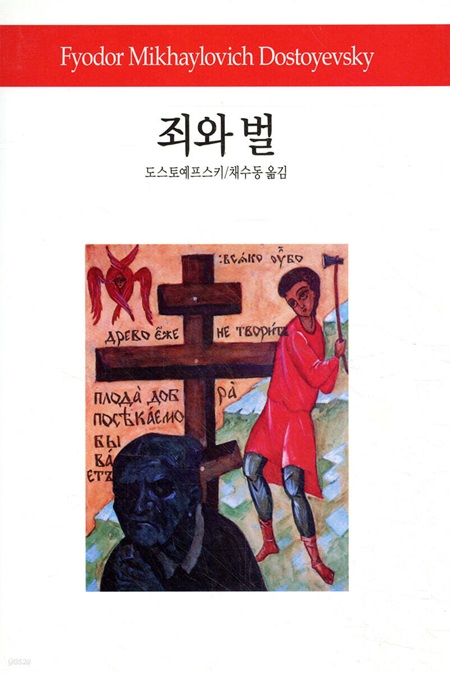 Crime and Punishment / by Fyodor Dostoevsky. Dongseo Culture Press
While readers condemn him, they also follow his inner journey. This following is the power of literature. The moment we understand evil, we confront the possibilities of humanity.
Flattening evil removes structure. Only individual cruelty remains, and the environment that enabled it becomes invisible. Literature must reveal the environment: institutions, language, customs, power relations.
Evil does not occur in a vacuum. Evil occurs within context. If this context is removed, the work becomes a moral declaration.
Furthermore, the flattening of evil deifies the victim. The more purely the victim is depicted as a pure being, the flatter the perpetrator becomes. But in reality, humans are not divided so neatly. A victim can also be a perpetrator in other relationships. If literature ignores this complexity, humans are reduced to symbols.
Works that deeply explore evil make readers uncomfortable. Because readers feel a connection to the world they belong to. When evil is not unfamiliar, we are asked a question: "Where do I stand?" When this question disappears, literature becomes safe. But safe literature cannot change the world.
The Comfort of a World Without Explanation
When explanation disappears, the world becomes simple. Reasons are reduced to one, and responsibility is concentrated on one side. Readers can quickly determine the emotional position. Such a world is comfortable. But that comfort is shallow.
In a world without explanation, repetition cannot be prevented. If we don't know why something happened, we also cannot see the possibility of it happening again. Literature is a memory device to prevent repetition. But when memory replaces explanation, memory becomes a tool. It becomes a means of organizing emotions.
Literature must restore explanation. Beyond simple anger, it must show the conditions that made the incident possible. Explanation is uncomfortable. Explanation takes time. But with explanation, responsibility also becomes precise.
Works with living explanations mature their readers. They do not easily judge characters. They examine the background of the conflict. They read the meaning of silence. Such readers are not easily swayed by simple slogans in reality.
Ultimately, refusing to simplify the perpetrator is an act of respecting humanity. The attitude of trying to understand human beings does not blur responsibility; rather, it refines responsibility. The strength to endure complexity is the sense that literature must cultivate.
Literature must transcend the technique of dividing the world into good and evil. By maintaining complexity, preserving depth, and not abandoning explanation, we can understand humanity more fully. And understanding is always stronger than simple anger.

◆ Matsuyama
A poet and a researcher of history and philosophy. Former director of the Syngman Rhee Academy. Currently serving as a senior advisor to the Korean Modern and Contemporary History Research Society and as the head of the philosophical forum Lyceum. He has published four poetry collections, co-translated 'Heroes of the Hook Coast,' and published the historical psychology commentary 'Joseon as Myth' (2026). He is actively engaged in the research and practice of liberal cultural movements. Matsuyama is a pen name.

 Iranian Foreign Ministry: "Continuing Message Exchanges with the U.S. and Activities of Mediating Countries"
Esmaeil Baghaei, Spokesperson for the Iranian Ministry of Foreign Affairs [Xinhua, Yonhap News file photo]Esmaeil Baghaei, spokesperson for the Iranian Ministry of Foreign Affairs, stated on the 26th
Iranian Foreign Ministry: "Continuing Message Exchanges with the U.S. and Activities of Mediating Countries"
Esmaeil Baghaei, Spokesperson for the Iranian Ministry of Foreign Affairs [Xinhua, Yonhap News file photo]Esmaeil Baghaei, spokesperson for the Iranian Ministry of Foreign Affairs, stated on the 26th
 President Yoon: "Do You Think You Are Safe from the Special Counsel?"... Final Statement Video Released
President Yoon Suk Yeol rebuking the special prosecutor on the 24th. [Court video / @birds_justice X account subtitle GIF] A video of President Yoon Suk Yeol's closing statement at his trial rega
President Yoon: "Do You Think You Are Safe from the Special Counsel?"... Final Statement Video Released
President Yoon Suk Yeol rebuking the special prosecutor on the 24th. [Court video / @birds_justice X account subtitle GIF] A video of President Yoon Suk Yeol's closing statement at his trial rega
 President Yoon, regarding the first-instance ruling on the Public Official Election Act: “An excessive political verdict that distorts the facts… We will appeal immediately.”
The first-instance sentencing hearing for President Yoon Suk Yeol regarding violations of the Public Official Election Act is being broadcast live at Seoul Station on the 27th. [Photo=Yonhap News]Pres
President Yoon, regarding the first-instance ruling on the Public Official Election Act: “An excessive political verdict that distorts the facts… We will appeal immediately.”
The first-instance sentencing hearing for President Yoon Suk Yeol regarding violations of the Public Official Election Act is being broadcast live at Seoul Station on the 27th. [Photo=Yonhap News]Pres
 WSJ: "SK Hynix ADR Premium Is a Sign of AI Trading Overheat"
Advertisement for SK Hynix ADR listing in New York's Times Square [Reuters=Yonhap News file photo]The Wall Street Journal (WSJ) has pointed out that the price of SK Hynix’s American Depositary Recei
WSJ: "SK Hynix ADR Premium Is a Sign of AI Trading Overheat"
Advertisement for SK Hynix ADR listing in New York's Times Square [Reuters=Yonhap News file photo]The Wall Street Journal (WSJ) has pointed out that the price of SK Hynix’s American Depositary Recei
 'Godfather of Japanese Mystery Novels' Keigo Higashino Passes Away After Battle with Cancer at 68
Famous Japanese mystery novelist Keigo Higashino [AFP=Yonhap News]It has been belatedly reported that Keigo Higashino, the "godfather of Japanese mystery novels" and author of bestsellers such as "The
'Godfather of Japanese Mystery Novels' Keigo Higashino Passes Away After Battle with Cancer at 68
Famous Japanese mystery novelist Keigo Higashino [AFP=Yonhap News]It has been belatedly reported that Keigo Higashino, the "godfather of Japanese mystery novels" and author of bestsellers such as "The
 [Park Pil-kyu Security Column] To the Ignorant Trying to Clothe a Beast in Sheep's Clothing
Rep. Kim Byung-joo of the Democratic Party of Korea [Photo=Yonhap News]“The Air Force Academy doesn't teach you how to fly a plane!” “The Army, Navy, and Air Force academies are exactly the
[Park Pil-kyu Security Column] To the Ignorant Trying to Clothe a Beast in Sheep's Clothing
Rep. Kim Byung-joo of the Democratic Party of Korea [Photo=Yonhap News]“The Air Force Academy doesn't teach you how to fly a plane!” “The Army, Navy, and Air Force academies are exactly the
 [Issue Diagnosis] Two Effects of the Election Petition Review
 [Photo] Evidence of Election Fraud Flooding U.S. Media… Trump Had 2.7 Million Votes Stolen
 [Video] U.S. Semiquincentennial Air Show... 'Art in the Sky' streaks across New York
 [Editorial Cartoon] A Draconian Law That Undermines Freedom of Expression

 List
List









